Monday, May 30, 2022

Memorial Day - Let Us Pause to Remember


Pictured: the Bunker Hill American Legion participated in Taps Across America 2022 by playing Taps at the American flag in the middle of town at 3:00 on the afternoon of Mon., May 30 - the National Moment of Remembrance.* 


From Reflections: A History of the Bunker Hill-Woodburn Area

The Memorial Day Committee of the Union Veteran Union has arranged the following program for May 30th.  Soldiers meet at 1 'o clock p.m. at Huggins block and march to Huber's Opera House at 1:30 o' clock.  

The program at the hall is as follows: Music, Bunker Hill Cornet Band; Prayer, Rev. J.V. Hopper; Remarks, Pres. Geo. McPherson; Music, Woodburn Glee Club; Address, Hon. Benson Wood, Music, Woodburn Glee Club, Comrades and Band will then march to Cemetery for the decoration of the graves, after which they will return to Monument, where assemblage will sing "My Country 'Tis of Thee" after which Rev. C.B. Riggs will pronounce the benediction.

The business meeting will take place at the secretary's office.  The committee on decoration requests the assistance of Ida and Alice Hetzler, Daisy and Bertha Hayes, Mary and Virgie Hedley, Irene Williams, Minnie and Lillie Brandenberger, Cora and Jess Hill, Annie Wendt, Minnie and Lillie Lee, Amelia and Myra Larmer, Mary and Effie Neil, Minnie and Nellie McPherson, Cora James, Josie McPherson, Lucy and Belle Cross, Josie Hanson, Lulu Wiegand, Annie Kardell, Bertha Schmolinskie, Edna and Nannie Hayes, Mary Sutton, Minnie Dable, Lizzie Dowitt, Cleda Wood, Minnie Smith, and all other daughter and sons of the solders.

They are requested to meet at the basement of the Congregational Church on Thursday May 29, at 10 o' clock a.m. to make wreaths, etc.  They are also requested to join with the soldiers on May 30th and march to the cemetery and assist in decoration of the graves.  Badges will be furnished, to those not already supplied by the committee, E.W. Hill, Thomas Larmer and John Brandenburger.

--Cite this Story: Redford, Carol, and Betty Triplett. "Bunker Hill History." In Reflections: A History of the Bunker Hill-Woodburn Area, p. 64. Bunker Hill: Bunker Hill Publications, 1993. Provided by the Bunker Hill Historical Society.

*Photo credit: Bunker Hill Gazette-News, June 2, 2022.

Thursday, May 26, 2022

Lawrence Gosch Sells Gazette-News to Carl Stanton, May 1964

Pictured: Bunker Hill Gazette-News 

April 30, 1964: The Bunker Hill Gazette-News has been sold to Carl L. Stanton of Roxana, IL effective May 1.  Announcement of the sale was made jointly by Stanton and Lawrence Gosch, present editor and publisher.  Stanton has been in Bunker Hill the past week going through the operation with Gosch.

    Gosch came to work at the Gazette-News in 1948 when Arthur Strang was publisher.  He was named editor in July, 1953 succeeding Jim Herda.  He purchased the newspaper and became editor and publisher in July 1954.

    Arthur Strang came to Bunker Hill in 1939, purchasing the Gazette-News from Harold Gerlach.


From Relections: A History of the Bunker Hill-Woodburn Area

    The Union Gazette first rolled off the presses on January 10, 1866, with A.W. Edwards as publisher.  Some 300 issues were printed, and circulation climbed to 1,000 by the end of the year.

    Edwards sold the publication in 1867 to Dr. A.R. Sawyer and F.Y. Hedley.  Sawyer died the following year.  Hedley changed the name to The Bunker Hill Gazette in 1871.

    W.S. Silence became the publisher, with Hedley remaining as editor, in 1879, at which time the paper was leased for a short time before returning to Hedley's editorship.

    The paper became the Gazette-News in 1905 under the association of Phil C. Hansen and W.B. Powell.  At this time two competing newspapers were combined, The Bunker Hill News and the Gazette.

    Other names of leadership throughout the years included Harold Gerlach, Arthur and Frieda Strang, and Lawrence Gosch.

    In 1964, the paper was purchased by Carl Stanton, who remained publisher/editor until 1987, at which time it was sold to John Galer, a Hillsboro, Illinois publisher.

    The Gazette-News is one of five news and advertising media now being published under the name of Bunker Hill Publications.  The other publications are The Advertiser, the Southwestern Journal News, and the Southwestern Shopper at Brighton, and the Madison County Chronicle at Worden.  --Submitted by the Gazette-News.

...Read this and other Bunker Hill, IL historical stories at https://bunkerhillhistory.org/

--Cite this story: The Bunker Hill IL Historical Society. "A Look Back in Bunker Hill History." Bunker Hill Gazette-News, May 26, 2022.

Redford, Carol, and Betty Triplett. "Bunker Hill History." In Reflections: A History of the Bunker Hill-Woodburn Area, p. 131. Bunker Hill: Bunker Hill Publications, 1993. Provided by the Bunker Hill Historical Society.

Wednesday, May 18, 2022

W.B. Powell Tells of Coming to Bunker Hill, Buying Paper

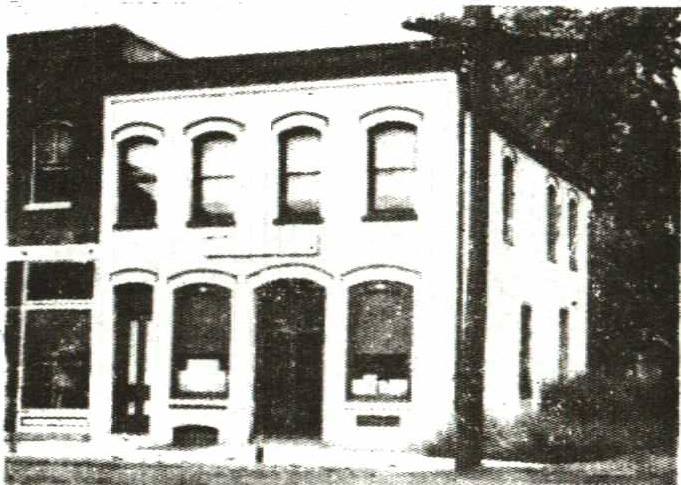
Pictured: Bunker Hill Gazette-News on NW corner of E. Warren and N. Pine St.
Was the former Chas. Folkerts Grocery Store  

    In the September 13, 1940 issue of the Gazette news, the 75th anniversary issue, a letter from W.B. Powell tells about the beginning of the Gazette news.  Mr. Powell, former editor of the paper, then the Bunker Hill News, is the man responsible for merging that paper with the rival Gazette.

    "One bright Sunday, sometime in 1903 or 1904," Mr. Powell began, "I went to Bunker Hill on an excursion that ran out of St. Louis.  I bought some of Louie Bartels' peanut candy.  If it hadn't been for that candy, Bunker Hill would never have had the distinction of my presence."

    "I resigned from the managership of Nugents' mail order department, a St. Louis concern doing a two million dollar a year business, and with a few manipulations with a newspaper broker, with offices in Litchfield, I found myself owner of the Bunker Hill News, located in a two-story brick building back of Sessel's Store, and over Barth's Harness Shop."

    From the building, Mr. Powell could smell Louis Bartels' candy cooking, but there was little else to recommend the plant he had purchased sight unseen.

    "The presses and make up stones were in the rear of the loft and the type cases in front and between the two there was space for a basketball court."

    The paper also had 125 subscribers and a broken job press.  Full page ads were sold for $5 an issue.  Mr. Powell bought new equipment, rented another building, hired a staff, and two weeks later published an issue of the Bunker Hill News.

    Within a few weeks, Mr. Powell bought out his competitor, the Gazette for $1,000.  This was the beginning of the Bunker Hill Gazette-News.

    From 100 subscribers, the number rose to 1,600.  Mr. Powell bought the Dorchester Hustler and merged it with the Gazette-News.

    It wasn't all quite that smooth going.  Once, as a result of a religious war in Bunker Hill, women cancelled their subscriptions and made the husbands cancel their advertising.  However, Powell's faithful friends, the German dairymaen of the area, ordered two subscriptions for every one that was cancelled and forced out of business, a man who cancelled his advertisement, the whole thing blew over and the Gazette-news came out on top.

...Read more about this and other Bunker Hill, IL historical stories at https://bunkerhillhistory.org/

--Cite this story: The Bunker Hill IL Historical Society. "A Look Back in Bunker Hill History." Bunker Hill Gazette-News, May 19, 2022.  

Thursday, May 12, 2022

Gazette has Roots in Staunton and Gillespie

Pictured: Bunker Hill Gazette-News on SW corner of N. Washington and W. Fayette St.

    The Staunton Banner first appeared March 8, 1858, owned and edited by Parsons Percy, who bought the office from Monroe County.  He continued publication until 1860 when it was purchased and removed to Gillespie by A.W. Edwards, and in November of 1860 the first issued appeared in Gillespie as the Union and Gazette.  This paper continued under Edwards until 1863 when Edwards enlisted in the Union Army.  The publication continued for sometime afterwards by Alonzo James, but when he enlisted, the publication was suspended.

    The first Newspaper printed in Bunker Hill was the Bunker Hill Journal, five column paper with E.J. Bronson as editor and publisher.  The first issue was December 8, 1859 and the last in May 1860.

    When Edwards returned from the war in 1865, he moved the printing office from Gillespie to Bunker Hill, and resumed the publication as the Union-Gazette, with the first issue being published January 19, 1866.

Edwards continued publication until January 31, 1867 when he sold to Dr. A.R. Sawyer and F.Y. Hedley.  Dr. Sawyer died in May 1867.  In 1871, the name of the paper was changed with the word Union dropping out.

    Hedley continued as editor and proprietor until January 1, 1878, when W.S. Silence became editor.  This arrangement continued until January 24, 1879 when it was leased to Mr. Said and Mr. Poorran of Charleston, who published until July 1879.  At that time, Hedley, then the postmaster, resumed the editorship.

...Read this and other Bunker Hill, IL historical stories at https://bunkerhillhistory.org/

--Cite this story: The Bunker Hill IL Historical Society. "A Look Back in Bunker Hill History." Bunker Hill Gazette-News, May 12, 2022.

Thursday, May 5, 2022

The "Not So Warm" Welcome of President Andrew Johnson

Pictured: Big Four Depot
 

A reprint of our blog from Oct., 9, 2014... https://bunkerhillhistory.blogspot.com/2014/10/president-andrew-johnson-hooted-during.html

From the Bunker Hill Union Gazette September 14, 1866

President Andrew Johnson Hooted During Train Stop in Bunker Hill

    Quite a large collection of people were at the depot on the arrival of the special train at 9:40 on Monday morning.  Bunker Hill, true to her instincts and past record, offered no insult to President Johnson and only showing their abhorrence of him by their prolonged cheers for General Grant and Admiral Farragut (with Lincoln's assassination, Vice President Andrew Johnson became President).

    The President of the United States, Andrew Johnson, was introduced by John Hogan; three cheers were given which he acknowledge [Sic] by taking off his hat and was about to leave with us the Constitution and the Stars and Stripes, when a gentleman proposed three cheers for General Grant, three cheers for Admiral Farragut, and three cheers for the Congress.  President Johnson again attempted to speak, but the cries for Grant compelled him to forgo.

Mr. Hogan proposed three cheers for the Thirty-Six States, which were given and then someone fired a pistol in the crowd, which disturbed the nerves of the party.  The train moved off and, as far as the eye could reach, the humble individual with hat in hand was bowing to the right and left, poor President Johnson.  We sympathize with Grant and Farragut in their forced company.

Pictured: The Big Four Depot (circa 1939)


...Read more about this and other Bunker Hill, IL historical stories at https://bunkerhillhistory.org/

--Cite this story: The Bunker Hill IL Historical Society. "A Look Back in Bunker Hill History." Bunker Hill Gazette-News, May 5, 2022.  

Redford, Carol, and Betty Triplett. "Bunker Hill History." In Reflections: A History of the Bunker Hill-Woodburn Area, p. 35. Bunker Hill: Bunker Hill Publications, 1993. Provided by the Bunker Hill Historical Society.

Thursday, April 28, 2022

National Defense Class in Electricity Wires Oldest House in Community


Pictured is the Joe Jarden Home

From the Bunker Hill Gazette News: February 20, 1941

     The first unit of the National Defense Training Program offered in Farm Mechanics Shop at the local high school completed an eight week course this week with the wiring of a barn and complete layout of out buildings for Frank Gerdes, and the wiring and installation of fixtures in the Al Goodwin farm house.

    According to Edward J. Barnes, instructor, the class gained some valuable experience through difficult wiring in the Al Goodwin Home;  the back part of which was a Drover Hotel on the trail between St. Louis and Springfield.  No one knows what year the hotel was built, however, Goodwin can trace it back to 1834, and it was not a new building at that time.  The part of the dwelling which was the old hotel is of log construction, with the walls packed with mud, bound together by chopped prairie grass and hickory sticks.

    As related to the class by Mr. Goodwin, there are many pioneer stories connected with the old hotel.  Mr. Goodwin has in his possession a tax receipt amounting to forty cents which was the annual property tax on the old hotel and accompanying 160 acre farm.  Taxes at that time were paid in Edwardsville.

    Members of the class wiring the historic building were Oscar Boettger, Melvin Buhs, Harold Brueggeman, Stanley Dana, Victor Dubbelde, Albert Fahrenkrog, Harvey Howerton, Ralph Huette, Alfred Jacobi, Daniel Mancini, Kenneth Mansholt, Arnold Oldenettle, Elmer Oldenettle, Chester Rull, and Leland Scroggins.

    This property was owned by Lillian Goodwin Jarden and is the home of her son, Joe.

...Read more about this and other Bunker Hill, IL historical stories at https://bunkerhillhistory.org/

--Cite this story: The Bunker Hill IL Historical Society. "A Look Back in Bunker Hill History." Bunker Hill Gazette-News, April 28, 2022.  

Redford, Carol, and Betty Triplett. "Bunker Hill History." In Reflections: A History of the Bunker Hill-Woodburn Area, 50. Bunker Hill: Bunker Hill Publications, 1993. Provided by the Bunker Hill Historical Society.

Stanton, Carl L. . "Bunker Hill News 1941." In Bunker Hill Revisited, Volume Seven, 1941-1948, p. 2. Bunker Hill: Bunker Hill Publications, 2007. Provided by the Bunker Hill Historical Society.


Thursday, April 21, 2022

Bunker Hill Memorial Dedication Ceremony to Truesdale, MO Founder


Pictured is the headstone of William Truesdale in the Bunker Hill Cemetery

From the Bunker Hill Gazette:

Truesdale, MO Founder Buried in Bunker Hill     

     On Saturday, April 9, 2022 in the Bunker Hill Cemetery, a memorial headstone was dedicated to honor William Truesdale. 

    Mr. Truesdale was born in Chautauqua County New York on January 9, 1815.  At the age of 12, he was working as an indentured merchant in Erie, PA.  In 1849, he contracted with the Panama Railroad Company to build a railroad across the Isthmus of Panama.

     In 1851, Mr. Truesdale, now married and with a growing family, headed west.  He contracted to build a railroad from Sandoval, IL to St. Louis, MO.  During his years working for the railroad in Missouri, he settled his family in Warren County, MO.  He purchased land (932 acres) and laid out a village.  He made a deal with the North Missouri Railroad to give them land to build a depot and switch yard if they would agree to name the village after him.  In 1857, the first train arrived in Truesdale, MO.

     Although he remained a civilian throughout the Civil War, Mr. Truesdale was referred to as "Colonel" Truesdale.  After the fall of Fort Sumpter, he was appointed as a military superintendent of the North Missouri Railroad.  He was put in charge of the Police and Secret Service under General Rosecrans who was in command of the Army of the Mississippi.

     Mr. Truesdale's 932 acre estate, comprising of most of present Warrenton and Truesdale, MO., was purchased May 19, 1863 by the Methodist Episcopal church as a school and home for orphans of fallen Civil War soldiers.  It was called the Western Orphan Asylum and Educational Institute.  The large house that the Truesdale's lived in became the orphanage.  In 1869, the name changed to Central Wesleyan College and Orphan Asylum.

     In 1864, Mr. Truesdale moved his family to Bunker Hill.  Mr. Truesdale died November 28, 1867.  His wife and children remained here until 1868 when they moved to Pennsylvania to live with her parents.  Buried here in the Bunker Hill Cemetery are Mr. and Mrs. Truesdale, two of their daughters, and three of their grandchildren.

     The city of Truesdale, MO conducted the dedication ceremony.  Guests included the City Hall staff:  Elsa Smith-Fernandez, Missy Bachamp, Elsie Morris, Mark Bennett, and Hal Pherigo. Police Chief Casey Doyle, Truesdale Mayor Chris Watson and Board of Alderman: Joe Brooks, Jerry Cannon, Robert Green, and Mike Thomas.  Mr. Truesdale's ancestor, grandson, Steve Williams from Tennessee and retired Truesdale Administrator and Truesdale Historian Marylou Rainwater.  other guests were also present.

...Read more about this and other Bunker Hill, IL historical stories at https://bunkerhillhistory.org/

--Cite this story: The Bunker Hill IL Historical Society.  "A Look Back in Bunker Hill History." Bunker Hill Gazette-News, April 21, 2022

Thursday, April 7, 2022

History of Round Prairie Christian Church


    This is a followup blog to our previous posting at: https://bunkerhillhistory.blogspot.com/2022/02/history-of-round-prairie-church.html

    The Round Prairie Christian Church organized July 1, 1845 by appointing John P. Bayless and Samuel Wood to the office of Eldership.  Hiram Daughterty [Sic], and John Nesbit were appointed as Deacons at the same time.  About 1849, John W. Keller was added to the list of Elders and Johnson McGilvary and W.S. Spruill were ordained Elders.  Levi Miller and William Nesbit were ordained as Deacons at the same time.

    Johnson McGilvary went off to the Army and died.  In 1874, Peter C. Randle and Albert Fairchild were added to the Eldership and Benjamin Mize and Wm. Soapes to the deaconship.

    Elder Fairchild moved his membership and died  March 12, 1881.  Scott Mize was added to the list of Deacons by the church and Sanford Mize, at the same time, was appointed the same time as an assistant clerk for the church at Round Prairie.  The church continued to add persons to the roll until the membership reached 376.  The church was discontinued about 1918.  --Submitted by Helen Mize.

From Bunker Hill Revisited, Vol. 6, 1920-1940 by Carl Stanton

    March 25, 1932: the site of Round Prairie Christian Church located about 5 or 6 miles Southeast of the City was recently sold and the proceeds distributed to the National City Church at Washington, D.C., the neighboring Christian churches, and to missionaries.  

    While a church has passed, its memory and influence still live.  This congregations was organized on July 31, 1845. Its first officers were John P. Bayless, Samuel Wood, elders, Hiram Daugherty and Jon Nesbit, deacons.  Other office bearers remembered are John Keller, 1849; John McGilvery, W.P. Spruill, 1854; Peter Randle, Albert Fairchild, Benjamin Mize, William Soapes, 1874;  Scott Mize, deacon, 1881; Sanford Mize, clerk.  Trustees who served from 1912 to the date propery was disposed of are: R.N. Nesbit, J.R. Coatney and James Richards.  Early members still living are Mrs. C.A. Craw, Wichita, Kans. 95 years, and Mrs. Margaret Mize Teeters, Kansas City, Mo., age 86.  W.H. Groner, one of the ministers long since dead, who served for 37 years and baptized upward of 400 of its members, is lovingly remembered.

...Read more about this and other Bunker Hill, IL historical stories at https://bunkerhillhistory.org/

--Cite this story: The Bunker Hill IL Historical Society. "A Look Back in Bunker Hill History." Bunker Hill Gazette-News, April 7, 2022, February 10, 2022.  

Stanton, Carl L. . "Bunker Hill News 1932." In Bunker Hill Revisited, Volume Six, 1920-1940, p. 120. Bunker Hill: Bunker Hill Publications, 2006. Provided by the Bunker Hill Historical Society.

Redford, Carol, and Betty Triplett. "Bunker Hill History." In Reflections: A History of the Bunker Hill-Woodburn Area, p. 123. Bunker Hill: Bunker Hill Publications, 1993. Provided by the Bunker Hill Historical Society.

Thursday, March 31, 2022

History of the Bunker Hill Gazette

Pictured: Bunker Hill Gazette-News on NW corner of E. Warren and N. Pine St.
Was the former Chas. Folkerts Grocery Store

    The press and type of the STAUNTON BANNER were purchased by A.W. Edwards, and in November of 1860 the first number of the Gillespie UNION AND GAZETTE  made its appearance.  The paper continued under Mr. Edwards control until 1863, when he enlisted in the Union Army where he remained until the close of the war.  The publication was, however, continued for some time afterwards by Alonzo James, but he too enlisted and the publication was then suspended.  The UNION AND GAZETTE was extremely Democratic in tone.

    The BUNKER HILL JOURNAL was the name of the first paper published in Bunker Hill.  E.J. Bronson was the editor and proprietor.  It was a five-column folio and was neutral in politics.  The first number was issued December 8, 1859 and the last in May 1860.

    In 1865, after the return of Mr. Edwards from the war, her removed the printing office from Gillespie to Bunker Hill and resumed the publication of the UNION AND GAZETTE.

    The first number was issued January 19, 1866.  He continued the publication until January 31, 1867 when he sold out to Dr. S.R. Sawyer and F.Y. Hedley.  The paper was then Republican in politics.  When Messers Sawyer and Hedley assumed control, they changed the tone and made it independent and it so remained until Dr. Sawyer's death, which event occurred on May 24, 1868.  After that date, it again became Republican in politics and has remained the organ of the Republican party of Bunker Hill to the present time.  In 1871, the name of the paper changed.  The work [Sic] "UNION" was dropped out and from that date to the present it is known as the BUNKER HILL GAZETTE.

    Mr. Hedley continued as editor and proprietor until January 1, 1878 when Mr. W.S. Silence became the publisher, Mr. Hedley still acting as editor.  This arrangement continued until January 24, 1879 when both Hedley and Silence retired and the office was leased to Messers Said and Poorman of Charleston, IL, who published the paper until July 1879.  The circulation of the GAZETTE is about 750.  It is a neat, sprightly paper and enjoyed the confidence of its constituency.  Mr. Headly, who may be regarded as the father of journalism in Bunker Hill, has retired from the active participation of the business but not without first demonstrating his entire capability to run a newspaper successfully.  He is a practical printer, and the GAZETTE, under his management, was a model of typographical neatness.  He is a good writer.  He is now postmaster of this beautiful little city, and as a man and officer, is respected by all who knew him  Mr. Headley resumed editorial charge of the GAZETTE  about the 10th of July, 1879.

    The paper became the GAZETTE-NEWS in 1905 under the association of Philip C. Hansen and W.B. Powell.  At this time, two competing newspapers were combined, the BUNKER HILL NEWS  and the GAZETTE.  Other names of leadership through the years included Harold Gerlach, Arthur and Frieda Strang, and Lawrence Gosch.

    In 1964, the paper was published by Carl Stanton, who remained publisher/editor until 1987, at which time it was sold to John Galer, a Hillsboro, Illinois publisher.

Pictured: Bunker Hill Gazette-News on SW corner of N. Washington and W. Fayette St.

    The GAZETTE-NEWS is published under the name of BUNKER HILL PUBLICATIONS along with the MT. OLIVE HERALD,  the MADISON COUNTY CHRONICLE,  and the SOUTHWESTERN JOURNAL.  Cheri Petroline is the current manager.

...Read this and other Bunker Hill, IL historical stories at https://bunkerhillhistory.org/

--Cite this story: The Bunker Hill IL Historical Society. "A Look Back in Bunker Hill History." Bunker Hill Gazette-News, March 31, 2022.

Redford, Carol, and Betty Triplett. "Bunker Hill History." In Reflections: A History of the Bunker Hill-Woodburn Area, p. 131. Bunker Hill: Bunker Hill Publications, 1993. Provided by the Bunker Hill Historical Society.

Thursday, March 17, 2022

Bunker Hill City Library


Pictured: Present-day Bunker Hill Public Library


From the Bunker Hill Gazette-News October 1950

    The J.H.L. Fahrenkrog building on Warren Street has been purchased by the local library board at a cost of $1,500 and will house the Bunker Hill Library.  (Today, the City of Bunker Hill owns the building which housed the Bunker Hill Historical Society and Museum.

    The Bunker Hill City Library will open for public use Saturday evening, October 7.  The opening will be held although there are some minor details both inside and out of the building yet to be finished.

Pictured: Old Bunker Hill Public Library

    The new library is located on East Warren Street and occupies the site of the library and contents that were destroyed in the March 1948 tornado.  Although the building had been completed for some time, opening has been delayed because of the limited budget on which the board has to work.

    Much of the equipment has been donated.  Two desks were given by Dr. and Mrs. George Hess and one each by Mr. and Mrs. W.E. Haxel and Mr. and Mrs. R.E. Rigg.  Some steel cabinet and six chairs have been purchased by the board.  It is pointed out that more chairs are needed and if anyone has some spares they would be gladly accepted for use at the library.

    Some 300 books have also been donated to start off the new library.  Mr. and Mrs. F.A. Wende of Winnetka, IL have given 195 books and others have been given by Mrs. B. Deffenbaugh of St. Louis, MO., and Mrs. Bella Zimmerman of Beloit, WI., who donated a book in memory of her son.

    Mrs. Theo Stone of St. Louis has donated a number of books which she collected there from members of the book club.

    As books come into the library, they are catalogued [sic] by a library committee of which Mrs. O.C. Weidner is chairman.  This committee has received the help of several interested citizens in their work.

    For the opening, six cases of books from the State Library will be on hand.  These are made available on a loan basis.  By receiving books from the state, much good reading is provided for both children and adults.  Miss Loretta Bartels will continues as librarian as she has done for many years in the past.

    The new library building is a modern fireproof structure, with buff brick front.  The interior has been finished in a light green plaster and it is heated with an oil furnace.  Ralph Moxey installed the heating plant free of charge.

    Members of the library board, of which R.E. Rigg is chairman, are Lee Sutton, Walter Heal, Goebel Ladd, max Bertagnolli, Clara Mason, Cora Fensterman, Mr. O.C. Weidner, and Mrs. L.O. Schreier, who is secretary.  Board Committees will be working at the library Thursday and Friday getting ready for opening on Saturday.  At the opening, a free souvenir book markers will be passed out to all who attend.

...Read more about this and other Bunker Hill, IL historical stories at https://bunkerhillhistory.org/

--Cite this story: The Bunker Hill IL Historical Society. "A Look Back in Bunker Hill History." Bunker Hill Gazette-News, March 17, 2022.

Redford, Carol, and Betty Triplett. "Bunker Hill History." In Reflections: A History of the Bunker Hill-Woodburn Area, p. 32. Bunker Hill: Bunker Hill Publications, 1993. Provided by the Bunker Hill Historical Society.

Thursday, March 10, 2022

Ed Bruckert's School Buses

Pictured: Bruckerts on NW Corner of N. Washington and W. Fayette St. in 1950


From the Gazette-News March 20, 1952

    Each day, some 200 children living outside the City of Bunker Hill are brought to school in four buses.  The mileage they cover on their on their trips averages 230 miles daily.  In a few cases, students drive their own cars to school.

    Ed Bruckert's Garage furnished transportation for the school district, being under contract and receiving payment on the mileage basis.  Bruckert assumes full responsibility for the buses, which he owns, doing his own maintenance and providing drivers for each.  In addition to being a regular driver himself, Bruckert employs the following men, Chester Kehr, Charlie Forrler, and Chester Scroggins.  Alfred Snedeker is an alternate driver.

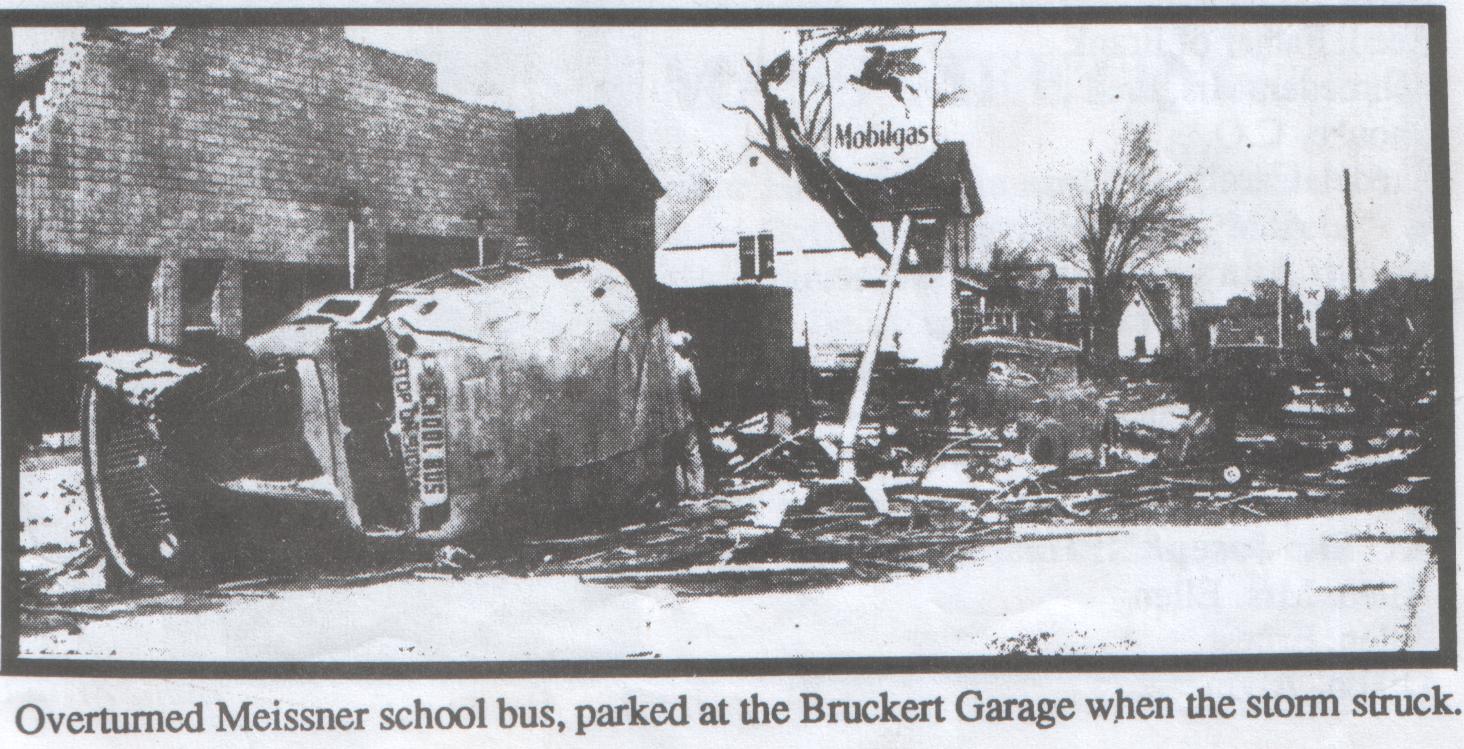
Pictured: Overturned Meissner schoolbus parked at the Bruckert Garage after the 1948 Tornado
    
    Prior to 1948, the school maintained their own transportation, owning their bus and employed drivers for the daily trips.  The system proved to be hard to manage properly and was costly in upkeep because of such.  The arrangement with Bruckert was instituted in the fall of 1948 and has been efficient and has provided better service.

Pictured: Ed Bruckert's Mobilegas / Mobiloil  Dealership Plaque


    In order to facilitate orderly conduct and loading of buses, at the end of the day, classes are dismissed after short intervals to avoid pushing and a big rush which would be likely if they were all turned loose at once.

...Read more about this and other Bunker Hill, IL historical stories at https://bunkerhillhistory.org/

--Cite this story: The Bunker Hill IL Historical Society. "A Look Back in Bunker Hill History." Bunker Hill Gazette-News, March 10, 2022. 

Redford, Carol, and Betty Triplett. "Bunker Hill History." In Reflections: A History of the Bunker Hill-Woodburn Area, p. 105. Bunker Hill: Bunker Hill Publications, 1993. Provided by the Bunker Hill Historical Society.

Thursday, March 3, 2022

Mercers' Confectionery

 From the Gazette-News - August 1951

    Roger S. Mercer is holding a formal opening of his newly built confectionery on Saturday.  The new business, located between the C.M. Miller Card Co., and "Tickles" Barber Shop, is a fine addition to the business section of town.

    The confectionery is 18 x 50 feet in size and is of concrete block construction.  It has a perma-stone front, done up in brown and white, and is pleasing to the eye.  Another building, east of the confectionery, purchased by Mercer from C.M. Miller, has also been given a perma-stone front.  Equally attractive is the interior of the new building, which has been finished entirely in natural color knotty pine.  All new fixtures have been installed.  These include a large fountain, counter and stools, booths with red and green plastic coverings and a showcase and coolers necessary for the operation of such a business.

    Full kitchen facilities are provided behind a partition toward the rear of the building.  In addition offering smokes, soda, candy and a fountain service, a complete line of sandwiches will also be offered patrons.

    In a statement on his opening Mercer said that it isn't going to be as formal as you might expect in that he has already been pouring coffee and dishing up ice cream for about a week.  Saturday will be the first day the full facilities of the store will be put into operation and he says it will be  "just come as you are".

    Mercer formally operated a similar business across the street from his present location on East Warren Street and without a doubt many of his friends are glad to see him back at his old work.  This newspaper, as we are sure many other people have already cone [Sic],  congratulate him for making such a fine addition to the business district.

...Read more about this and other Bunker Hill, IL historical stories at https://bunkerhillhistory.org/

--Cite this story: The Bunker Hill IL Historical Society. "A Look Back in Bunker Hill History." Bunker Hill Gazette-News, March 3, 2022.  

Thursday, February 17, 2022

The Fires of Bunker Hill

Pictured: The Bunker Hill Fire Department, date unknown.  Firemen and horses pose before the old fire house which was replaced in the 1940's

Reprint of our earlier Bunker Hill News article blog postings  at https://bunkerhillhistory.blogspot.com/2015/05/the-fires-of-bunker-hill.html and also at  https://bunkerhillhistory.blogspot.com/2020/04/the-fires-of-bunker-hill.html

From Bunker Hill Revisited Volumes - One and Three    


Pictured: Washington St., as viewed from the Opera House corner.  Sanford's south wall on right.

    The fire January 23, 1880, originated in Sanford's Grocery Store on the same ground.  The damage on the fire proper footed up $12,000.  The insurance was fair.[1]

    December 1, 1882, the ground from Bumann's three story building to Sessel's corner and on Warren Street west to the alley, was burned.  The loss totaled $37,000, nearly equally divided between buildings and stock.[1],[2]

These fires occurred on the west side of Washington Street.

Pictured: Warren St. as seen from Klinefelter's store.  Sessel's west wall on right.


    From the Gazette News, September 20, 1893:  On Friday evening, for the third time, fire held a fierce carnival on the west side of Washington Street.  The alarm was given about 6:20 p.m. and within two hours $75,000 worth of the business property in the city had been wiped out.

    The fire originated in the immense barn in the rear of the Johnston block.  It was probably due to the pipe of a tramp or bum, or a cigar of card-playing youngsters.  The facts will never be known.  Almost simultaneously, all buildings south of the Johnston block were ablaze so fiercely that little could be done in the way of saving contents.

    The local fire company did noble work with the fire engine, chemical, and new extinguishers and were nobly seconded by many of our people.  To such effort is due the arrest of the fire at the Johnston block and the saving of the business property on the east side of Washington Street.

    As near as can be ascertained the fire losses were $75,000.  This includes damage to buildings and stocks not destroyed.[3],[4]

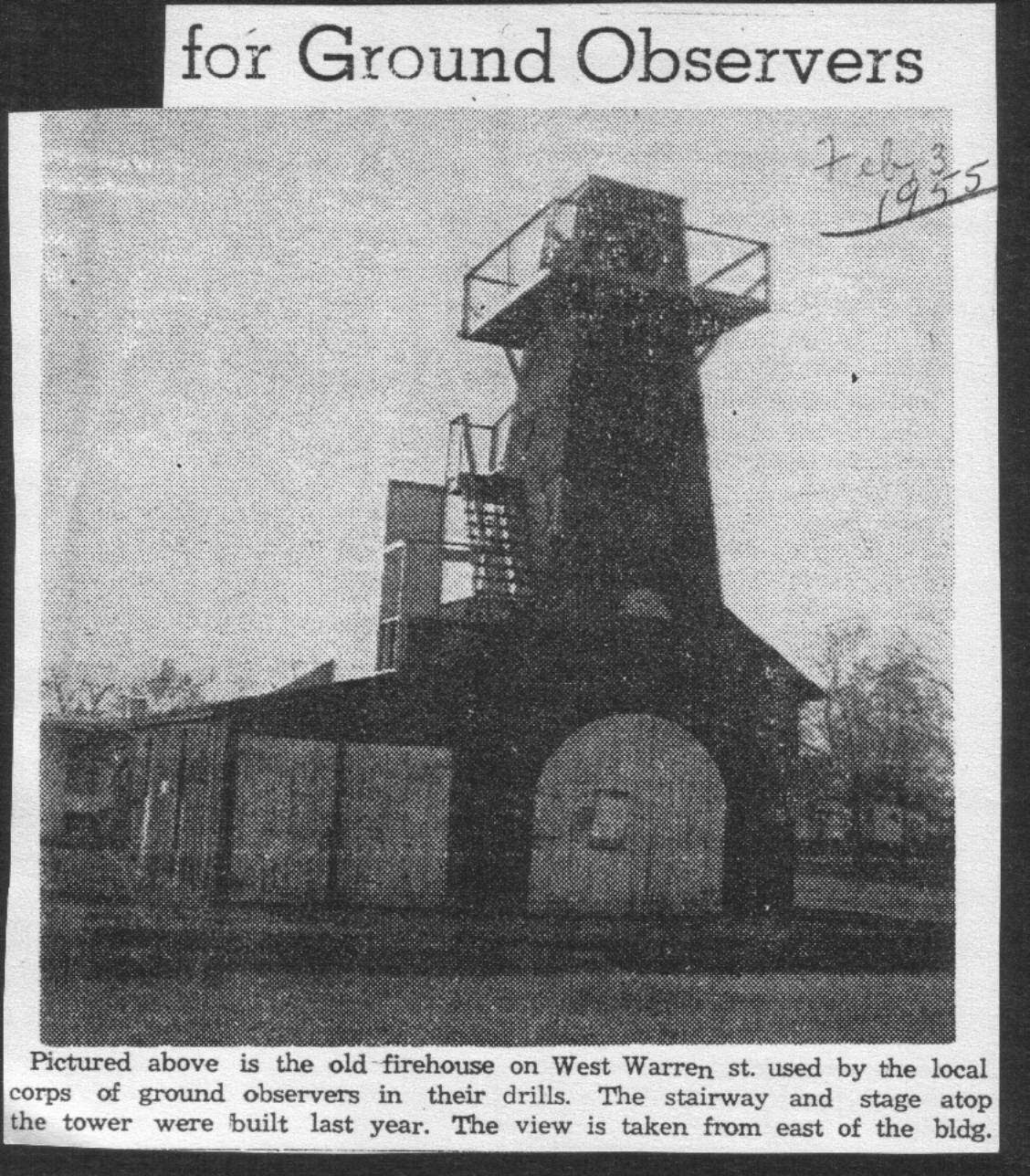
Pictured: The old firehouse on West Warren St. used by the local Corps of ground observers in their drills.  The stairway and stage atop the tower were built last year.  The view is taken from east of the building. (photo circa Feb. 3, 1955)


...Read more about this and other Bunker Hill, IL historical stories at https://bunkerhillhistory.org/

--Cite this story: The Bunker Hill IL Historical Society. "A Look Back in Bunker Hill History." Bunker Hill Gazette-News, January 10, 2013, April 30, 2020, February 17, 2022. 

[1]Stanton, Carl L. . "Bunker Hill News 1893." In Bunker Hill Revisited, Volume Three, 1892-1900, p. 62. Bunker Hill: Bunker Hill Publications, 2000. Provided by the Bunker Hill Historical Society.

[2]Stanton, Carl L. . "Bunker Hill News 1882." In Bunker Hill Revisited, Volume Two, 1882-1891, pp. 44-46. Bunker Hill: Bunker Hill Publications, 1999. Provided by the Bunker Hill Historical Society.

[3]Stanton, Carl L. . "Bunker Hill News 1893." In Bunker Hill Revisited, Volume Three, 1892-1900, p. 60-64. Bunker Hill: Bunker Hill Publications, 2003. Provided by the Bunker Hill Historical Society.

[4]Stanton, Carl L. . "Bunker Hill News 1880." In Bunker Hill Revisited, Volume One, 1866-1881, pp. 209-210. Bunker Hill: Bunker Hill Publications, 1997. Provided by the Bunker Hill Historical Society.


Thursday, February 10, 2022

History of the Round Prairie Church


    The first church to be erected was by the Christian denomination at Round Prairie, Section 32 in Dorchester Township, in the year 1845.  This church would have been about two miles east of the Willis Wolf farm on the Catholic Springs Road.  The first ministers were Robert Foster and Jonathan G. Wood.

The following is from the records of the church:

    Round Prairie Church was organized July the first in the year of our Lord eighteen-hundred and forty  five by appointing the following named persons to the office of the Eldership to wit:  John P. Bayless, Samuel Wood, and Hiram Daugherty, and John Nesbit as Deacon, at the same time.  About 1849, John W. Keller was added to the list of Elders and resigned in 1854 and Johnson McGilvary and W.S. Spruill were ordained as Elders and Levi Miller and William Nesbit were ordained Deacons at the same time.  Johnson McGilvary went off to the Army in 1862 and died.  In 1874, there was added to the Eldership, Peter C. Randle, Albert L. Fairchild, Benjamin Mize, and William Soapes to the Deaconship.  Elder Fairchild moved his membership and died March 12, 1881.  Scott Mize was added to the list of Deacons by the church and Sanford Mize at the same time was appointed as an assistant clerk for the church of Round Prairie.

    January 1, 1865, a subscription for the support of a minister at Round Prairie Church, eighty nine dollars contributed by 16 people.

--Cite this story: The Bunker Hill IL Historical Society. "A Look Back in Bunker Hill History." Bunker Hill Gazette-News, February 10, 2022, April 7, 2022.  

Stanton, Carl L. . "Bunker Hill News 1932." In Bunker Hill Revisited, Volume Six, 1920-1940, p. 120. Bunker Hill: Bunker Hill Publications, 2006. Provided by the Bunker Hill Historical Society.

Redford, Carol, and Betty Triplett. "Bunker Hill History." In Reflections: A History of the Bunker Hill-Woodburn Area, p. 123. Bunker Hill: Bunker Hill Publications, 1993. Provided by the Bunker Hill Historical Society.

Thursday, February 3, 2022

Ordinances of the City of Bunker Hill - 1873


Ordinances of the City of Bunker Hill 

Organized April 15, 1873, under the general law of the State of Illinois

City Officers 1873

Mayor: James F. Cummings

Aldermen for two years: S.A. Fletcher; E.S. Williams; and David Morris

Aldermen for one year: H.H. Brown; C.A. Bartels; and John Gosch

City Clerk: S.N. Sanford

Treasurer: John G. Auer

City Attorney: H.R. Budd

An Ordinance relating to misdemeanors:

Sec. 17: Whoever shall, without the consent of the owner or occupant of the premises, fasten any horse or other animal to any tree or to any boxing place around any tree, shall forfeit and pay the sum of not less that one dollar.

Sec. 19: Whoever shall purposely, rapidly, or immoderately ride or drive any horse or mule, or any cattle, or other like animals, or any team in any street or alley of the City of Bunker Hill shall forfeit and pay for each sum of not less that ten dollars. 

Sec. 37: The running of large cows within the city limits of the City of Bunker Hill, between the 15th day of November and the 1st day of April each year, shall forfeit and pay the sum of one dollar for each cow, and in addition, shall pay the sum of one dollar for every twelve hours said cow shall continue to run at large.

Sec. 42: Any person or persons who shall within the city limits carry any concealed on their persons any knife, Bowie knife, pistol, revolver, slingshot, or any dangerous or deadly weapon for the purpose of unlawfully using the same, shall forfeit and pay the sum of not less than twenty-five dollars.

Sec. 44: That any person or persons who shall ride, lead, or drive any horse, mule, or ox upon or over any plank or brick sidewalk within the city limits shall on conviction thereof, be fined not less than three or more than ten dollars.

Pictured: One of the later Ordinances of Bunker Hill


...Read more about this and other Bunker Hill, IL historical stories at https://bunkerhillhistory.org/

--Cite this story: The Bunker Hill IL Historical Society. "A Look Back in Bunker Hill History." Bunker Hill Gazette-News, February 3, 2022.  

Thursday, July 15, 2021

Restoration of the Lincoln Statue

Pictured: The 1988 Lincoln Statue Restoration Project      

    Restoration has begun on the Lincoln Statue after delays last year due to COVID-19.  The company hired to do the restoration is Russell-Marti Conservation, Inc. from California, Mo.

    The last conservation treatment was in 1998.  At that time, the statue was cleaned of corrosion with glass beads, and then given a hot chemical patina, followed by successive applications of protective coatings. 

Pictured: Lincoln Statue Prior to the 1998 Restoration


    General treatment step this time will be:

1.)  Remove all loose, deteriorated coatings from the surface by cleaning with CO2 (carbon dioxide, or dry ice) blasting.  The CO2 cleaning method was used as part of recent conservation/maintenance treatments in St. Louis, including the Apotheosis of St. Louis (in front of the St. Louis Art Museum), the Meeting of the Waters (at Aloe Plaza, across from Union Station) and on sculptures at the St. Louis Art Museum.

2.)  Wash the bronze, using water and non-ionic surfactant, rinse and dry.

3.)  Apply a clear lacquer by spray, building up the coating in successive thin applications.

4.)  Apply a toning layer to adjust the patina as necessary

5.)  Apply a final clear lacquer.

    While conservation treatment will stabilize the sculpture and bring it to an appropriate and well cared for appearance, routing annual maintenance is important to preserve the effect of the treatment over the long term.

    The Lincoln Statue was donated to the City of Bunker Hill in 1904 by Capt. Charles Clinton.  Most of the men in Capt. Clinton's Civil War Unit were men from Bunker Hill.  He had such high regard for these men that he decided to donate a statue of Lincoln identical to the one which he donated to his hometown of Cincinnati, OH.  There are two other statues in Iowa, but they do not have the Lady Liberty.  These statues were donated by other individuals.  All of the statues were sculpted by William Granville Hastings.

Further information about the History of our Lincoln Statue can be found on our blog posting at https://bunkerhillhistory.blogspot.com/2015/01/lincolns-statue.html

Pictured: The 1988 Lincoln Statue Restoration Project

Pictured: The 1988 Lincoln Statue Restoration Project

...Read more about this and other Bunker Hill, IL historical stories at https://bunkerhillhistory.org/

--Cite this story: The Bunker Hill IL Historical Society. "A Look Back in Bunker Hill History." Bunker Hill Gazette News, July 15, 2021.  

Thursday, July 8, 2021

The Bunker Hill Train Wreck of August 1857

    Pictured: Hotel and Big Four Railroad Station in Bunker Hill IL
 

From the Missouri Democrat, August 17, 1857

    Accident on the Terre Haute, Alton and St. Louis Railroad

    On Saturday evening, about eight o'clock, as the westward bound passenger train on the Terre Haute, Alton, and St. Louis railroad had reached a point about one mile from Bunker Hill, IL, the locomotive broke through a bridge, which was constructed over a small creek or ravine.  The baggage and express cars were, at the same time, precipitated beyond the engine and down a steep embankment.

    The car next to the emigrant car, containing a number of ladies and gentlemen, fell in after the engine and was turned up on its forward end.  At the time of the accident, a hard thunderstorm was prevailing, which added to the terror of the occasion.  Another thing which contributed to the dismay of the passengers was the communication of fire to a portion of the train by the explosion of the engine.  The flames, notwithstanding the rain, were spreading rapidly, but by the exertion of the passengers were subdued.

    Edward Warden, fireman, was instantly killed.  Mr. Wilcox, engineer was badly hurt and burned.  The baggage master of the train, whose name we were unable to obtain, and B. Deming, a brakeman, were hurt, but not seriously.

    As if the heavens had conspired to add terror and death to the scene, a little girl, daughter of Mr. Templer, was struck by lightning just after the explosion of the engine took place, and was instantly killed.

    Edward Warden died on August 16, 1857, and is buried in the Bunker Hill Cemetery.

...Read more about this and other Bunker Hill, IL historical stories at https://bunkerhillhistory.org/

--Cite this story: The Bunker Hill IL Historical Society. "A Look Back in Bunker Hill History." Bunker Hill Gazette-News, July 8, 2021.  

Thursday, May 13, 2021

"Carrie was There" - A Caregiver to Many


Pictured: Carrie Braash

This article was submitted by Carol DuFrain, granddaughter of Carrie Braash

    When my grandmother's name is mentioned in this area, someone usually recalls a time when "Carrie was there".  She was involved with many families on the occasion of the birth of a son or daughter and, in this way, was an important part of the history of this area.

    She was well known for assisting Dr. Bley and Dr. Hess with home deliveries and the aftercare of the mother and baby.  According to a record kept by her, she cared for over 350 babies over a 23 year period.  The first baby noted was Irma Bartels in 1921 and the last was Joyce Adcock in 1944.  There were some years in the 1930's when she helped with as many as 40 in one year.

    She became a widow with three small children in 1917 when my grandfather, Charles, passed away.  She moved to Bunker Hill in 1929.  Her children were Dorothy, Marcella, and Otto.  She had four grandchildren and raised one of them from age three.

    She was also known for her beautiful quilts and her work as a member of Zion  Lutheran Church.  She is fondly remembered by many for her kindness and "always being there" to lend a helping hand.

    Carrie passed away in 1965 at the age of 80.  A great-granddaughter she never new bears her name.

...Read more about this and other Bunker Hill, IL historical stories at https://bunkerhillhistory.org/

--Cite this story: The Bunker Hill IL Historical Society. "A Look Back in Bunker Hill History." Bunker Hill Gazette-News, May 13, 2021.  

Thursday, March 18, 2021

Bunker Hill Digs Out in Cold, Dismal Sunday Rain

Pictured: Washington Street in the Bunker Hill Business District resembled the set of a Hollywood disaster film after a tornado struck on March 19, 1948.  Nineteen people were killed and almost every building in town was damaged or destroyed. (File/The State Journal Register)

Read more about the Bunker Hill Tornado in our March 19, 2020 blog posting at https://bunkerhillhistory.blogspot.com/2020/03/72-years-ago-march-19-1948-tornado.html and also  our November 2015 blog at https://bunkerhillhistory.blogspot.com/2015/11/bunker-hill-tornado-67th-anniversary.html

From the Alton Telegraph, March 20 and 22, 1948

    In a cold and dismal rain that began falling yesterday, efforts continued in the little town of Bunker Hill to open streets and clear debris from around dwellings that could be used as shelters.  This is the second time in "10 days less than 10 years" that a tornado struck the town which is the center of a dairy and farming community.  The town was established about 1835 and until the tornado of 10 years ago, a storm of such proportions had never swept the locality.

Pictured: Bunker Hill Main Business Area - This photo taken Saturday morning after debris had been cleared from the streets shows the damage done to the city's business areas.  Roofs were torn off and buildings demolished by the hard-hitting tornado.

    Sightseers have been barred since the militia took over mid-afternoon Saturday.  Route 112 (now 159), two miles north of the city limits at the spur connecting with Route 138, was patrolled by State Police, who were helped in their efforts to let only those with legitimate business enter the town by long time residents of the community.  Stories were listened to and only those with a compelling reason were given the nod to drive on.  All other roads are barricaded and patrolled against unnecessary traffic.
Pictured: Toppled Abraham Lincoln Statue

    Headquarters for John Ritter, assistant chief, State Police, have set up in a trailer in the parking space on Route 112 in the mid-section of the business district.  It stands only a few feet from the base of the statue of Abraham Lincoln.  The statue itself, almost life size, is lying headless against the north side of the base, when it toppled backward early Friday morning.  On the south side kneels the figure of a woman with hand posed, as in writing, but without the pencil, that was formerly hers, who is ready to complete the sentence, "With malice toward none."

Pictured: Salvation Army tents

Pictured: Salvation Army assisting Bunker Hill residents

    A few feet to the north of the statue, is the tent, where help is administered by the Salvation Army.  Military personnel and citizens alike were loud in their praise of "The Army".  The Red Cross headquarters is established in the Meissner High School building, where the roof, badly damaged, admitted the pouring rain.  A first aid station functioned there after the tornado and remains to continue further efforts if needed.  Various desks and offices to house records and equipment for the management of the huge task, occupy hall space and parts of other rooms, wherever a small space can be found.  A registered nurse, Miss Phyllis Baker, and a high school music teacher, Mr. Pal Byron Hale, a medical corpsman in World War II, aided Dr. C.W. Draper and Dr. Lusk of Carlinville, in setting up an aid station at Meissner High School, where 74 patients were registered.  Doctors estimated that 150 had been treated at the school, a home, a business district store, and the three aid centers.  Six dead lay in one room of the school awaiting the coroner.  Arrival of the coroner and additional State Police was a welcome relief for Mrs. Ethel Herndon, who stood guard at the door of the improvised morgue. 


Pictured: Meissner School set up as a Red Cross Headquarters

    The once proud town, with its wealth of historical background, is leveled.  Only the school building stands among the major building, and a few of the houses are habitable.  but with agencies of the government and charity converging on the town, it was digging its way out.

...Read more about this and other Bunker Hill, IL historical stories at https://bunkerhillhistory.org/

--Cite this story: The Bunker Hill IL Historical Society. "A Look Back in Bunker Hill History." Bunker Hill Gazette-News, March 18, 2021.  

Thursday, February 25, 2021

Smalleytown and Pleasant Hill Schools

Pictured: Smalleytown School in 1900's 

Smalleytown School #162

Smalleytown School was located on Miles Station Road, Bunker Hill Township in Section #3.

In 1906, Mrs Frances (Smalley) Pennington was the teacher and she had 24 students and her salary was $40 per month.

Pictured: Smalleytown School Class (circa 1906 or 1907)
Front row: Lester Smith, Frank Smith, Lydia Heal Dey, Billy Bort, Bertha Peters Stammer, Goldie Peters Rull, Bessie Marston.
Middle row: Lester Heal, Henry Smith, Mildred Wood Lloyd, Beulah Barnes Olmsted, Elsie Bort Schaller, Ferna Jacobi, Della Peters Buhs, Annie Bort.
Back row: Chester Kehr, Harry Jones, Rose Peters Penning, Van Jacobi, Francis Smalley Pennington (teacher), Oliver Marston, Viva Wood Leggett, Milton Jacobi.

In 1919, Edith Pyle was the teacher and she had five students.  Edith Pyle received $50 per month.

In 1921, Charles F. Keirle was the teacher and he had five students.  Mr. Keirle received $75 per month.

In 1922, Mrs. Gladys Smith was the teacher and she had six students.  She received $75 per month.

In 1944-45, the school had a radio and warm lunch programs heated on an electric plate.  The last annual report was 1947-48 and the last teacher was Mrs. Laura Snedeker.  When the school closed, the students had a choice of where to go.  Three girls chose Woodburn School and the three boys went to Bunker Hill.

Some of the many families who attended Smalleytown Schools were Olmsted, Howald, Pennington, Barnes, Bort, Jacobi, McCurdy, Heal, and Brummer.


Pictured: Map for Bunker Hill area Country Schools


Pictured: Pleasant Hill School #165

Pleasant Hill School #165

Pleasant Hill School was located in Bunker Hill Township in Section #26.  Today, that is Rust Road.

In 1907-08, Mary Aveiss, teacher, had 25 students and received #35 per month.  The tuition for each student per month was $1.40.  In Mary Aveiss' teachers report, she stated that the blackboards needed repairing badly.  Chicken pox and bad roads had a lot to do with the poor attendance.  The schoolhouse is very much in need of repair.  I, with the help of a 12-year old boy, built a little porch to keep the mud at least a short distance from the door.

In 1920-21, Chester Kehr was the teacher.  There were 15 students and Mr. Kehr received $85 per month.

In 1924-25, Miss Claribel Seim was the teacher.  She had 13 students and received $74 per month.  The school director was Anton Bruckert.

Some of the many families that attended Pleasant Hill School throughout the years were Rust, Haneghan, Zarges, Sauerwein, Goebel, Bunte, Enke, Ladenforf, Bixen, Bruckert, Duelm, Goodwin, Foreman, Altevogt, and Moulton.

Pictured: 1918 Pleasant Hill School Class

...Read more about this and other Bunker Hill, IL historical stories at https://bunkerhillhistory.org/

--Cite this story: The Bunker Hill IL Historical Society. "A Look Back in Bunker Hill History." Bunker Hill Gazette-News, February 25, 2021. 

Redford, Carol, and Betty Triplett. "Bunker Hill History." In Reflections: A History of the Bunker Hill-Woodburn Area, p. 100. Bunker Hill: Bunker Hill Publications, 1993. Provided by the Bunker Hill Historical Society.