Thursday, April 27, 2017

A History of the Bunker Hill Schools


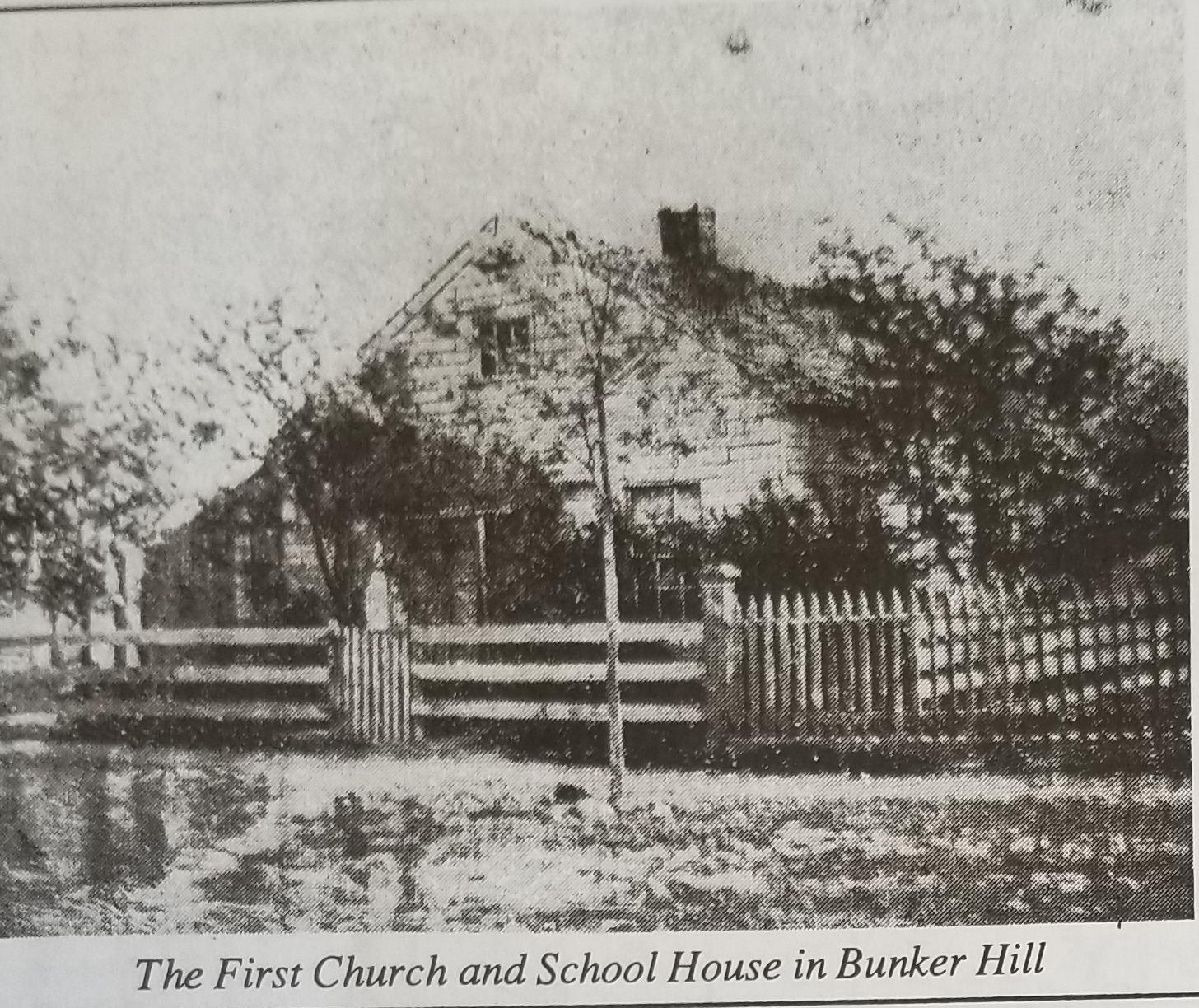
Pictured: The First Church and Schoolhouse in Bunker Hill


Read about the History of Bunker Hill Schools from our earlier blog posting at https://bunkerhillhistory.blogspot.com/2015/05/a-history-of-bunker-hill-schools.html


From the Gazette-News, September 20, 1973

Written by Miss Florence Seim

The full pdf document of Miss Seim's paper titled "History of Bunker Hill Schools" can be downloaded from: https://drive.google.com/file/d/1UDvSjqh2WAwZfMhEQHMe7h-QzmGBFtMy/view?usp=sharing

    Scarcely had Bunker Hill shown signs of becoming a town until the early pioneers turned their thoughts to the education of their children.  These early pioneers, who were determined to develop this new country, were advocates of "Learning" and wished to have their children, who were to be the men and women of tomorrow, versed in the fundamentals of a workable education.

    A combined church and schoolhouse was erected in the fall of 1839 by the citizens of Bunker Hill.  It was an 18' x 26' and was only a few feet from the present Congregational Church.  Most of the material used was produced in this vicinity.  Other material, such as grease, oil, putty, locks for the doors, pine lumber for seats, etc. were store purchased.  The bill totaled less than $100.  It was a very rough, unplastered little room with blankets and shawls hung around the walls and doors to keep out the cold winds and snow.  This building, primitive an roughly built, was the first church and first schoolhouse.  In it, the early settlers worshipped [sic] and his children were taught to read.  In later years, the old schoolhouse became the property of W.J. Knibb and was used as a barn.  It has been moved many times; its last location being on the southeast corner of Mr. Knibb's yard, just back of the Methodist Church.  In March 1883, the building was torn down and destroyed.  

    Francis N. Burnham operated the school and was succeeded February 3, 1840 by John A. Pettingill.  In March, the spring term was in charge of Jane Putnam, who afterward became Mrs. Jonathan Huggins.  Dr. John Delano taught school here some years before going into practice with Dr. E. Howell.

From Reflections: A History of the Bunker Hill-Woodburn Area:
    
    The first school in Macoupin County was conducted at Staunton by William Wilcox in 1824.  He was paid $30 for ten weeks of work.  He was replaced by Roger Shell in 1827.  James Howard taught school in the northern part of the county near Apple Creek.  He taught until his death in 1824.  In 1831, the first school was established in Bunker Hill in a small house near the hat factory of Daniel Branscomb.

    The first schoolhouses were constructed of unhewn logs and covered with boards which were held in place by weight poles.  The floor was nothing but dirt.  Oiled paper, placed over a hole in the wall, was used to take the place of glass.  Heat was provided from a fireplace at one end of the building.

    Seats were usually made of split logs with wooden pins driven into them for legs.  The writing desks were simply split log shelves against the walls.

    The subjects taught in those early schools were reading, writing, and orthography, which was spelling.  In some of the better schools, arithmetic was taught.

    
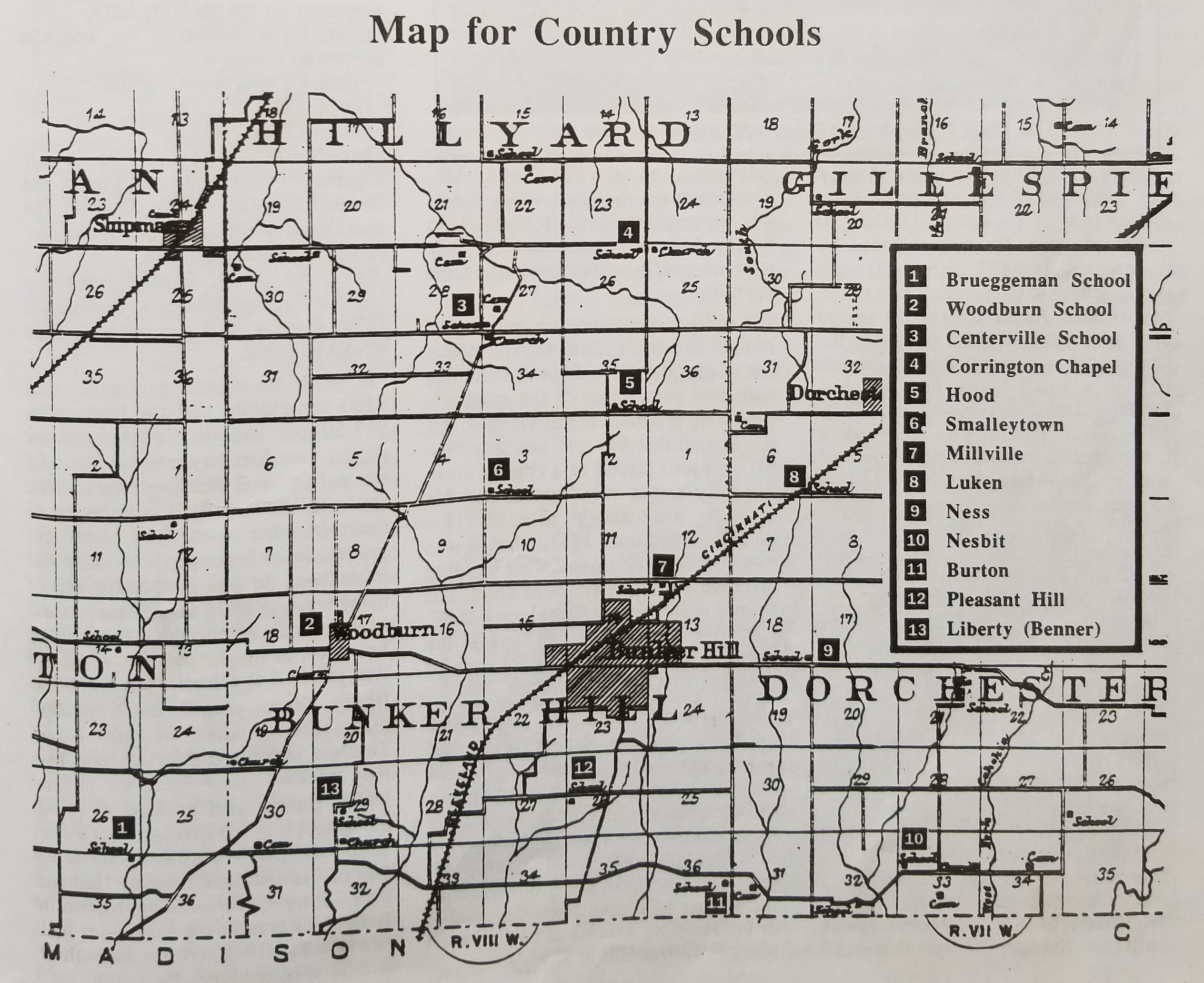
Pictured:  Map of Bunker Hill area country schools


    The first schoolhouse in Bunker Hill stood on Section 21 and was later moved to Section 22 (Section 21 and 22 are in between Bunker Hill and Woodburn).  In 1831, a schoolhouse was built on Section 20 on the land belonging to John T. Wood.  Mr. Richardson was the first teacher and he was succeeded by Josiah B. Harris.  John Wilson, Jesse Wood, and Aaron Leyerly were also early school teachers in the township.  

    The first schoolhouse in the City of Bunker Hill was built in 1839 and was one of the last of a number of buildings built that year.  Most of the materials used were produced in this vicinity, and it was said that the cost was less that $100.  It also served as a church.  In it, the early settler worshipped [sic] and his children  were taught to read.  this building stood until 1883, when it was torn down and destroyed.  The  building had been moved a number of times, and in the later years became the property of W.J. Knibb.  Its last location was at the southwest corner of a lot, just back of the Methodist Church.

    In the years following the building of the first school here, Bunker Hill proved to be a popular place for settlers, and soon outranked Woodburn in population and continued its growth to become the second largest town in the county.  This shift in population from Woodburn, which was settled before Bunker Hill, can largely be attributed to the coming of the railroad, which ran its first train through Bunker Hill in 1855.

    Bunker Hill had 4 private schools in 1867.  Professor T.L. Sawyer advertised his school as a "Classical and Scientific Institute", and opened the fall term on September 3, 1866.  According to Professor Sawyer's advertising, "Young ladies and gentlemen wishing to qualify themselves for teachers would receive the instructions required." Spelling, reading, and writing were daily exercises for the entire school.  Forty-five minutes of every day were devoted to penmanship.  One afternoon each week was devoted to composition, and every scholar capable of forming a sentence was required to compose.  Commercial arithmetic and bookkeeping were exclusively attended to for those preparing for the counting room.  

    Costs for a session for ten weeks in the private school were:
  • Primary Department - $6.00
  • Junior Class - $9.00
  • Senior Class - $12.00
 Incidental expenses in each were $.50 and French and German languages were $5 extra.  No deductions were allowed for absence, except in protracted illness.  

    Rev. J.H. Hilmes opened a German evening school on October 23, 1874 starting at 7 p.m. at the public school building.  

    In 1879, the highest paid salary was $100 per month, and the lowest was $17.50 per month.  Teachers were stricter than they are now.  They did not put up with horsing around.  The students knew what was expected of them.  In some cases, there were eight grades in one room.  If a child did misbehave, he was punished in one of many ways.  A child might have to stand in the corner, be hit with a ruler on the knuckles, or maybe paddled.  If a child was paddled at school, then more than likely there would be a second punishment when he got home.  Teachers were respected much more than they are now.

    With Bunker Hill growing as it did, the school was too small, so that by the 1860's, the City Hall was leased to the school.  Read more about the City Hall - Bunker Hill's Second School, at the blog posting at https://bunkerhillhistory.blogspot.com/2017/05/city-hall-bunker-hills-second.html

Pictured: City Hall, leased by the public school in 1863-1869


...Read more about this and other Bunker Hill, IL historical stories at https://bunkerhillhistory.org/

--Cite this story: The Bunker Hill IL Historical Society. "A Look Back in Bunker Hill History." Bunker Hill Gazette-News, September 20, 1973, April 27, 2017.

Redford, Carol, and Betty Triplett. "Bunker Hill History." In Reflections: A History of the Bunker Hill-Woodburn Area, p. 102. Bunker Hill: Bunker Hill Publications, 1993. Provided by the Bunker Hill Historical Society.
Thursday, April 20, 2017

Bunker Hill Ordinances of 1873

Pictured: The cover of the booklet for Ordinances of the City of Bunker Hill - 1873


Some of the Ordinances of Bunker Hill, circa 1873 booklet on display at the Museum.

Ordinance relating to Misdemeanors:

 Sec. 17: Whoever shall, without the consent of the owner or occupant of the premises, fasten any horse or other animal to any tree or to any boxing place around any tree, shall forfeit and pay the sum of not less that one dollar.

Sec. 19: Whoever shall purposely, rapidly, or immoderately ride or drive any horse or mule, or any cattle, or other like animals, or any team in any street or alley of the City of Bunker Hill shall forfeit and pay for each sum of not less that ten dollars. 

Sec. 37: The running of large cows within the city limits of the City of Bunker Hill, between the 15th day of November and the 1st day of April each year, shall forfeit and pay the sum of one dollar for each cow, and in addition, shall pay the sum of one dollar for every twelve hours said cow shall continue to run at large.

Sec. 42: Any person or persons who shall within the city limits carry any concealed on their persons any knife, Bowie knife, pistol, revolver, slingshot, or any dangerous or deadly weapon for the purpose of unlawfully using the same, shall forfeit and pay the sum of not less than twenty-five dollars.

Sec. 44: That any person or persons who shall ride, lead, or drive any horse, mule, or ox upon or over any plank or brick sidewalk within the city limits shall on conviction thereof, be fined not less than three or more than ten dollars.

Ordinance relating to fees and salaries:

Sec. 1:  The superintendent of streets shall receive one dollar and fifty cents per day for each day actually employed in laboring or superintending the labor on the streets, alleys, or reads in said city.  For removing each dead horse, mule, cow, or ox out of the city limits, one dollar, for removing any other dead animal, fifty cents.

Police shall receive two dollars per day when employed.

The calaboos (jail) keeper shall received one dollar for each person confined and one dollar per day for caring and boarding each person confined.

All ordinances passed on May 17, 1873, by Mayor J.F. Cummings.


...Read more about this and other Bunker Hill, IL historical stories at https://bunkerhillhistory.org/

--Cite this story: The Bunker Hill IL Historical Society. "A Look Back in Bunker Hill History." Bunker Hill Gazette-News, April 20, 2017.  

Thursday, April 6, 2017

The Hard Road - The End of Old Dirt Roads through Bunker Hill


Pictured: A hand sketch of people travelling on old dusty roads to Bunker Hill by Stage coach

Read our earlier blog posting about the Bunker Hill Hard Road at ... https://bunkerhillhistory.blogspot.com/2015/04/a-hard-road-through-bunker-hill.html

    When the first homesteaders came to Bunker Hill, there were no roads as we think of them today.  You would just go out in the direction of your destination and go across country.  Over time, certain paths and trails were more heavily traveled and became the early roads.  As people went through the road and made ruts, it would wash deeper and deeper making the road bed lower than the sides of the road.  There were no organized maintenance of these roads.  People often had hard times getting to and from town.  

    In dry weather, the dust was six to eight inches deep and sometimes the visibility was cut to almost zero when following another vehicle.  Getting stuck in the mud was one of the inevitable happening following big rain storms or in rainy or thawing seasons.  Some teams and wagons would get stuck the axle deep slop.  Sometimes travelers would have four or five horses per wagon to pull it through muddy roads.  Not only the main road, but all roads through the area were like this at some time.  After many years of traveling this way, residents of the community began to complain.

Pictured: Travelling was done by horseback on dirt roads to the Lincoln Post Office

    The town council, for the purpose of keeping streets, alleys, and highways in repair, was authorized and empowered to require every able bodied male over twenty-one years of age and under fifty to labor on streets, any number of days not exceeding three in each year.

Pictured: Looking South on Franklin Street before paved roads were introduced. 

    When the practice of oiling roads started, the neighbors would chip in and oil the roads.  Very little oil was spread on country roads.  This job was not done mechanically, but was done by manual labor.  Very few streets were all weather during the winter months.  In 1923, the city began to oil the streets.  The roads and city streets were very messy and the oil ran off the dust like water.

Pictured: North Washington Street before 1920's


    In 1925, Senator A. Cuthbertson, who was a former merchant and resident of Bunker Hill, initiated the idea of a hard road to the area that would replace the old stage coach road running north and south through town. The planning was done in the next several years with Cuthbertson's help.

Pictured: The Lincoln statue before the hard roads


    The road work started in Bunker Hill in 1927.  One problem that had arisen was that the state wanted to take the Lincoln Statue out when the road was put in, however, popular sentiment won out and the road was built around the statue instead.

    The foundation of the road was made from bricks and dirt.  Workers who helped on the road used over one hundred mules to haul materials to construct the foundation.  Big scoops were used to move and to place materials where they wanted them.   After the foundation was finished, the concrete was poured and smoothed.

Pictured: The map of the first hard road through Bunker Hill

    September 28, 1928, there was a big celebration to celebrate the opening of the hard road.  The old stage coach that had run the route through here on the Springfield and St. Louis route from 1822-1850 was brought here from Edwardsville for the celebration.  There was a big chicken dinner.  It rained so hard that the celebration had to be moved to the new Lincoln Hall.  The scheduled platform dance was postponed until October 6, when a huge platform was laid out between the Lincoln monument and the bandstand for dancing.  

Pictured: An early Bunker Hill automobile

    The final touches were made and the new Route 112 was finished in the early 1930's.  A few years after the route was completed, the hard road's name was changed to Route 159.  There have been slight changes in the road since then.  Several years after the road was completed, the road that ran south of Bunker Hill was changed.  This alteration took out three turning points which were located just south of the present location of the big blue water storage tank and north of the Madison County line.  The highway is still a two-lane road as it has been for eighty plus years, but has been resurfaced and widened to fit present day needs.


Pictured: Bunker Hill Ordinance-Notice to Automobile Owners


    Read more about this and other Bunker Hill, IL historical stories at https://bunkerhillhistory.org/

--Cite this story: The Bunker Hill IL Historical Society. "A Look Back in Bunker Hill History." Bunker Hill Gazette-News, December 13, 2012, April 6, 2017. 

Redford, Carol, and Betty Triplett. "Bunker Hill History." In Reflections: A History of the Bunker Hill-Woodburn Area, pp. 25-26. Bunker Hill: Bunker Hill Publications, 1993. Provided by the Bunker Hill Historical Society.

Thursday, March 2, 2017

The Smith Canning Factory


Pictured: Smith's Sorghum Mill

From the Gazette-News: January 2, 1903
     The News is pleased to present to the public this week a photo engraving of Smith's Sorghum Mill, which is located one mile north of Bunker Hill and is one of the good institutions of this city.  The Smith Brothers, (Haney V. and Edward) are energetic and popular and have succeeded in drawing a large trade in their line to Bunker Hill.  Not being content with their large output of sorghum each year, they have established a canning factory in connection and each season ship thousands of cans of tomatoes.

SORGHUM
By H. V. Smith

     During the Civil War, after the railroads and the lower part of the Mississippi river became blockaded, the northern central states in a great measure were cut off from their supply of sugar and molasses from the plantations of the south.  Then it was that our lawmakers, as has always been the case in every emergency which this nation has passed, came to the rescue of the people, and the bureau of agriculture, learning that over in the Celestial Empire there existed a sugar producing plant (called in the Chinese language Sargo), they had imported into this country vast quantities of seed, which was sent out broadcast among the farmers through the mails in small packages, containing about a teaspoon full.  This was planted and the seed saved for planting the next year.  Then commenced one of the greatest eras of molasses making in North Central and Western states that probably ever was known in the history of any nation on earth.  In nearly every molasses making in North Central and Western states that probably ever was known in the history of any nation on earth.  In nearly every community was found a sorghum mill.

     The means of manufacture at first was very primitive and crude.  The farmer would procure a solid oak log and cut it about three feet lengths, and with the assistance of a carpenter would dress them to a smooth round surface, and on the upper end would cut huge wooden cogs.  To the end of one of the rollers projecting above the cogs would be morticed a crooked pole or sweep.  The rolls would be fixed in a strong wooden frame and to the end of the sweep would be hitched a horse, and the machine would be ready for grinding.  The farmer would often arise long before daylight and commence pressing the cane, making the early hours of the morning hideous with the creaking, groaning and howling of the wooden logs as their un-oiled surfaces came in contact, disturbing the peaceful dreams of his neighbors for about a mile around.

     For evaporating the juice he would take two pine planks, six or eight feet long and twelve inches deep, to which he would nail on a sheet iron bottom turned up at the ends.  This would be set on two brick walls with a stove pipe at the back end for a chimney.  In this pan would be poured the raw juice from the mill, the fire started, and the result generally would be a black , scorched, sweet-bitter conglomeration called sorghum.

     But soon improved methods of manufacture came into use.  the wooden mill was supplanted by the iron mill; the simple pan gave way to a succession of pans, one above the other, the juice running from the mill into the first pan and after skimming and boiling, on down to two or three into the finishing pan.  Also clarifying agencies, such as eggs and soda were used.  Then came the steam mill with the two story building, the juice being pumped up into the upper story, where it is defecated and purified by the clay process and settled before passing down to the finishing evaporators, thereby eliminating that raw vegetable taste so common in unpurified syrup.  By this process of manufacture, the sorghum cane will produce a grade of syrup equal to the New Orleans or Sugar House, and in some respects superior, because it is more dense and contains all the sugar, while the Sugar House is but the residue after the sugar has been extracted.


Pictured: Smith's Canning Factory

  
From the Gazette-News: October 20, 1905
     Smith Brothers have filled about 50,000 cans of tomatoes this season and are through with their work for the year.  The brothers have decided to quit the cannery business.  They have made money but the work does not appeal to them.  It is likely that some citizen will lease the cannery from them and operate it under the Smith Brothers labels for their goods have a great reputation in the neighboring cities.

The Smith Brothers cannery was located where Mrs. Bess Forwood's home used to be.  This property belonged to Mrs. Forwood's grandparents about 170 years ago.  This was once known as Bird Hill.  Mrs. Forwood's uncle Edward owned the home previous to Mrs. Forwood.  When Bess Forwood died at the age of 102, the property went to her grandson John Stephenson.

...Read more about this and other Bunker Hill, IL historical stories here at https://bunkerhillhistory.org/

--Cite this story: The Bunker Hill IL Historical Society. "A Look Back in Bunker Hill History." Bunker Hill Gazette-News, March 2, 2017.

Stanton, Carl L. . "Bunker Hill News 1903." In Bunker Hill Revisited, Volume Four, 1901-1910, pp. 33-34, 118. Bunker Hill: Bunker Hill Publications, 2003. Provided by the Bunker Hill Historical Society.

Thursday, February 23, 2017

Bunker Hill in the Days Before the Automobile

Pictured: (l-r) The business buildings seen thin the picture start at the corner of East Warren and Washington Streets.  Hale Drug Store, Bastian's Barber Shop, Frank Teichgraber's Saloon and Boarding House, and Charles Folkert's Grocery with saloon in the rear.

    Folkert's Grocery and Provision Store was at the corner of East Warren and Pine Street (the alley) and was the home of the Gazette-News in the 1940's.

Pictured: Folkert's Grocery and Provision Store (Now Gazette-News)


Pictured: The new building on the west side of Washington Street (February 28, 1894)

    There have been some changes made in the corner since those days.  The hitch racks, well, lamp post, and beer barrels are gone as is the Huggins pear orchard, which covered the ground from the Huggins House, which is now Dr. Bley's office (where Dr. Hess's office was located) over to the Congregational Church.  Pine Street (the alley) was then unopened and, where we travel with cars now, there was at the rear of the Gazette-News building a large gate into the pear orchard.

First Automobiles in Bunker Hill
Gazette-News - August 18, 1905

Pictured: An early Bunker Hill automobile

    Up to Tuesday, there were no automobiles in Bunker Hill.  Within 2 hours, there were two.  W.P. Powell came in with a Cadillac at 6 P.M. from Staunton and Al Goodall from Galesburg with a Gales two hours later.  There are others contemplating buying autos and within a month there will be 4 or 5 in town.


Pictured: Bunker Hill Business District (circa 1947)


 ...Read this and other Bunker Hill, IL historical stories at https://bunkerhillhistory.org/

--Cite this story: The Bunker Hill IL Historical Society. "A Look Back in Bunker Hill History." Bunker Hill Gazette-News, February 23, 2017.

Redford, Carol, and Betty Triplett. "Bunker Hill History." In Reflections: A History of the Bunker Hill-Woodburn Area, p. 26. Bunker Hill: Bunker Hill Publications, 1993. Provided by the Bunker Hill Historical Society.

Thursday, February 16, 2017

Weishaupt's Cafe'


Pictured: Weishaupt's Cafe' on East Warren Street

Reprint about Weishaupt's Cafe' from our earlier blog posting at https://bunkerhillhistory.blogspot.com/2014/10/weishaupts-cafe.html

Article by the late Carolyn Scroggins    

    Ask anyone who lived in Bunker Hill in the late 1920's through the early 1950's, about Weishaupt's Cafe' and you will hear nothing but good comments about the delicious meals served there.

    Clara and Ed (Cappy) Weishaupt were the proprietors.  They lived on a small farm at the southwest edge of Bunker Hill (the Vollmar place).  The restaurant business began in the Warner Building about 1926 then moved across the alley where Dia's Beauty Shop is today (now House of Styles).  The property was two stories with rooms for boarders and other rooms downstairs besides [sic] the restaurant.  Mrs. Freeman, who taught Latin, with her daughter Shirley, roomed there and many others through the years.  Mrs. Weishaupt was a hard worker.  Cappy usually sat in a rocking chair by the front window.  Someone said he and Warner Rull liked to go to the races. 

    Weishaupt's was a favorite place for the working man to eat and generous portions were common.  Marie Kampwerth remembers her husband took a silo filling crew to town to eat in September of '46 when she wasn't up to cooking for the gang.  The men and cooks lined up across the street in front of the former Gazette-News building for a picture.  

    The Sunday chicken dinners were popular with townspeople.  Even in the 1930's, it was reported that "People drove miles to eat Clara Weishaupt's sumptuous chicken dinners".  During the week, when school was in session, hamburgers were fried ahead of time and kept warm in a very large dishpan lined and covered with towels.  I wonder how many hamburgers could fit in a large dishpan.  Some refer to them as greasy but everyone says they were good.  We used to like grease, remember?

    Ralph Gerdt remembers the Commercial Club met for supper in her dining room which was followed by their regular meeting.  She also served family groups there.  She catered large groups such as alumni banquets in Lincoln Hall over the drug store.  Ralph remembers men telling about the strong coffee Mrs. Weishaupt made in her big coffee pot, but she also had a smaller pot that wasn't so strong which Bill Behrens preferred.

    There was a well in front of the cafe' about 10 feet in front of the sidewalk.  Grandma Ladendorff used the well water in her store and living quarters but we don't know if Clara did.  Marie has a picture showing the pump and the drinking cup.

    Lilly Welch (Brueggeman) and Clara Weishaupt were good friends.  Clara was almost like a second mother.  Lilly rode in early every morning with her brother, Ross, who worked at Ed Bruckert's garage.  She stayed at Weishaupt's until it was time to go to school, then after school, she stayed there until Ross got off work.  She remembers Clara was such a good cook.  She made delicious pumpkin pie by using her hand packed ice cream which made it rich.  Her dressing, made with currants, was delicious.  

    Thelma Roberts remembers when she was in grade school, Angie Bertagnolli took the kids money for hamburgers.  Bob Woods mother, Lula, worked in 1929 and '30 and again in 1937 and '38.  He said she and others worked very hard.  His mother killed and dressed chickens, and she did the boarders laundry and other people in town brought laundry at times.  Mrs. Weishaupt had a gasoline powered washing machine.

    Delores Kehr (Davis) who began work there in '46, said when you were hired, it wasn't just to be a waitress but included many household chores.  Most people I've talked with seem to think that the restaurant closed following the tornado, but Delores said it was open into the early to mid 50's.  The tornado took the top story so her business wasn't the same.  No doubt her health was the cause of the closing.  Thelma remembers Mrs. Weishaupt lived with the Gerhardt's in her latter years.  

    Marie Kampwerth says the weekday menu always included roast beef, roast pork, and baked ham, and meals were ready to be served by 10:00 a.m.  The Noll's bread man always ate his noon meal at Weishaupt's at 10 a.m. after he'd finished his town delivery.  The Sunday specialty was delicious fried chicken dinner including dessert.  

    Orland Snedeker said his mother, Laura Dingerson, worked at Weishaupt's Cafe' and that is where she met Orville Snedeker whom she later married.  Through the years, Laura used Clara's recipe for cole slaw dressing which included a bit of mustard and it was quite tasty.  Orland remembers that patrol boys were feted to a chicken dinner in 1955.

    Last week, I mentioned that family dinners could be held in Clara's dining room.  Mary Vaughn said the story brought back memories of Thanksgiving and Christmas dinners when the Hess family and grandmother gathered in the Weishaupt's dining room.  

   In March 1956, Joe and Dorothy Blevins moved to Bunker Hill.  They remember eating at Weishaupt's.  She recalls how the counter defined the edge of the kitchen and you could watch the cooking and serving.  She remembers the large block tile floors, the metal top tables, and ice cream chairs.  Joe thinks the cafe was possibly open as late as '57.

    Speaking of the Blevins makes me think of the Wisch's who made ice cream and sold it from their home in the next block south of the Dairy Queen.  Dorothy and I don't remember whether Russell Rigg started making ice cream or Wisch.  The Blevins bought the home and ice cream making equipment and for a couple of years tried their hand at the business.  Dorothy remembers making cups of ice cream for the Baptist Sunday School picnic at Simmermaker's Grove.  They made a cherry garden flavor with cherries and nuts which was the favorite of many.


From Bunker Hill Revisited, Volume Six, 1920-1940:

April 6, 1928: A very fine building occupied by the former Rubber Works Plant, was remodeled last summer by the Rull Brothers and is now occupied by the Weishaupt Hotel and Restaurant and Charles Rull Pool Room

June 28, 1940: Enjoy a Spring chicken Dinner for only 40 cents, Sunday, at Weishaupt's Cafe, in Bunker Hill (advertisement).


...Read more about this and other Bunker Hill, IL historical stories here at https://bunkerhillhistory.org/

--Cite this story: The Bunker Hill IL Historical Society. "A Look Back in Bunker Hill History." Bunker Hill Gazette-News, October 8, 2014, February 16, 2017.

Stanton, Carl L. . "Bunker Hill News 1920, 1940." In Bunker Hill Revisited, Volume Six, 1920-1940, pp. 57, 236. Bunker Hill: Bunker Hill Publications, 2006. Provided by the Bunker Hill Historical Society.

Thursday, February 9, 2017

George Lee's Livery Stable in the 1890's

Pictured: George Lee's Livery Stable in the 1890's.  On the left are Lee and Tom Payne.  In the center buggy is Bull Hutson and on the right is John Payne and Abe Turk.

     In the days of old, the the livery stable business was one of the most thriving that was engaged in Bunker Hill.  One of the old livery barns was owned and operated by George Lee, who purchased it from Dr. S.F. Hale in 1895.

    In this livery barn, Mayor J.R. Richards kept some nice horses.  Mr. Bastien and Dr. Milton had some nice race horses which they also boarded at the barn.


Pictured: Phoenix Insurance Company calendar.  Many horses from insurance salesmen were boarded at George Lee's Livery Stable. 

    Back in those days, the insurance and other salesmen came into Bunker Hill, where they remained for several days before they drove out the team.  Matt Gaunt kept his funeral hearse in the barn.  Some of the Gazette-News' old readers will recall the two hotels, Goodalls and Mrs. Lee's, both of which always were filled to capacity.  Oil tanks were erected and mechanics came in all around to set up the condensery plant and equipment.

    A vinegar works by the Big Four tracks had several men with it, while the Wise and Mercer flour mill flourished following its rebuilding after the fire destroyed it.

    This livery barn was headquarters later for the builders of the hard road through Bunker Hill, housing office quarters, machinery, cement, and trucks.


...Read more about this and other Bunker Hill, IL historical stories at https://bunkerhillhistory.org/

--Cite this story: The Bunker Hill IL Historical Society. "A Look Back in Bunker Hill History." Bunker Hill Gazette-News, October 15, 1937, February 9, 2017.

Stanton, Carl L. . "Bunker Hill News 1937." In Bunker Hill Revisited, Volume Six, 1920-1940, p. 200. Bunker Hill: Bunker Hill Publications, 2003. Provided by the Bunker Hill Historical Society.

Thursday, February 2, 2017

The Dr. Hess Building Destroyed By Fire


Pictured: Dr. Hess building being destroyed by fire

Article by the late Eldon Duelm

    Sunday Night, February 17, 2005 at 10:17 p.m. a young lady rushed into the Bunker Hill Police Station saying that there was a house on fire up town.  The Fire Department was dispatched.

    By the time I arrived on the scene at about 10:30 p.m. fire lit up the sky and flames were shooting out of the back of the building.  It appeared to me that the fire traveled up the wall and came out of the peak of the roof.  Smoke was getting thick and everyone was scurrying around.  Police were setting up roadblocks at the Post Office at Morgan Street and at the flagpole.  Fire department equipment and firemen seemed to come from everywhere.  Fire hoses were hooked to hydrants, a portable tank was set up in the center of town parking area.  Lights were flashing, equipment was being unloaded and firemen were attacking the flames.

    Tank trucks started pulling into the area emptying their load of water into the portable tank.  A pumper was pumping the water from the tank into the lines which were directed onto the base of the fire plumes from the front yard, north side, east side, and from the roof of the United Community Bank just a very few feet from the south side of the burning building.

    The Bunker Hill Area Ambulance and ambulance personnel set up nearby standing at the ready, "just in case".  They also provided water to the firemen.

    Soon spectators started swarming into the area standing on the sidewalk, Chiropractic Center parking lot and around the Lincoln Statue, some taking pictures, some taking videos, and some just standing there in awe to see this historic building being destroyed by flames.

Pictured: The Dr. Hess Building after the tornado of 1948

    
Pictured: Dr. Hess's building location at the time of the 1948 tornado.  Bunker Hill was devastated by the tornado in the morning of March 19, 1948.  Much of the uptown area was destroyed.

    The building was something like our own being taken away from us - this historic building which was part of so many of our lives.  We knew that it was soon going to be removed anyway, either by being relocated or by being dismantled, but we didn't expect it to go this way.  We stood there in unbelief that this was happening.  It was like, "pinch me to wake up and realize that this is like a bad dream".   As the roof started caving in, windows began crashing, and the building started turning black at all the openings, we realized that this was not a dream, but reality.

    I saw Dr. Dan and Richard Jones, owners, standing on the sideline not being able to do anything to change the situation.  How frustrated and sad they must have felt.

    It wasn't too long, but seemed like a long time, the fire was knocked down and only smoke was coming from the building, and finally, that stopped too.

    This morning, as the light of day came, I came to work across the street at the Gazette-News, a sad feeling came over me as the burned out empty hulk became visible.  A relic of history was no more.  

Pictured: Dr. George Hess and wife, Lucile at a church dinner at Berean Baptist.


    I got to thinking about the history of the location.  Dr. Jones arranged for me to look at the abstract and here's what I found.        

    Jon Tilden, Moses True, and Ursula True, Moses' wife, received a certification survey dated April 6, 1836 performed by Luke Knowlton, Deputy County Surveyor.  It included lots 127 and 128, which are each 66 feet front by 165 feet in depth.

    The property conveyed to John Cavender for consideration of one dollar in 1836.  It was then conveyed to Philander C. Huggins in 1841.  Mr. Huggins departed this life January 18, 1892, and the property was left to his wife, Elizabeth F. Huggins.  Frank E. Huggins and Mary E. Davis, his children and heirs.  Elizabeth passed away May 17, 1903 and the property was left to Mary E. Davis and Henry S. Davis, Mary's husband.  The property was then conveyed to Dr. Robert E. Bley, Sr. and Dr. Robert E. Bley, Jr in January of 1917.  Dr. Bley Jr. passed away January 18, 1942 and the property was left by will to his wife, Gertie Mae Bley.  Mrs. Bley conveyed the property by Warranty deed to Frank Keirle and Annie E. Keirle, Gertie's parents in March 1942.  The property was then conveyed in December 1945 to Dr. George J. Hess and his wife, Lucile Hess.  The last entry in the abstract that previewed was a Certification of Abstract of Title dated September 25, 1979.

    The fire will apparently end of the story of the Dr. Hess building.  We will continue to watch the location to see what the future will hold and provide a history that others can watch after we are gone.  


Pictured is the Dr. Hess's building across from the Gazette-News

    The building has apparently been a doctors office since Dr. Robert Bley and his son, Dr. Robert Bley, Jr. acquired it in 1917 and then Dr. Hess in 1945.  Now that Dr. Jones has acquired the property, hopefully it will continue its tradition as a location for healing.

Pictured: The Dr. Hess Building before adding to the south side and putting the upstairs entrance inside.


It is Gone!!

Article by the late Eldon Duelm


Pictured: the Chimney came rumbling down on Sat. April 2, 2005

    The last remnants of a Bunker Hill Landmark came tumbling down Saturday morning about 7:45 a.m.  

    The Dr. Hess building started its demolition on Monday of the last week, March 25.  First the back side of the building was drawn down by a backhoe bucket.  The structure came down a little at a time and debris piled up and then hauled away.  The bucket kept nibbling away at the structure until only the large chimney on the south side stayed standing.  All of the other debris was cleaned away and out of the basement.  Then the bucket was placed behind the chimney about three-fourths of the way up and the chimney pulled northward.  It came down with an earth moving boom.  I was sitting in the car on the north side of the property and the earth shook like an explosion.  The chimney fell neatly into the basement like it was supposed to.

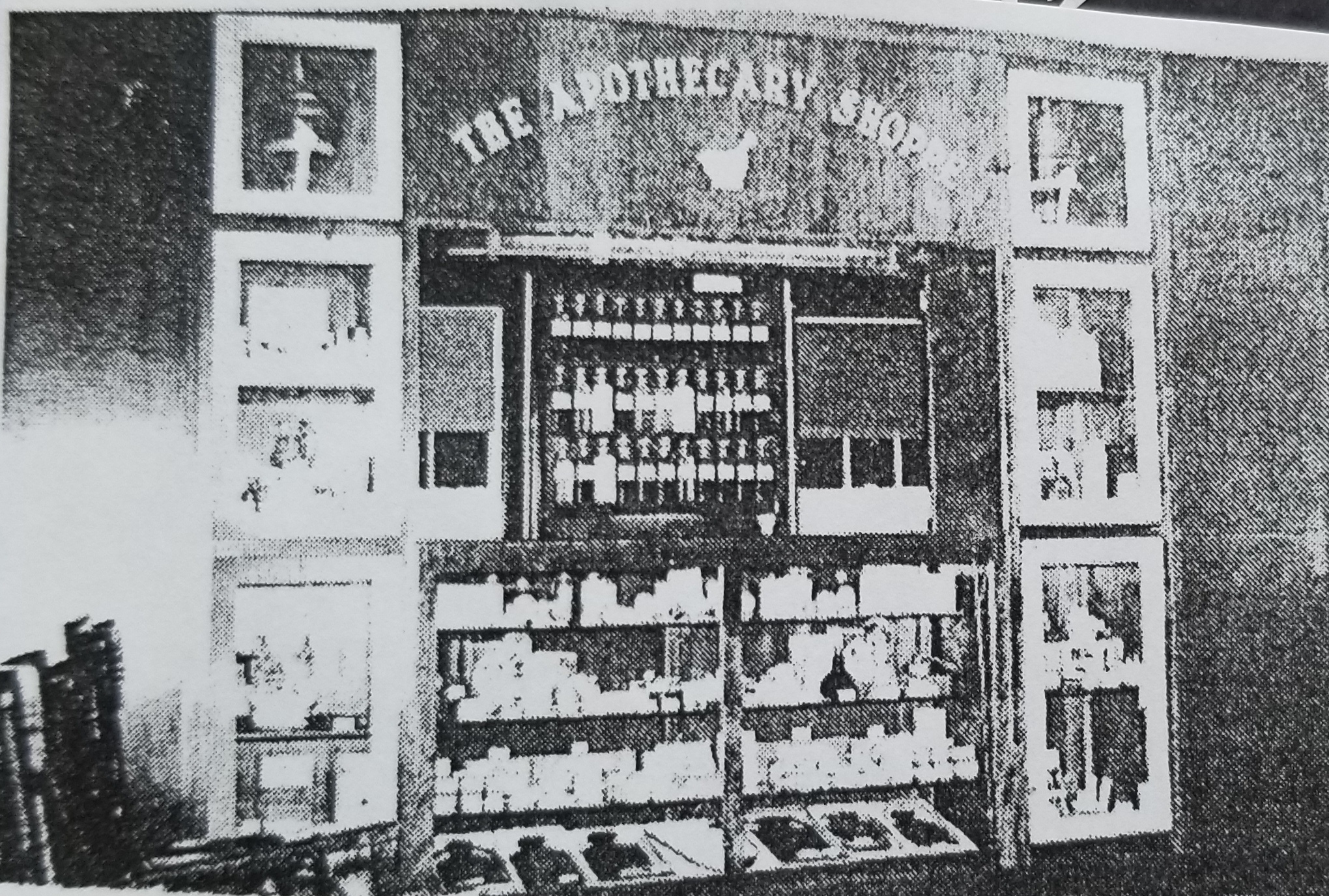
Pictured: The Apothecary Shoppe inside the front entrance of Dr. Hess's office area

    Mary Vaughn (Dr. Hess' daughter) and her husband Bill picked up several of the rocks that were part of the beautiful fireplace on the second floor and took them with them at momentos.  Mary said, "We had a number of pictures taken in front of that fireplace so I just had to have something to remember."  I also took a couple of the rocks to place in the museum.  They were white rocks and two sides were covered with ash from the fire that destroyed the home on February 27th.

    On Monday morning, April 4, the lot was leveled and there was no longer a basement.

...Read more about this and other Bunker Hill, IL historical stories at https://bunkerhillhistory.org/

--Cite this story: The Bunker Hill IL Historical Society. "A Look Back in Bunker Hill History." Bunker Hill Gazette-News, February 2005, February 2, 2017.

Thursday, December 10, 2015

History of the Bunker Hill IL Post Office

Pictured: The present-day Bunker Hill Post Office

    What is known as the Bunker Hill Post Office was established in 1833, under the name of Lincoln.  It was located on a farm one mile south of town, land later occupied by I. A. Smith in 1885.  There is some discrepancy as to who was the first postmaster.  An article in the December 3, 1885 issue of the Bunker Hill Gazette names Anthony Linder as the first postmaster.  Then Centennial edition of the Gazette names John Wilson or John Lunderman.  (See more about the Lincoln Post under blog "True and Tilden's Folly" at https://bunkerhillhistory.blogspot.com/2014/09/true-and-tildens-folly.html )


Pictured: Bunker Hill's first Post Office, Lincoln


    In 1837, Lincoln failed to materialize as a town, and the office was moved to Bunker Hill, but retained its former name.  Josiah Richards then acted as Postmaster.  In the following year, on petition, the name of the post office was changed to Bunker Hill, and Nathaniel Phillips was appointed its first postmaster.

    (Excerpt from the 1911 "History of Macoupin County (pg. 360) states "Anthony Linder was succeeded by a Mr. Cook, , while in 1837, Samuel Buell took charge of the office.  In November of the latter year, the Post Office was transferred to Bunker Hill.  Nathaniel Phillips was the first postmaster appointed after the removal of the office to Bunker Hill.  Josiah Richards then acted as assistant.  In 1837, a post office was also established in Woodburn")

    Mr. Phillips served until his death in 1845, when Judge Philander C. Huggins took charge and removed the office from its location on the lot north of the Congregational Church to his store on the side of George Drew's building on Washington Street.

Pictured: People traveling to Bunker Hill via Stage Coach


    In those days, mail was carried by coaches on the St. Louis and Chicago Stage Line.  The stage arrivals were very irregular and it was no infrequent occurrence for the postmaster to be gotten out at any hour after midnight to change mail.

    Judge Philander C. Huggins held the office about two years when Edward H. Davis succeeded him and removed the business to the "Old Tavern".  About a year later, David Wright circulated a petition asking the appointment of Judge Huggins, and the office was moved back into that gentleman's store building.

Pictured: Railroad Mail Clerks, Lee and Arthur Sutton


    During the term of office, the Alton and Terre Haute Railroad was built and a better mail service was established.  (See "The Big Four Station" blog post at: https://bunkerhillhistory.blogspot.com/2014/10/the-big-four-station.html and "Lee and Arthur Sutton - Railroad Clerks" - https://bunkerhillhistory.blogspot.com/2014/10/lee-and-arthur-sutton-railroad-mail.html )

    In 1856, Judge Philander C. Huggins accepted a legislative nomination and resigned his position.  He was succeeded by Deacon Noah Flanigan, who held the office until the end of Lincoln's administration.

    About the close of the Civil War, Mr. Flanigan was succeeded by E. Atchinson, who served until 1868, followed by Edward H. Davis.  As soon as General Grant was elected president, Mr. Atchinson was reinstated in the summer of 1869.

    In 1872, Mr. Atchinson resigned and was succeeded by F. Y. Hedley.  In November of 1885, T. J. Carroll was appointed.  The following is a list of postmasters following Mr. Carroll:  
  • F. Y. Hedley - September 28, 1889
  • J. S. Klinefelter - October 20, 1893
  • William P. Dickie - January 20, 1898
  • M. M. Brown - February 1913
  • J. H. Truesdale - February 1922
  • Charles M. Jacobi - June 23, 1932
  • Ed A. Bauser - July 1, 1936 (or June 23, 1936*)
  • Edna A. Bauser (Acting Postmaster) - March 5, 1940*
  • Edna A. Bauser - October 10, 1940* (also see "Bunker Hill's Youngest Postmaster", https://bunkerhillhistory.blogspot.com/2014/09/miss-edna-bauser-youngest-postmaster.html )
  • M. L. Kohlenberg (Officer-in-Charge) - August 25, 1972*
  • William E. Vaughn, November 25, 1972*
  • David A. Wolf (Officer-in-Charge) - May 27, 1994*
  • David A. Wolf - June 11, 1994*
  • Lisa M. Pierce (Officer-in-Charge) - November 22, 2013*
  • Lisa Pierce - April 5, 2014*
...Read more about this and other Bunker Hill, IL historical stories at https://bunkerhillhistory.org/

--Cite this story: The Bunker Hill IL Historical Society. "A Look Back in Bunker Hill History." Bunker Hill Gazette-News, December 10, 2015

Thursday, October 1, 2015

Remote Tombstone Connected with the History of Goodnight Trail in Texas


When Willis Wolff, Sr. bought his farm southeast of Bunker Hill in 1938, he was aware of a small one grave cemetery on the property, but didn't learn the full significance of the grave in Texas history until later.

The grave holds the remains of Charles Goodnight, Sr., the father of a man, who went on to become one of the richest cattlemen of the Old West, making his mark as a strong minded, demanding but fair dealing man, who was part of this historic Goodnight-Loving Trail.

Charles Goodnight, Sr., and his wife, Charlotte, moved from Kentucky to Madison County, Illinois in 1828 and crossed over into Macoupin County, where he bought a farm.

Charlie Goodnight, Jr. was born March 5, 1838, one of four children born before Charles, Sr. died in 1840.

The weather worn monument of Charles Goodnight Sr. is enclosed in an iron fence, which is in surprisingly good condition in spite of a tall pine tree, and the effect of cattle in the grazing area of the Wolff farm.

Goodnight Sr.'s wife remarried shortly thereafter and the family moved by covered wagon to Milam County, Texas.  Young Charlie was nine years old and made the journey bareback on a white faced mare named Blaze.

Charlotte Goodnight and her second husband divorced not long after that and Charlie and his older brother, Elijah, went to work for a local merchant for $4 a month.

Charlie was initiated into cattle ranching after his mother married Adam Sheek in 1853.  In addition to his expertise in cattle, he became a tracker of hostile Indians.  After serving in the confederate States War, he resumed cattle ranching.

History books state the fact of the Goodnight-Loving Trail, a previously unheard of journey in which Charlie and Oliver Loving and 18 hands attempted to drive 2,000 cattle from Fort Belknap, Texas to Denver, Colorado.  They made it through with enough of the cattle to give them $12,000 in gold to take back to Texas.  Loving was injured by a Comanche Indian attack during the trail ride and died from complications shortly thereafter.

The story of Charlie's survival is interlaced with his accomplishments: he is credited with inventing the side saddle, creating the chuck wagon, developing a bed tarp, and adapting stirrups and ropes and other gear.

In later years, he and his wife, Mary Ann, opened Goodnight College, one of the pioneer educational institutions of west Texas, and they also built two churches.  Mary Ann died in 1926, and a year later, on his 91st birthday, Charlie married Corrine Goodnight, a distant cousin, with whom he lived for three years before dying December 12, 1929.  Charlie is buried next to his first wife, Mary Ann, in the Goodnight Cemetery near Amarillo, Texas.

Little would Charlie Goodnight Sr. have dreamed that his own son would become a a "cattleman, pioneer, cowboy, trailblazer, Indian fighter, and Texan", a man with no children, but one who left a heritage of undeniable importance to historians across the nation.

Larry McMurtry's Pulitzer Prize winning novel, "Lonesome Dove" is a fictionalized account of Goodnight and Loving's third cattle drive.  Woodrow F. Call represents Goodnight and Augustus McCrae is Loving.  "Lonesome Dove" is the winner of seven Emmy Awards and is one of the highest rated mini-series in television.

Several books, songs, poetry, and the mini-series have been written about Charlie Goodnight:
In 1935, Laura Vernon Hammer published a novelized biography of Charlie, "The No-Gun Man of Texas".
The western novelist Matt Braun's novel "Texas Empire" is based on the life of Goodnight.
The song "The Goodnight-Loving Trail" by Utah Philips.
The songwriter Andy Wilkinson wrote "Charlie Goodnight, His Life in Poetry and Song".
Mari Sandoz's "Old Jules County"
In James A. Michener's book "Centennial, the Skimmerhorn Trail" is based on the actual Goodnight-Loving Trail.
Ralph Compton's novel, "The Goodnight Trail".

...Read more about this and other Bunker Hill, IL historical stories at https://bunkerhillhistory.org/

--Cite this story: The Bunker Hill IL Historical Society. "A Look Back in Bunker Hill History." Bunker Hill Gazette-News, October 1, 2015.

Thursday, August 13, 2015

The Bunker Hill Brick Plant


From the Bunker Hill Gazette, November 30, 1898:

The Bunker Hill Brick Plant stood on the south side of Alton Street adjoining Meehan's Plaza and possibly some ground on the north side.

When Charlotte and Art Thyer bought the property in 1987, there was still part of the old kiln in the basement of the house.  There is a brick basement wall with the date May 26, 1899 and the name John Herbst scratched into it.


A brick in the old carriage house is marked, built in 1910.  The patio is made out of six inch square bricks, one having the date of August 19, 1899.  There are several bricks with the Star of David imprinted on them.  One brick in the sidewalk has the initials J. H..  The carriage house had room for the buggy on one side and on the other side was a place for the horse.  There is a display of bricks from the old Herbst Brick Factory at the museum, donated by Charlotte Thyer.

From the Bunker Hill / Woodburn History Book, March 6, 1889:
Another brick maker in Bunker Hill was Frank Lancaster.  Mr. Lancaster came to this country from England in 1841.  He was the pioneer brick maker in this place, if not in the county.  The first year he was here, he made the bricks for the old Congregational Church.  he then made 50,000 bricks for a massive chimney for the "Old Red Mill".  He also made the bricks for the Bunker Hill Military Academy, and bricks for the stores in the business area.


NOTE: Read more info about Francis Lancaster at https://bunkerhillhistory.blogspot.com/2015/11/francis-lancaster-portrait-and.html

...Read more about this and other Bunker Hill, IL historical stories at https://bunkerhillhistory.org/

--Cite this story: The Bunker Hill IL Historical Society. "A Look Back in Bunker Hill History." Bunker Hill Gazette-News, August 13, 2015, March 12, 2015.

Thursday, April 23, 2015

Francis Lancaster - A Portrait and Biographical Record


Info provided by Portrait and Biographical Record of Macoupin County, 1891

Mr. Lancaster was among the British-American citizens of Macoupin County.  He was a successful, practical farmer, and progressive stock raiser, who lived on a fine farm in Bunker Hill Township.  The tract was comprised of 800 acres, most of which was in a fine state of improvement.  He had owned and lived on the homestead since 1848, and procured most of the land when it was in its unbroken state.

Mr. Lancaster came to the United States in 1841, voyaging on a three mast sailor, the "Ontario", landing in New York City, March 7.  Three years later, he was able to send for his wife and children, whom he had left at the old home.

Our subject was born August 7, 1813, in Buckinghamshire, England.  His father was Joseph Lancaster, a brick maker and fruit dealer by occupation.  His mother was Harriet (Daveny) Lancaster.  She became the mother of 14 children, and four of her sons came to the United States.

After he became of age, he married Miss Elizabeth Collins, who was born in 1812 in the same shire.  He learned the trade of brick making.  She was the mother of 10 children.  Frank married Miss Caroline Hooker; William married Miss Mary Hovey; Elizabeth married Mr. Henry Wise; Mary married Mr. Asoph Barnes; John married Miss Hannah Parmenter; Matilda married Mr. Joseph Barnes; and Joseph married Miss Mary Parmenter.  Harriet and Albert passed away when young and an infant passed away unnamed.

This valuable family stood high in social and industrial circles of Macoupin County .  Its members did much to develop the resources of the section of the country.

NOTE: Read more info about Francis Lancaster in the story about the Bunker Hill Brick Plant at https://bunkerhillhistory.blogspot.com/2015/11/the-bunker-hill-brick-plant.html

...Read more about this and other Bunker Hill, IL historical stories at https://bunkerhillhistory.org/

--Cite this story: The Bunker Hill IL Historical Society. "A Look Back in Bunker Hill History." Bunker Hill Gazette-News, April 23, 2015

Thursday, March 12, 2015

Bunker Hill Tornado - 67th Anniversary


Thursday, March 19, will mark the 67th Anniversary of the Tornado which hit Bunker Hill

March 25, 1948: A terrific disaster descended on Bunker Hill at 6:45 a.m., Friday morning (March 19), when a tornado ripped through this 112 year old city, taking a toll of 19 dead and 126 injured, and left a bumbled mass of wreckage in its wake.  The storm, which rolled over the business and residential areas like a steamroller, smashed brick and frame structures like paper houses, laying 80 percent of the city to waste, and caused damage estimated at one and a half million dollars.

The destructive windstorm also hit North Alton, practically wiped out Fosterburg, a village of 200 inhabitants about 15 miles southwest of Bunker Hill, struck south Gillespie, causing great damage, and wrecked many farm homes along the entire route....read entire article reprint at  https://www.bunkerhillhistory.org/Tornado.html

From the Bunker Hill Gazette News, April 23, 2015:


Ironically, this was taken after the tornado in 1948.  The man on the left is my late father, Reno "Blackie" DalPozzo, who worked at Bahn's in Bunker Hill.  The morning of the tornado, my dad told the story that he had the truck at home and it was raining.  He forgot his umbrella and raincoat and went back in the house to get them, may have actually saved his life.  The truck stalled out in the bottoms on Bunker Hill Road and he saw the tornado go overhead.  When he got to Bunker Hill and saw the damage, he realized how lucky he was.  Having spent his time in the Army during World War II as a medic, he volunteered to help with the injured.  He never gave any details about that day other than the fact that someone was looking out for him that morning.

He couldn't seem to remember who the man on the right is.  Perhaps your readers will help with that question.  
 ---Photo compliments of Cindy (DalPozzo) Leonard, Staunton.

...Read more about this and other Bunker Hill, IL historical stories at https://bunkerhillhistory.org/

--Cite this story: The Bunker Hill IL Historical Society. "A Look Back in Bunker Hill History." Bunker Hill Gazette-News, March 12, 2015, April 23, 2015

Thursday, February 5, 2015

Fire Chief Ed Gerdes

Pictured: Bunker Hill Fire Chief Ed Gerdes

Reprinted from the Gazette-News, January 8, 1970

    Ed Gerdes, Chief of the Bunker Hill Fire Protection District, is observing his 88th birthday today.  He is likely doing the thing he does nearly everyday, tending to matters at the firehouse in Bunker Hill. He has been a member of the Bunker Hill Fire Department for nearly 42 years.

    Chief Gerdes joined the fire department in 1928, and became chief in 1939.  He was chief when the present fire protection district was formed in 1950.

    He is chief of one of the largest fire districts in the state, with boundaries in two counties, from Prairietown and Dorsey on the south to near Wilsonville, Dorchester, and Plainview on the north, and near Brighton on the west.  There are more than 800 farms in the district, as well as communities of Dorsey, Prairietown, and Shipman, each of which has its own fire company with a pumper and firehouse.  The Bunker Hill Company has two pumpers and an emergency truck.

Pictured: Bunker Hill Firemen surveying the 1948 Building Tornado Damage


    Naturally, he has many memories of fires in the past.  Some are tragic while some incidents were humorous.  He recalls the time the old Reo truck caught fire.  It was at the farm of Jake Mamie.  Jim Jencks was chief then and had the fire truck close to the burning house to pump from a well or cistern.  The wind shifted and the fire was too close.  The hose had to be cut to get the truck away from the building.  Before that was accomplished, the seat had caught fire.

    Gerdes was born and reared in St. Louis.  He came to Bunker Hill at the age of 18.  He went to work on the farm of his uncle, George Gerdes until he was 21.  Then he started working at other places.  At the condensery, the Bunker Hill coal mine for 17 years, then worked at the water works for 13 years.  He worked at the Ford garage and also did carpentry and electrical work.

Pictured: The Bunker Hill Fire Department (date unknown).  Firement andn horses pose before the old firehouse which was replaced in the 1940's


    The task that he has been doing since the flagpole was built uptown, and continues to do (except when the Christmas lights are up) is to raise the flag each morning and lower it each evening.  He is the only one who performs this task, except when he is ill.

    Behind Ed Gerdes is his wife of 64 years, the former Elizabeth Sneeringer, to whom he was married January 26, 1916 at St. Mary's parsonage.  They moved to Bunker Hill two years after their marriage and have resided on West Warren Street since 1918.

...Read more about this and other Bunker Hill, IL historical stories at https://bunkerhillhistory.org/

--Cite this story: The Bunker Hill IL Historical Society. "A Look Back in Bunker Hill History." Bunker Hill Gazette-News, February 5, 2015.