Provided by Carlos Arzuagas in cooperation with the Bunker Hill Historical Society, Bunker Hill, IL. 62014
Thursday, March 31, 2022
History of the Bunker Hill Gazette
Thursday, March 17, 2022
Bunker Hill City Library
From the Bunker Hill Gazette-News October 1950
The J.H.L. Fahrenkrog building on Warren Street has been purchased by the local library board at a cost of $1,500 and will house the Bunker Hill Library. (Today, the City of Bunker Hill owns the building which housed the Bunker Hill Historical Society and Museum.
The Bunker Hill City Library will open for public use Saturday evening, October 7. The opening will be held although there are some minor details both inside and out of the building yet to be finished.
The new library is located on East Warren Street and occupies the site of the library and contents that were destroyed in the March 1948 tornado. Although the building had been completed for some time, opening has been delayed because of the limited budget on which the board has to work.
Much of the equipment has been donated. Two desks were given by Dr. and Mrs. George Hess and one each by Mr. and Mrs. W.E. Haxel and Mr. and Mrs. R.E. Rigg. Some steel cabinet and six chairs have been purchased by the board. It is pointed out that more chairs are needed and if anyone has some spares they would be gladly accepted for use at the library.
Some 300 books have also been donated to start off the new library. Mr. and Mrs. F.A. Wende of Winnetka, IL have given 195 books and others have been given by Mrs. B. Deffenbaugh of St. Louis, MO., and Mrs. Bella Zimmerman of Beloit, WI., who donated a book in memory of her son.
Mrs. Theo Stone of St. Louis has donated a number of books which she collected there from members of the book club.
As books come into the library, they are catalogued [sic] by a library committee of which Mrs. O.C. Weidner is chairman. This committee has received the help of several interested citizens in their work.
For the opening, six cases of books from the State Library will be on hand. These are made available on a loan basis. By receiving books from the state, much good reading is provided for both children and adults. Miss Loretta Bartels will continues as librarian as she has done for many years in the past.
The new library building is a modern fireproof structure, with buff brick front. The interior has been finished in a light green plaster and it is heated with an oil furnace. Ralph Moxey installed the heating plant free of charge.
Members of the library board, of which R.E. Rigg is chairman, are Lee Sutton, Walter Heal, Goebel Ladd, max Bertagnolli, Clara Mason, Cora Fensterman, Mr. O.C. Weidner, and Mrs. L.O. Schreier, who is secretary. Board Committees will be working at the library Thursday and Friday getting ready for opening on Saturday. At the opening, a free souvenir book markers will be passed out to all who attend.
Thursday, March 10, 2022
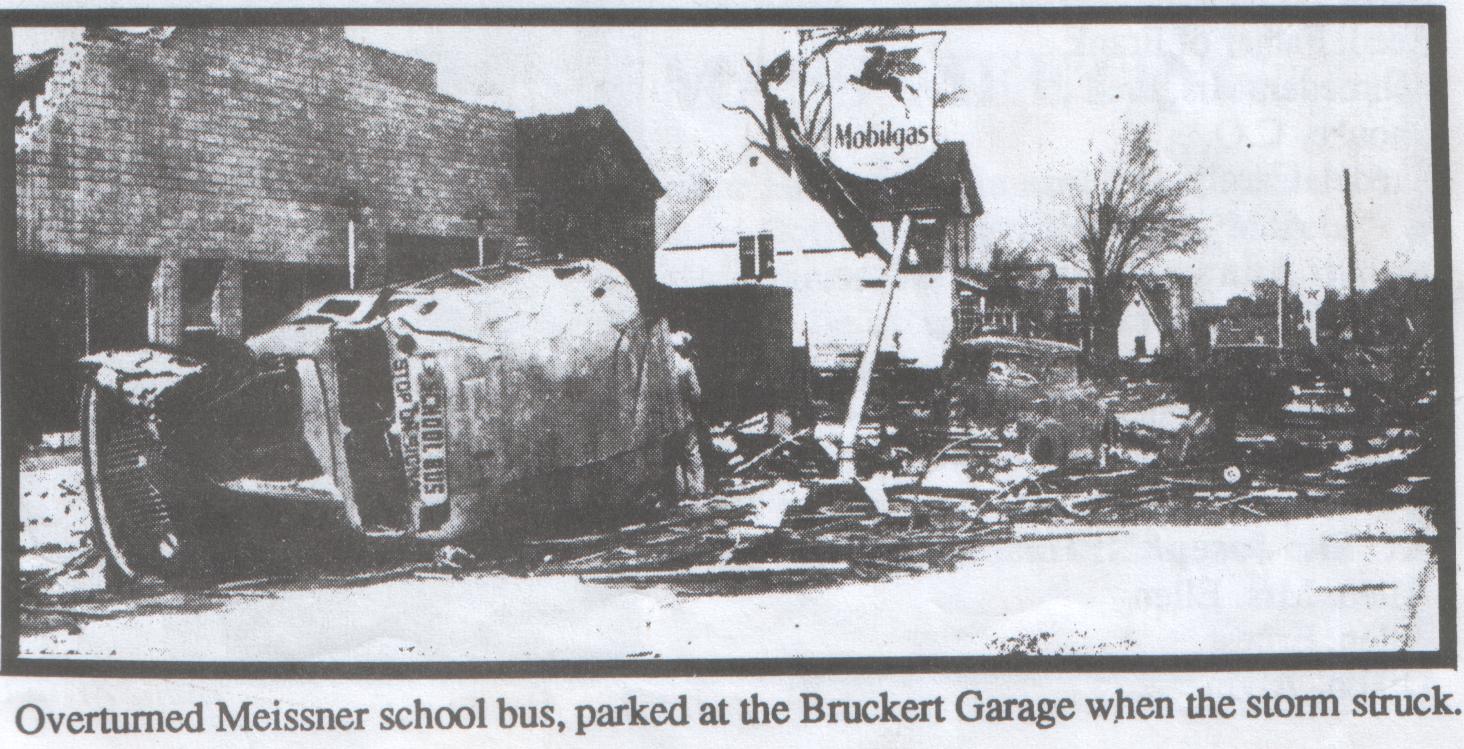
Ed Bruckert's School Buses
Thursday, March 3, 2022
Mercers' Confectionery
From the Gazette-News - August 1951
Roger S. Mercer is holding a formal opening of his newly built confectionery on Saturday. The new business, located between the C.M. Miller Card Co., and "Tickles" Barber Shop, is a fine addition to the business section of town.
The confectionery is 18 x 50 feet in size and is of concrete block construction. It has a perma-stone front, done up in brown and white, and is pleasing to the eye. Another building, east of the confectionery, purchased by Mercer from C.M. Miller, has also been given a perma-stone front. Equally attractive is the interior of the new building, which has been finished entirely in natural color knotty pine. All new fixtures have been installed. These include a large fountain, counter and stools, booths with red and green plastic coverings and a showcase and coolers necessary for the operation of such a business.
Full kitchen facilities are provided behind a partition toward the rear of the building. In addition offering smokes, soda, candy and a fountain service, a complete line of sandwiches will also be offered patrons.
In a statement on his opening Mercer said that it isn't going to be as formal as you might expect in that he has already been pouring coffee and dishing up ice cream for about a week. Saturday will be the first day the full facilities of the store will be put into operation and he says it will be "just come as you are".
Mercer formally operated a similar business across the street from his present location on East Warren Street and without a doubt many of his friends are glad to see him back at his old work. This newspaper, as we are sure many other people have already cone [Sic], congratulate him for making such a fine addition to the business district.
Thursday, February 17, 2022
The Fires of Bunker Hill
Reprint of our earlier Bunker Hill News article blog postings at https://bunkerhillhistory.blogspot.com/2015/05/the-fires-of-bunker-hill.html and also at https://bunkerhillhistory.blogspot.com/2020/04/the-fires-of-bunker-hill.html
From Bunker Hill Revisited Volumes - One and Three
Pictured: Washington St., as viewed from the Opera House corner. Sanford's south wall on right.
The fire January 23, 1880, originated in Sanford's Grocery Store on the same ground. The damage on the fire proper footed up $12,000. The insurance was fair.[1]
The local fire company did noble work with the fire engine, chemical, and new extinguishers and were nobly seconded by many of our people. To such effort is due the arrest of the fire at the Johnston block and the saving of the business property on the east side of Washington Street.
As near as can be ascertained the fire losses were $75,000. This includes damage to buildings and stocks not destroyed.[3],[4]
Thursday, February 10, 2022
History of the Round Prairie Church
The first church to be erected was by the Christian denomination at Round Prairie, Section 32 in Dorchester Township, in the year 1845. This church would have been about two miles east of the Willis Wolf farm on the Catholic Springs Road. The first ministers were Robert Foster and Jonathan G. Wood.
The following is from the records of the church:
Round Prairie Church was organized July the first in the year of our Lord eighteen-hundred and forty five by appointing the following named persons to the office of the Eldership to wit: John P. Bayless, Samuel Wood, and Hiram Daugherty, and John Nesbit as Deacon, at the same time. About 1849, John W. Keller was added to the list of Elders and resigned in 1854 and Johnson McGilvary and W.S. Spruill were ordained as Elders and Levi Miller and William Nesbit were ordained Deacons at the same time. Johnson McGilvary went off to the Army in 1862 and died. In 1874, there was added to the Eldership, Peter C. Randle, Albert L. Fairchild, Benjamin Mize, and William Soapes to the Deaconship. Elder Fairchild moved his membership and died March 12, 1881. Scott Mize was added to the list of Deacons by the church and Sanford Mize at the same time was appointed as an assistant clerk for the church of Round Prairie.
January 1, 1865, a subscription for the support of a minister at Round Prairie Church, eighty nine dollars contributed by 16 people.
--Cite this story: The Bunker Hill IL Historical Society. "A Look Back in Bunker Hill History." Bunker Hill Gazette-News, February 10, 2022, April 7, 2022.
Thursday, February 3, 2022
Ordinances of the City of Bunker Hill - 1873
Organized April 15, 1873, under the general law of the State of Illinois
City Officers 1873
Mayor: James F. Cummings
Aldermen for two years: S.A. Fletcher; E.S. Williams; and David Morris
Aldermen for one year: H.H. Brown; C.A. Bartels; and John Gosch
City Clerk: S.N. Sanford
Treasurer: John G. Auer
City Attorney: H.R. Budd
An Ordinance relating to misdemeanors:
Sec. 17: Whoever shall, without the consent of the owner or occupant of the premises, fasten any horse or other animal to any tree or to any boxing place around any tree, shall forfeit and pay the sum of not less that one dollar.
Sec. 19: Whoever shall purposely, rapidly, or immoderately ride or drive any horse or mule, or any cattle, or other like animals, or any team in any street or alley of the City of Bunker Hill shall forfeit and pay for each sum of not less that ten dollars.
Sec. 37: The running of large cows within the city limits of the City of Bunker Hill, between the 15th day of November and the 1st day of April each year, shall forfeit and pay the sum of one dollar for each cow, and in addition, shall pay the sum of one dollar for every twelve hours said cow shall continue to run at large.
Sec. 42: Any person or persons who shall within the city limits carry any concealed on their persons any knife, Bowie knife, pistol, revolver, slingshot, or any dangerous or deadly weapon for the purpose of unlawfully using the same, shall forfeit and pay the sum of not less than twenty-five dollars.
Sec. 44: That any person or persons who shall ride, lead, or drive any horse, mule, or ox upon or over any plank or brick sidewalk within the city limits shall on conviction thereof, be fined not less than three or more than ten dollars.
Thursday, July 15, 2021
Restoration of the Lincoln Statue
Restoration has begun on the Lincoln Statue after delays last year due to COVID-19. The company hired to do the restoration is Russell-Marti Conservation, Inc. from California, Mo.
The last conservation treatment was in 1998. At that time, the statue was cleaned of corrosion with glass beads, and then given a hot chemical patina, followed by successive applications of protective coatings.
General treatment step this time will be:
1.) Remove all loose, deteriorated coatings from the surface by cleaning with CO2 (carbon dioxide, or dry ice) blasting. The CO2 cleaning method was used as part of recent conservation/maintenance treatments in St. Louis, including the Apotheosis of St. Louis (in front of the St. Louis Art Museum), the Meeting of the Waters (at Aloe Plaza, across from Union Station) and on sculptures at the St. Louis Art Museum.
2.) Wash the bronze, using water and non-ionic surfactant, rinse and dry.
3.) Apply a clear lacquer by spray, building up the coating in successive thin applications.
4.) Apply a toning layer to adjust the patina as necessary
5.) Apply a final clear lacquer.
While conservation treatment will stabilize the sculpture and bring it to an appropriate and well cared for appearance, routing annual maintenance is important to preserve the effect of the treatment over the long term.
The Lincoln Statue was donated to the City of Bunker Hill in 1904 by Capt. Charles Clinton. Most of the men in Capt. Clinton's Civil War Unit were men from Bunker Hill. He had such high regard for these men that he decided to donate a statue of Lincoln identical to the one which he donated to his hometown of Cincinnati, OH. There are two other statues in Iowa, but they do not have the Lady Liberty. These statues were donated by other individuals. All of the statues were sculpted by William Granville Hastings.
Further information about the History of our Lincoln Statue can be found on our blog posting at https://bunkerhillhistory.blogspot.com/2015/01/lincolns-statue.html
Thursday, July 8, 2021
The Bunker Hill Train Wreck of August 1857
From the Missouri Democrat, August 17, 1857
Accident on the Terre Haute, Alton and St. Louis Railroad
On Saturday evening, about eight o'clock, as the westward bound passenger train on the Terre Haute, Alton, and St. Louis railroad had reached a point about one mile from Bunker Hill, IL, the locomotive broke through a bridge, which was constructed over a small creek or ravine. The baggage and express cars were, at the same time, precipitated beyond the engine and down a steep embankment.
The car next to the emigrant car, containing a number of ladies and gentlemen, fell in after the engine and was turned up on its forward end. At the time of the accident, a hard thunderstorm was prevailing, which added to the terror of the occasion. Another thing which contributed to the dismay of the passengers was the communication of fire to a portion of the train by the explosion of the engine. The flames, notwithstanding the rain, were spreading rapidly, but by the exertion of the passengers were subdued.
Edward Warden, fireman, was instantly killed. Mr. Wilcox, engineer was badly hurt and burned. The baggage master of the train, whose name we were unable to obtain, and B. Deming, a brakeman, were hurt, but not seriously.
As if the heavens had conspired to add terror and death to the scene, a little girl, daughter of Mr. Templer, was struck by lightning just after the explosion of the engine took place, and was instantly killed.
Edward Warden died on August 16, 1857, and is buried in the Bunker Hill Cemetery.
Thursday, May 13, 2021
"Carrie was There" - A Caregiver to Many
This article was submitted by Carol DuFrain, granddaughter of Carrie Braash
When my grandmother's name is mentioned in this area, someone usually recalls a time when "Carrie was there". She was involved with many families on the occasion of the birth of a son or daughter and, in this way, was an important part of the history of this area.
She was well known for assisting Dr. Bley and Dr. Hess with home deliveries and the aftercare of the mother and baby. According to a record kept by her, she cared for over 350 babies over a 23 year period. The first baby noted was Irma Bartels in 1921 and the last was Joyce Adcock in 1944. There were some years in the 1930's when she helped with as many as 40 in one year.
She became a widow with three small children in 1917 when my grandfather, Charles, passed away. She moved to Bunker Hill in 1929. Her children were Dorothy, Marcella, and Otto. She had four grandchildren and raised one of them from age three.
She was also known for her beautiful quilts and her work as a member of Zion Lutheran Church. She is fondly remembered by many for her kindness and "always being there" to lend a helping hand.
Carrie passed away in 1965 at the age of 80. A great-granddaughter she never new bears her name.
Thursday, March 18, 2021
Bunker Hill Digs Out in Cold, Dismal Sunday Rain
Read more about the Bunker Hill Tornado in our March 19, 2020 blog posting at https://bunkerhillhistory.blogspot.com/2020/03/72-years-ago-march-19-1948-tornado.html and also our November 2015 blog at https://bunkerhillhistory.blogspot.com/2015/11/bunker-hill-tornado-67th-anniversary.html
From the Alton Telegraph, March 20 and 22, 1948
In a cold and dismal rain that began falling yesterday, efforts continued in the little town of Bunker Hill to open streets and clear debris from around dwellings that could be used as shelters. This is the second time in "10 days less than 10 years" that a tornado struck the town which is the center of a dairy and farming community. The town was established about 1835 and until the tornado of 10 years ago, a storm of such proportions had never swept the locality.
Pictured: Bunker Hill Main Business Area - This photo taken Saturday morning after debris had been cleared from the streets shows the damage done to the city's business areas. Roofs were torn off and buildings demolished by the hard-hitting tornado.
Headquarters for John Ritter, assistant chief, State Police, have set up in a trailer in the parking space on Route 112 in the mid-section of the business district. It stands only a few feet from the base of the statue of Abraham Lincoln. The statue itself, almost life size, is lying headless against the north side of the base, when it toppled backward early Friday morning. On the south side kneels the figure of a woman with hand posed, as in writing, but without the pencil, that was formerly hers, who is ready to complete the sentence, "With malice toward none."
A few feet to the north of the statue, is the tent, where help is administered by the Salvation Army. Military personnel and citizens alike were loud in their praise of "The Army". The Red Cross headquarters is established in the Meissner High School building, where the roof, badly damaged, admitted the pouring rain. A first aid station functioned there after the tornado and remains to continue further efforts if needed. Various desks and offices to house records and equipment for the management of the huge task, occupy hall space and parts of other rooms, wherever a small space can be found. A registered nurse, Miss Phyllis Baker, and a high school music teacher, Mr. Pal Byron Hale, a medical corpsman in World War II, aided Dr. C.W. Draper and Dr. Lusk of Carlinville, in setting up an aid station at Meissner High School, where 74 patients were registered. Doctors estimated that 150 had been treated at the school, a home, a business district store, and the three aid centers. Six dead lay in one room of the school awaiting the coroner. Arrival of the coroner and additional State Police was a welcome relief for Mrs. Ethel Herndon, who stood guard at the door of the improvised morgue.
Pictured: Meissner School set up as a Red Cross Headquarters
The once proud town, with its wealth of historical background, is leveled. Only the school building stands among the major building, and a few of the houses are habitable. but with agencies of the government and charity converging on the town, it was digging its way out.
Thursday, February 25, 2021
Smalleytown and Pleasant Hill Schools
Smalleytown School #162
Smalleytown School was located on Miles Station Road, Bunker Hill Township in Section #3.
In 1906, Mrs Frances (Smalley) Pennington was the teacher and she had 24 students and her salary was $40 per month.
In 1919, Edith Pyle was the teacher and she had five students. Edith Pyle received $50 per month.
In 1921, Charles F. Keirle was the teacher and he had five students. Mr. Keirle received $75 per month.
In 1922, Mrs. Gladys Smith was the teacher and she had six students. She received $75 per month.
In 1944-45, the school had a radio and warm lunch programs heated on an electric plate. The last annual report was 1947-48 and the last teacher was Mrs. Laura Snedeker. When the school closed, the students had a choice of where to go. Three girls chose Woodburn School and the three boys went to Bunker Hill.
Some of the many families who attended Smalleytown Schools were Olmsted, Howald, Pennington, Barnes, Bort, Jacobi, McCurdy, Heal, and Brummer.
Pleasant Hill School #165
Pleasant Hill School was located in Bunker Hill Township in Section #26. Today, that is Rust Road.
In 1907-08, Mary Aveiss, teacher, had 25 students and received #35 per month. The tuition for each student per month was $1.40. In Mary Aveiss' teachers report, she stated that the blackboards needed repairing badly. Chicken pox and bad roads had a lot to do with the poor attendance. The schoolhouse is very much in need of repair. I, with the help of a 12-year old boy, built a little porch to keep the mud at least a short distance from the door.
In 1920-21, Chester Kehr was the teacher. There were 15 students and Mr. Kehr received $85 per month.
In 1924-25, Miss Claribel Seim was the teacher. She had 13 students and received $74 per month. The school director was Anton Bruckert.
Some of the many families that attended Pleasant Hill School throughout the years were Rust, Haneghan, Zarges, Sauerwein, Goebel, Bunte, Enke, Ladenforf, Bixen, Bruckert, Duelm, Goodwin, Foreman, Altevogt, and Moulton.
Thursday, January 21, 2021
The Millville School #163
In 1911, teacher Gertrude Love made $40/month and had 22 students. In 1920, the schools was listed as a brick building with six windows. The students had new desks and sold buttons at 10 cents each to buy books for the new library.
Some of the many families that attended Millville Schools through the years were Rose, Farris, Keirle, Gosch, Rull, and Acuncius.
Millville School was sold July 8, 1950 to LaVerne Gosch and used for a home.
Thursday, January 7, 2021
Luken School #160
In 1909, there was still no library because the books were destroyed by people who slept in the school. By 1915, the school had 38 books, blackboards, and slates.
In 1944-45, three students were transported to Dorchester #135 and to Bunker Hill #164, which was Meissner School. The building was destroyed in the 1948 tornado.
Some of the family names who attended Luken School were: Bohlmeyer, Knoche, Jarman, Johnson, Rose, Sauerwein, Wieseman, and Scheldt, many attended during the years.
Thursday, December 31, 2020
The Nesbit (Mize) School #50
March 11, 1860, Miss Mary Sinclair, the first teacher, was paid $24 a month. The district boarded the teacher if the family had no children in school. The family received $2.00/$2.50 per week for boarding.
In 1870, Benjamin Mize repaired the school for $40 for replacing glass and sealing the windows, patching the plaster and preparing the walls for painted blackboards. Wood for heating the schools was provided by the parents. The teacher was paid $30 at this time.
In 1882, a new schoolhouse was built by G.W. Mize at a cost of $80. Waste materials salvaged from the old school, built a fence for $8. Members of the Mize family served for many years on the Nesbit-Mize School Board of Directors. The school was sold at auction on July 8, 1950 to William Cooper and torn down for lumber.
Some of the many families who attended Nesbit-Mize Schools were: Mize, Sawyer, Tiek, Kurlhaum, Throne, Coatney, Wood, and Landers.
Thursday, December 24, 2020
The Woodburn School #167
In 1917, Mr. Charles Welch taught at Woodburn School for $70 a month. By 1952, Woodburn was the only other school, besides Meissner School that was in operation in Community District #8. It had an enrollment of 59 students and had three rooms to accommodate them.
Mrs. Mildred Pullen had grades one through four and Asbury Walk had grades five through eight.
The building was enlarged to nearly double its former size in the summer of 1950. An addition costing $12,250 was made to the rear of the school and was used by Mr. Walk's classes. Mrs. Pullen's classes occupied the south room in the original building. The other room was used for a recreational room in winter months and also as a study hall.
There were many families that attended Woodburn School through the years. Some of these families were Thyer, Wood, Buhs, Howald, Welch, Ray, Pennington, Dana, Morey, Schwallenstecker, and Heal just to name a few.
Thursday, December 17, 2020
The Liberty (Benner) School #166
Pictured: Map of Bunker Hill's Country Schools
Mrs. Mildred Pullen taught from 1944 to 1947. Her salary was $150 per month. The school then had a piano, radio, art equipment, maps, glove, and linen window shades.
Some of the families who attended the school were: Wood, Heutte [sic], James, Brenker, Gabriel, Partridge, Johnson, and Buhs. Many more families attended during the years.
Thursday, July 16, 2020
Bunker Hill's 8 o'clock Whistle Tradition
February 20, 1903: The early closing problem, so mythically solved by some of our businessmen, has become rudely intricate after a brief existence of one week. There was apparently no peace in such an arrangement from the beginning, and it was not uncommon each evening to see some of our good merchants standing in the by-ways and alleys, or peering around the corner to ascertain whether or not the other fellow had really closed up. One evening, an unfaithful brother was spied selling a pair of shoes after the hour for closing, and then the dander was up. Two or three others threw open their doors and declared they would keep open until midnight. This led more to lay themselves liable to breach of promise, and the whole thing, it seems, has been thrown up. We suppose our merchants think it is soon enough to shut up when the sheriff comes around.
By special arrangement the hour of closing of the stores in Bunker Hill has been changed from 7 to 8 o'clock. The curfew blast of the lighting plant whistle at 8 o'clock will give notice of the closing of stores. All merchants who signed the former agreement have pledged their word of honor to stand by this agreement, which became effective last evening.
That began the tradition of the 8 o'clock whistle. For years, the children of Bunker Hill, mine included, knew when they heard the 8 o'clock whistle, it was time to be in their own yards. The whistle is a 117 year old tradition. I suppose today's children don't hear the 8 o'clock whistle because they are in their houses on their electronic devices. Depending on where you live in town, and depending on the direction of the wind in the evening, you many not hear the whistle. This is a tradition unique to our town.
Thursday, July 9, 2020
The First Bunker Hill-Woodburn July 4th Celebration
In 1839, the whole community turned out, some 60 people in all, for the town's first 4th of July celebration. A liberty pole (flag pole) was raised, the Declaration of Independence was read, toasts were made, and much good food eaten. This celebration took place on the ground in the area now occupied by United Community Bank. On that same holiday in 1842, over 400 people participated in the celebration and listened to the Upper Alton Band. On July 4th, 1844, 350 citizens, headed by the Bunker Hill Band, went to Woodburn, and there met the Alton Band.
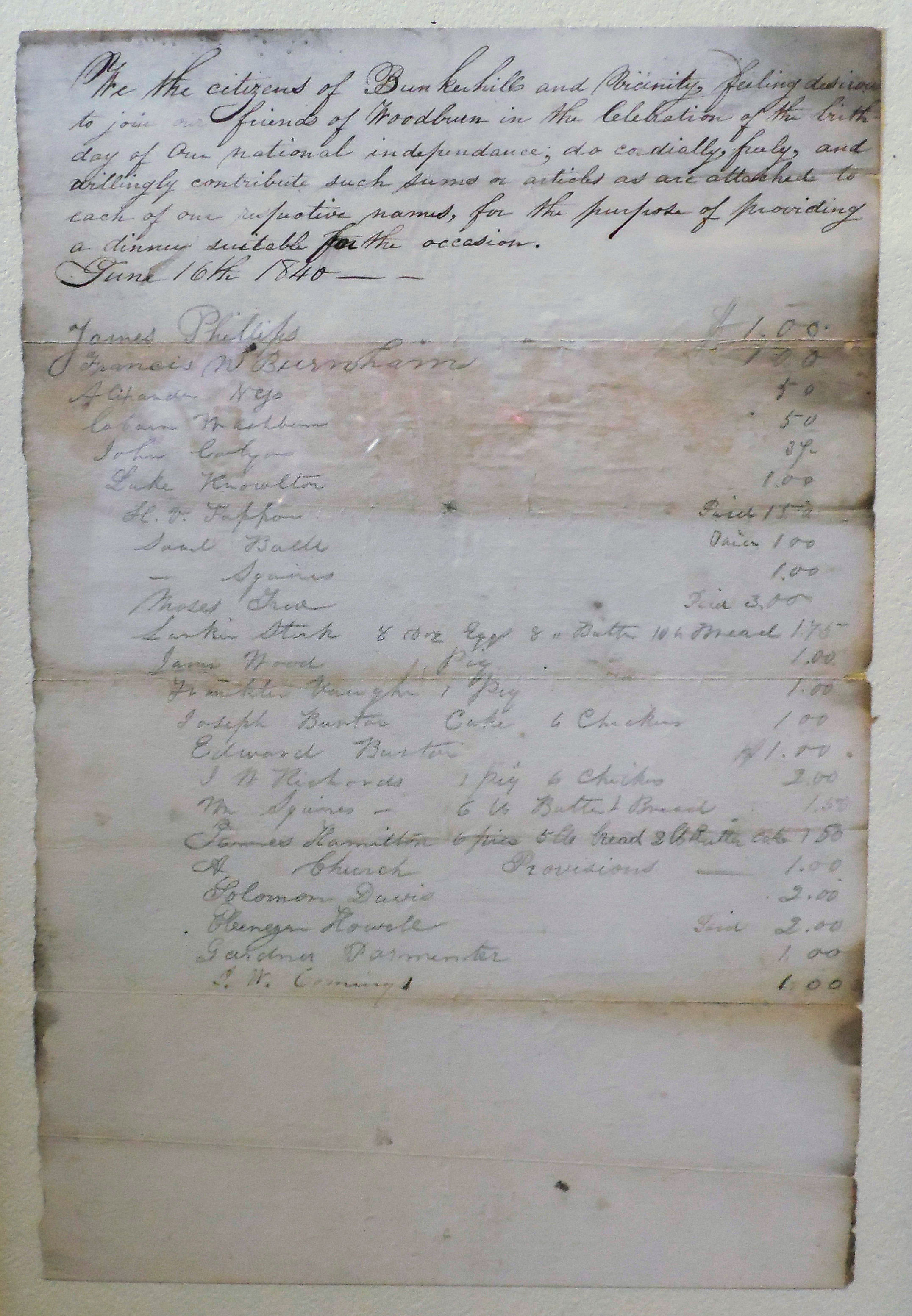
The paper below dated June 16, 1840, was found by carpenters when Dr. Hess remodeled his office in 1951. The article was in preparation of the upcoming July 4th celebration. June 16, 1840: There was said to be a crowd of 600 to 700 people in attendance.
- James Phillips, $1.00
- Francis W. Burham, $1.00
- Alexander Nys, .50
- C. Washburn, .50
- John C. ?
- Luke Knowlton, $1.00
- H.V. Hopper, $1.50
- Samuel B. ?, $1.00
- ? Squires, $1.00
- Moses True, $3.00
- Larkin Stark, eight dozen eggs, eight pounds of butter, 10 loaves of bread, and $1.75
- James Wood, one pig, $1.00
- Franklin Vaughn, one pig, $1.00
- Joseph Burton, cake, six chickens, $1.00
- Edward Burton, $1.00
- J.W. Richards, one pig, six chickens, $2.00
- Wm. Squires, six pounds of butter, bread, $1.50
- James Hamilton, six pies, five loaves bread, two punds of butter, cake, $1.50
- A. Chruch, provisins, $1.00
- Solomon Davis, $2.00
- Ebenezer Howell, $2.00
- G. Parmenter, $1.00
- A.W. Cummings, $1.00