Thursday, March 12, 2020

Monument House - Bunker Hill's "Grand Hotel"


The Monument House
 was located in the northwest block of Fayette and Clinton Streets.

This is a follow up expanded story from my earlier blog posting which can be read at https://bunkerhillhistory.blogspot.com/2015/03/the-monument-house-hotel.html


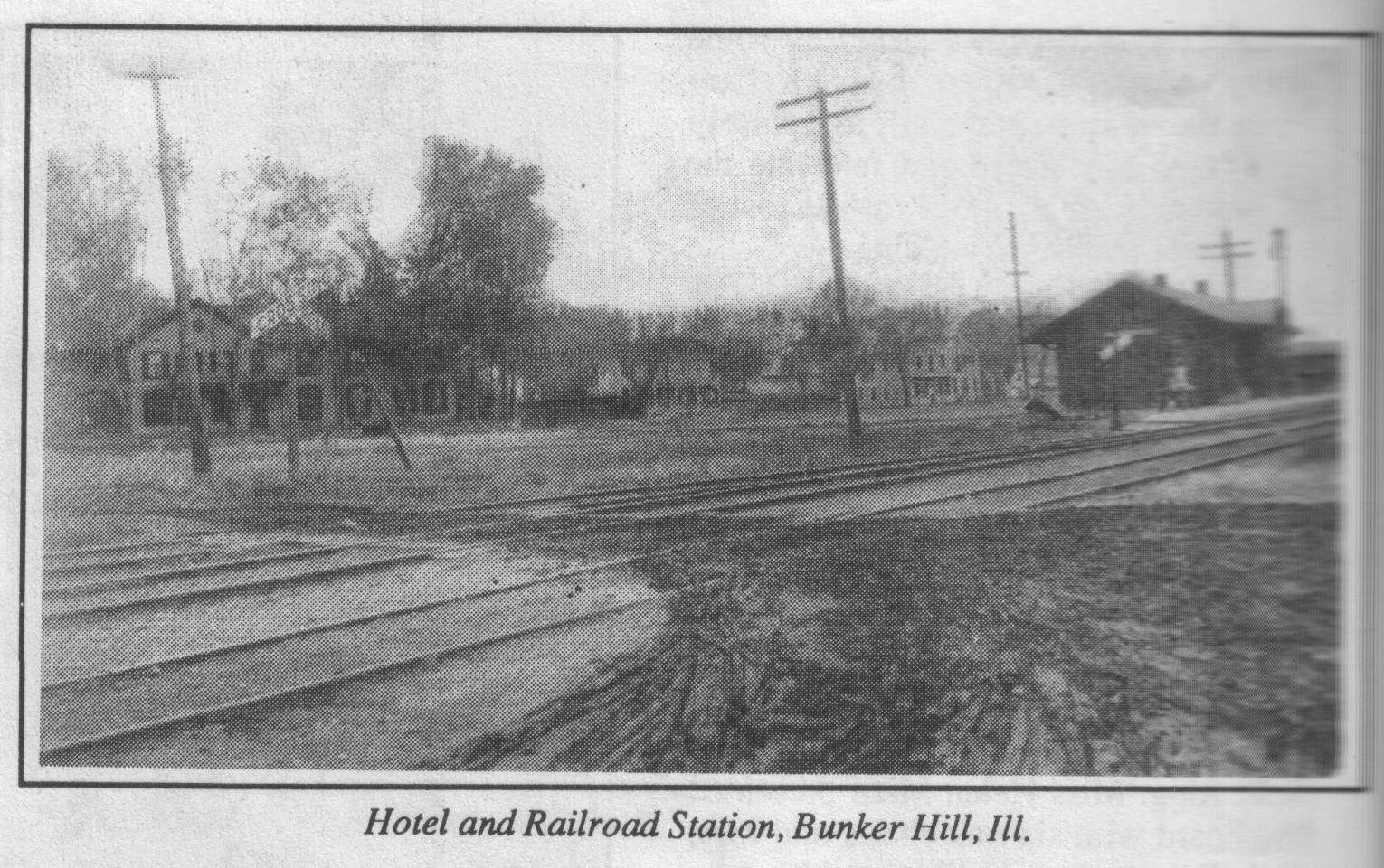
    Through the early years of the old Bunker Hill Gazette ran comments and references to the Monument House, Bunker Hill's grand hotel.  How old it was, exactly, we cannot say, but the following article on the Monument House appeared in the Aug. 5, 1896 issue of the Gazette, and we found it interesting.  A small picture appeared with the article, however, it is not fit for reproduction.  Should anyone have a picture of it, preferably during its grand days, bet even in its later years, we would appreciate the use of it.


August 5, 1896 --  One of the greatest events in the history of Bunker Hill, was the opening of the Monument house, which took place in 1856, under management of Mr. William H. Carroll (now long deceased).  This became one of the most famous hostelries between the Alleghenies and the Mississippi.  The Indianapolis & St. Louis Railway (then the St. Louis, Alton and Terre Haute) and the Ohio & Mississippi were then the only lines between St. Louis and the East and the passenger travel over the former was very heavy.  All through trains stopped here for meals and the table service was so excellent that the house was noted far and wide.  (See "The Big Four Station" blog post at: http://bunkerhillhistory.blogspot.com/2014/10/the-big-four-station.html and "Lee and Arthur Sutton - Railroad Clerks" - http://bunkerhillhistory.blogspot.com/2014/10/lee-and-arthur-sutton-railroad-mail.html ).  After the death of Mr. Carroll, the house passed through several hands, and some years ago burned. down.

    The name by which the famous old hotel went, has been resurrected in connection with the practically new house on lots adjoining the old one.  The engraving above shows the appearance of the new establishment.  In its renovation and furnishing, the owner, Mr. John R. Richards, has spared expense in no direction, and in the completion of his work he has reared a Monument to his own good taste and liberality, as indeed he has in such a handsome adornment to the city as his own residence, and in such a substantial addition to our business interest as in the Foundry.  That he has been highly successful in his work goes without saying.  The arrangement of the house is most complete for managers and patrons' one more comfortable or more handsomely furnished will not be found in any interior town.


    The building is frame, covering 33 by 75 feet, two stories high throughout, with porches and verandas on three sides.  The painting is fresh and tastefully contrasted in colors, and the tall grassed, abundantly shaded grounds, unmarred by fence, make handsome exterior surroundings.  Adjacent on the west and north are well grassed lawns.

    The lower floor contains office, parlors, dining room and kitchens, with good dry cellar under all.  The office is abundantly lighted with windows on north and south, and is wainscoated with oak.  The furniture is heavy well polished oak, upholstered in green leather.  There is a capacious safe, and the large clock on the wall is a handsome ornament.

    The ladies parlor is carpeted with Brussels of elegant pattern; the furniture includes some rich plush pieces; the wall and ceiling papering is rich and tasty, as it is throughout the house.  Across the hall is another parlor, which may be utilized as sample room or bed room; the furniture is well polished oak.

    The dining room is cheerful and well-lighted, and furnished with latest design of furniture in oak, the principal ornament being a very fine sideboard.  The room contains four dining tables which will accommodate twenty-four guests.

    The kitchen and pantry are models of convenience, containing a capacious range, reservoirs for hot and cold water, and closets stored with an unusually large and excellent outfit of tableware.  The floors are hard pine, with oak wainscoating.

    The upper floor has four bedroom suites of two rooms each (eight single rooms) and a double room all well lighted and ventilated.  They are handsomely papered and carpeted in first class wool ingrains and beautifully furnished with bedstands of iron with bright brass trimming, the other articles being highly polished oak.

    All the hallways and stairways are carpeted and papered, and most excellent taste has been shown throughout, in this as well as in the furnishing.  For the present the house will be lighted with coal oil, and heated by stoves.

    Mr. Richard has shown a commendable public spirit in dealing with home people in all his large undertakings.  The carpenters and painters; bills have been done by home workmen.  The home merchants are entitled to credit for filling their contracts well.  M. Sessel has furnished the table and the bedroom linen; the crockery and glassware came through S. N. Sanford; C. J. Jacoby put in the carpets, furniture, etc.;  J. F. Cummings provided the mammoth range and cooking utensils, and W. P. Dickie set up the office clock.

    The house was put in preparation for rent to a competent manager; there have been several applicants, but no contract has yet been signed, and the property is open at present to some capable man, ready equipped for immediate and satisfactory service.  It will not be let to any one who will not keep a high grade house on a two dollar basis, with the best service that the money will afford.  It was opened in a quiet way last Monday.  Miss Lizzie Kenyon acting as housekeeper; while Mr. Richards, who will take his meals there, will exercise a general supervision and act as a Bureau of Information.  In their hands there will be no want for creature comforts or kindly attention to the resident boarders who have engaged there, or of commercial travelers or other transients who happen along.  It is to be regretted that one who knows as much about good living, and has as many genial points as Mr. Richards, did not drop into the role of Boniface years ago and settle down to it as a life occupation.


Read more about the Monument House Hotel story on my blog posting at https://bunkerhillhistory.blogspot.com/2015/03/the-monument-house-hotel.html


--Cite this story: The Bunker Hill IL Historical Society. "A Look Back in Bunker Hill History." Bunker Hill Gazette-News, August 18, 1966. 

Friday, March 6, 2020

The Inception and Development of the First National Bank of Bunker Hill


United Community Bank
The Inception and Development of the First National Bank of Bunker Hill 

In 1877, the City of Bunker Hill was without banking facilities, as a former private bank had failed.  The businessmen of Bunker Hill were used to the checking and depositing plan of handling and protecting their cash.

One of these businessmen was Frederick Buman, operator of a grain elevator.  Prices were good and considerable amounts of cash were on hand.  Not wishing to keep a large amount of cash around the elevator, Mr. Buman established his son, Adolph Buman, in the dry goods and shoe business, bought a large safe, and left his cash money with his son at the store.  Mr. Buman would then issue to his customers an order showing how much grain had been sold by them and they would take this order to Adolph Bumans' Store and get the cash.  From this modes beginning the present bank started.

In 1878, Frank E. Huggins joined with Adolph and formed a partnership.  Because Mr. Huggins was not of age, the firm was known as A. Buman and Company.  Not long after this, the firm of Wise, Mercer and Company, were were operating a flour and feed mill, decided it would be to their advantage to likewise protect their cash.  So they also deposited money with Buman and started issuing orders for the payment of money.

In 1881, Mr. Huggins became of age and the firm assumed the name of Buman and Huggins.  Records show that deposits amounted to $2,951.73.  In 1881, another group opened a bank in Bunker Hill, but the First National Bank had established itself and deposits continued to climb.  Mr. Huggins sold his interest back to Adolph Buman.

When the deposit plan above was first adopted, the owners saw the need for some bank with which to do business and chose the Boatmen's Savings Institution as a correspondent.  It is significant to note that an account has been kept continuously with Boatmen's through all the years since 1877 up to the present.  This included many changes in both the Bunker Hill Bank and Boatmen's of St. Louis.

Until 1892, Mr. Buman conducted both the dry goods and shoe business and the banking business by himself.  Finding the task too confining, he took Charles E. Drew in as a partner and the business became Buman and Drew.

It was continued along the same lines with a gradual growth of deposits and in the same place as the present bank until 1898 when a fire completely destroyed the building.  The business was moved to the site later occupied by Jacobi Hardware.


In 1899, Buman and Drew purchased the present site of the bank and in conjunction the Mr. S. N. Sanford, built the bank building at the site later occupied by William's Red and White Store.  This was completed in 1900.  A new vault, modern for its time was included in the construction.

A steady increase in deposits brought them up to the $200,000 mark in 1913 at which time an agitation was started for a State or National Bank.  After due consideration, a National Bank was organized and opened for business on May 5, 1914.  This new bank brought the assets of Buman and Drew and also assumed the liabilities.  Adolph Buman was its first president and Charles E. Drew, the first Cashier.  At this point the bank continued to operate in in its usual quarters while the dry goods and shoe business was moved across the street and operated for a few years.  Then it was sold to E. R. Welch.

In 1921, Mr. Buman passed away and Mr. Drew became President, and I. E. Sanford was elected Cashier.  Deposits were over $400,000.  During the intervening years from 1921 to 1933, deposits at one time reached a peak of nearly $700,000.


In 1924, the demand for safe deposit boxes and other conveniences necessitated the building of a more secure and spacious vault.  Operations were started that Fall and completed in 1925.  It was during this period of construction of the new vault that the bank was robbed of $3,700 and several employees beaten by the holdup men.  Following the holdup, the bank installed safety bulletproof glass for the protection of its business and employees.  It was the first bank in in Macoupin County to make such and installation.  The walls and floors of the new vault were 27 inches of solid concrete with two rows of steel reinforcing bars.  With its nine ton doors, burglar alarm and nest of safe deposit boxes, it constituted one of the best and safest vaults in this part of the State.

 During 1933, the graveyard of many banks in the Untied States, it was closed during FDR's "bank holiday" and reorganized.  From 1914 to 1933, the stock in the bank was rather closely held by a few individuals.  One of the conditions of reorganization was to increase the number of stockholders.  When the bank reopened November 13, 1933, there were fifty-seven stockholders.  The Officers of the reorganized bank were: Mr. I. E. Sanford, President; Mr. Drew, Vice President; and W. E. Haxel, Cashier.


The bank has been remodeled several times since 1925.  In 1927, the building was remodeled and redecorated; in 1952 the old counters and the bulletproof glass were torn out and new counters were installed; and in the mid '70's, a walk-up window was added.  the Drive-up facility on the south end of town was added in 1979.  The main bank building expanded to the south as the buildings formerly housing the Red and White Store and Jacoby-Wise Furniture were acquired.  The most recent remodeling was in 1988 which included a new floor plan, and a totally new "look" to both the inside and the outside.  The plan included taking out the separating walls of the two buildings to the south for office an work space.  The bank remained open for business during this time.  Customers could make a careful entry through a temporary entrance on the north side of the building.  When all was completed, an open-house celebration provided the people a tour of the new facilities.


There have been two additional robberies since the one in 1925.  In September of 1967, approximately $22,000 was stolen.  This was not recovered as the statute of limitations had run out before the robbers were found .  Five hundred dollars stolen in 1978 was recovered and returned by  July of 1981.


Through the years, while the location, the vault, and the account with Boatmen's have stayed the same, the physical appearance of the building and the organization of the bank have changed.  In March of 1981, the bank became a one-bank holding company with Robert A. Narmont as President, Stephen D. Narmont as Vice-President , and Ralph L. Gerdt as Secretary.  In July 1985, it was again changed, this time to become part of a four bank holding company.  The four banks are Bunker Hill, Gillespie, Greenfield, and Pawnee/Chatam.  the First National Bank of Bunker Hill gave up its National Bank Charter and has been operating under a State Charter since January 1, 1992.  At that time, the name was changed to United Community Bank.  The present Officers (1993), are Robert Narmont, President of the holding company; Allen Moore, Executive Vice-President and Operations Officer; Jeannette Lawrence, Assistant Vice-President; and Elizabeth Wieseman, Cashier.


...Read more about this and other Bunker Hill, IL historical stories here at https://bunkerhillhistory.org/

--Cite this story: Redford, Carol, and Betty Triplett. "Bunker Hill History." In Reflections: A History of the Bunker Hill-Woodburn Area, pp. 127-128. Bunker Hill: Bunker Hill Publications, 1993. Provided by the Bunker Hill Historical Society.


Thursday, February 27, 2020

Isabella "Belle" Partridge - A Gold Star Mother's Pilgrimage


From the handwritten Historical Archive Manuscript of "History of the American Legion Auxiliary Partridge Post No. 578 of Bunker Hill Illinois, Macoupin Co." kept at the Bunker Hill Historical Museum.*  This is a story written by a World War I mother who made the trip to France to visit her son's grave.
      Mrs. Isabella "Belle" Partridge traveled to France as a part of a Gold Star Mothers pilgrimage.  A United States government program paid the travel expenses to grave sites for mothers and widows. whose sons and husbands had died overseas as members of American Expeditionary forces during World War I.

-------------

     I had a very interesting trip all the way through.  I left Bunker Hill on the 7th of July 1930 and returned August 15, 1930.   Everything was planned by the government so there was no worry on the part of the Gold Star Mothers, every change of train, bus, or ship.
      We arrived in New York Tuesday evening and were taken to the Roosevelt Hotel for the night having dinner and breakfast there.  Then buses called to take us to the "President Harding" leaving for France on Wednesday.

     The voyage was pleasant, no storms or bad waves while we crossed.  I was not sick at all so enjoyed my trip very much, eating each meal in turn.

     We arrived in France eight days later.  We stopped to deliver mail and some tourist passengers at Plymouth, England, then continued to Cherbourg, France.  We left the ship on a smaller boat named "Welcome", then took a train for Paris.

     I believe there was an American at the engine for we surely did some fast traveling on a rough train for six hours.  After reaching Paris, buses met us and we were taken to different hotels.  Mine was the Commodore.

  The next morning, all were taken to the Unknown Soldiers grave which the first thing each group does, place a wreath, and hear a welcome address!

     The French Counsel could not talk English which he said he never felt so bad about as when he delivered the welcome address.  He was a substitute for the French President.

     After returning to our hotels, we didn't see the whole group again until we returned to the ship "Roosevelt" to come back to the United States of America.
  
     Each group visited the cemetery where her son was buried.  We, about 80 or more, were taken to the Meuse-Argonne Cemetery where each mother was given a wreath to lay on her son's grave.

    The grounds contained 25 acres and have nearly 24,000 graves in it.  Nice Hostess houses and beautiful flowers with drives, paths, and workers, so the graves are easily found.

  It is about 175 miles from Paris. We made the trip in a bus on Saturday to hotel Verban, going each day to the cemetery of about 25 miles taking different roads and seeing the battlefields of the latter part of the World War.  Many of the building still show scars, although they are being repaired.
     Sunday, we spent the day at the cemetery and also took our lunch from the hotel with us, having coffee or tea served at the rest room.  At roll call, each mother was given a card with name and section where the grave of her son was with guides to show the way.

  The grounds are kept beautifully, with nice mown grass and workers all the time.  The workers and overseers of the grounds were Americans.  They grow the most beautiful flowers here of every variety.
  
     We visited the cemetery four different days and then returned to Paris.  The roads are kept in good condition but narrower than ours.

  It was just harvest time and people were gathering in the grain, both men and women working in the fields.  What seemed odd, we did not see any young people in the teenage. Only small children and old people.  I suppose the others were in school or in military training.

  The mothers or women in general all wore black with long crepe veils and the children did not seem to be playing happily, just sat and looked at us passing.  Often waved in return as we waved as we passed through.  The people live in villages and go out to their farm work.
     The horses were in good condition and driven one in front of the other which was hitched to a wagon.

     Women with dogs did the herding of the cattle along the roads or fields.  Many small buildings were roofed with old iron sheeting, probably picked up from the war waste heaps.  There is no rubbish along the sides of the roads but every small limb from the trees were gathered in bundles and taken to the town for fuel.
     I didn't see a calendar while there except the one in my purse so it was hard to keep track of days of week or month.  We left Paris on the 29th of July and arrived  in New York on August 6.  All bring tokens to the Astor Hotel until everything was settled and were were given tickets home.

  I visited in Brooklyn with Miss Bertha Muhleman and her cousins.  We took a boat ride up the Hudson and visited the stores and parks of Brooklyn, also Coney Island.

I was glad to get to the U.S.A and home.

Mrs. Belle Partridge was a charter member of Partridge Post #578.  Partridge Post was named for George B. Partridge, her son, who was killed in action in France, November 1, 1918

Click here to Download the original handwritten document in pdf format:
 
*Mrs. Annie Budd was the American Legion Auxiliary Post 578 Club Historian, elected October 8, 1929 from whom recorded this story into their History Ledgers.  She appears in the photo of Officers below.


    Cite this Story: Archival manuscript of Budd, Annie D., American Legion Womens Auxiliary Club Historian, "History of the American Legion Auxiliary Partridge Post No. 578 of Bunker Hill Illinois, Macoupin Co., 1920

Thursday, February 20, 2020

History of the American Legion and Auxiliary Partridge Post #578


American Legion Partridge Post #578
Bunker Hill, Illinois 

Nationally the American Legion was organized in the fall of 1919.  Soon after, a group of World War I Veterans from the Bunker Hill area began to organize a post locally.  In August of 1920, the American Legion Partridge Post #578 received its Charter.  The Post was named for George Partridge of Woodburn, Illinois.  George was the first soldier from the Bunker Hill area to be killed in action.

     After receiving its Charter, the membership grew quickly to 105 members.  Then under the leadership of the commander, Dr. Robert E. Bley, Jr. the American Legion Auxiliary was organized.

The main goals of the American Legion are mutual helpfulness for handicapped veterans, care of the widows and orphans of the soldiers who were killed during the war, to help the nation and community to remember those who were killed or died while in service, and to avoid the future wars by keeping our nation strong through improved education and devoting in everyone a strong, active interest and love of our country.


     The members of Partridge Post and the Auxiliary took these goals to heart.  They raised funds for the veterans hospitals and the widows and orphans care centers.  They visited the wounded and handicapped in the local hospitals.  They conducted memorial services for the community on Armistice Day.  Also, they banded together and assisted veterans who where having employment or financial difficulties. 


     Over the next two decades, the membership of Partridge Post dwindled to about 30, and as they conducted military funerals for the deceased members, the American Legion was fading away.   Then World War II, followed by the Korean War, the Vietnam War, the Grenada Conflict, and Desert Storm (the Gulf War) occurred and a new group of veterans returned and joined the Post.


       The American Legion Post and the Auxiliary have awarded the Legion School Award to the boy and girl of the graduation eighth grade to promote good citizenship.  The Post has enabled one or more boys and girls from the local high school to attend  Premier Boy State and Premier Girl State annually.  These programs have been in effect since the 1930's.


     The American Legion Partridge Post has sponsored Boy Scout Troop 2 for more than 50 years and sponsored the Bunker Hill Homecoming for more than 40 years.  The Post sponsors a Halloween party annually and assists other organizations with their civic functions.  The American Legion Partridge Post #578 and the Auxiliary are still active in civic affairs, encouraging the teaching of Americanism and Patriotism in our schools.


--------------------

History of the American Legion Auxiliary
Partridge Post #578

     Ten ladies met in the club room in American Legion Partridge Post #578 on  June 10, 1920 for organizing a Women's Auxiliary to the American Legion.  Dr. Robert Bley, Jr., Commander of the Post was present and explained the benefit and purpose of the Auxiliary.  Membership was limited to mothers, wives, daughters, and sisters of members of the American Legion and a year later, the step-mothers and step-sisters were eligible to join.

     A President, Vice-President, Secretary, and Treasurer were duly elected.  Since then, a second Vice-President, Chaplain, and Sergeant at Arms were added.  The Officers, with the exception of Secretary, were nominated by a committee and elected.  The Secretary was appointed by the President.  The following committees were appointed: Americanism, Rehabilitation, Child Welfare, Community Service, Fidac, Poppy, Constitution and By-Laws, History, Music, Visiting, Auditing, Membership, and Junior Activity.

  On June 15, 1920 at the second regular meeting, an application for a Charter was discussed, acted upon, and later received by the unit.  The following names were printed on the Charter:
  • Mrs. Belle Partridge
  • Mrs. Emma Kleinfelter
  • Mrs. Hatta Brown
  • Mrs. Mattie Hart
  • Mrs. Laura Davis
  • Mrs. Emma Ross
  • Mrs. Anna Greer
  • Mrs. Sophia Kruemmelbein
  • Mrs. Hanna Lee
  • Mrs. Mary Moss
  • Mrs. Emma Jacoby
  • Mrs. Della Wise

The first Officers elected in 1920 were:
  • President - Mrs. Hatta Brown
  • Vice-President - Mrs. Emma Kleinfelter
  • Secretary - Mattie Hart
  • Treasurer - Josephine Welch
  • Chaplain - Mrs. Laura Davis
----------------


Erected by the Citizens of Bunker Hill Township and Dedicated to the memory of:

George Partridge
Co. B 1st GAS Regt.
Killed in action at Bantheville Wood
Nov 1, 1918

Dietrich A. Rust
Co. A 5th Ltd. Service Regt.
Died at Camp Grant, Il.
Oct 3, 1918

Alfred heine
HDQ. Co. 14th Bn F.A.R.D. Bat C.
Died at Camp Taylor, Ky.
Oct 7, 1918


     The Post was named after George B. Partridge, who was the first of our soldiers to die in the service of his country.  George Partridge was born at Woodburn on January 16, 1896 and enlisted in the World War on November 3, 1917 at St. Louis.  He went across to France on Christmas in a Company of Engineers.  During the summer and fall, he was on the battlefield where he was killed in action November 1, 1918.

     He was buried where he fell but his body was later removed to Meuse Argonne Cemetery, where he lies amidst beautiful flowers and surrounded by his comrades, in a 25 acre area bought for a burying ground by America and kept in beautiful condition.


--Cite this story: Redford, Carol, and Betty Triplett. "Bunker Hill History." In Reflections: A History of the Bunker Hill-Woodburn Area, pp. 67, 146-148. Bunker Hill: Bunker Hill Publications, 1993. Provided by the Bunker Hill Historical Society.

-----------------------

From the Gazette-News January 3, 1919

     Since learning of the death of George Partridge, of Woodburn, son of Mr. and Mrs. Wallace Partridge, in action on the battlefield of France on November 1st, it has bothered us - kept jogging our conscience as it were, and doubtless most of you have thot the same thing.  At least, it was on our mind so  much that something fitting be done to commemorate the event and do honor to the memory of the only Bunker Hill township boy who died in action on the battlefield.


     Our boys who did not fall will be honored as they come home, and we hope when they all get back there will be something doing in the old town if there are enough of them back by Homecoming time, and we must do for our own three boys who sacrificed just as much by giving up their lives, and Woodburn will help us when we thus honor our boys but it is fitting that the boy's home town should handle its own town's dead and we head and handle ours we helping them in financial way if they wish to take up the matter.

Having consulted nobody at all we simply make a suggestion to give the project a start that, say, a tablet be placed in the public square at Woodburn as the proper place that the cost of such a tablet be ascertained by the people of Woodburn and we give our mites toward the accomplishment of this project...

Whether this suggestion is acted upon or not we have done our duty as we see it --felt that even an attempt should be made by the township...


---Cite this story: Stanton, Carl L. . "Bunker Hill News 1918." In Bunker Hill Revisited, Volume Five, 1911-1920, pp. 267. Bunker Hill: Bunker Hill Publications, 2004. Provided by the Bunker Hill Historical Society.


------------------------

THIS YEAR MARKS THE 100th ANNIVERSARY OF PARTRIDGE POST #578.


     American Legion Post #578 will erect a 7' 4" tall granite monument to honor all of our veterans in Mae Whitaker Park, Bunker Hill.  The monument will be surrounded by bricks engraved with the names of veterans.  There will also be a section for bricks engraved with the names of individuals, businesses, or organizations that wish to contribute to this worthwhile project.

Click to Enlarge Photo

     For questions regarding this project, please contact Robert Brunaugh, (618) 225-7534 or via email at command5@madisontelco.com,  or you may also contact Christa Jones at (618) 585-9957.

Click Link to Download the Veteran Memorial Brick Order Form 


Order forms for the bricks may also be picked up at the American Legion, 319 North Marion St., Bunker Hill or from the Gazette-News, Bunker Hill.  

-----------------

...Read more about this and other Bunker Hill, IL historical stories here at https://bunkerhillhistory.org/


Thursday, February 13, 2020

The Smith Sorghum Mill & Canning Factory


Pictured: Smith's Sorghum Mill

Also read about the Smith Canning Factory from our earlier blog post at https://bunkerhillhistory.blogspot.com/2017/03/the-smith-canning-factory.html

From the Gazette-News: January 2, 1903
     The News is pleased to present to the public this week a photo engraving of Smith's Sorghum Mill, which is located one mile north of Bunker Hill and is one of the good institutions of this city.  The Smith Brothers, (Haney V. and Edward) are energetic and popular and have succeeded in drawing a large trade in their line to Bunker Hill.  Not being content with their large output of sorghum each year, they have established a canning factory in connection and each season ship thousands of cans of tomatoes.

SORGHUM
By H. V. Smith

     During the Civil War, after the railroads and the lower part of the Mississippi river became blockaded, the northern central states in a great measure were cut off from their supply of sugar and molasses from the plantations of the south.  Then it was that our lawmakers, as has always been the case in every emergency which this nation has passed, came to the rescue of the people, and the bureau of agriculture, learning that over in the Celestial Empire there existed a sugar producing plant (called in the Chinese language Sargo), they had imported into this country vast quantities of seed, which was sent out broadcast among the farmers through the mails in small packages, containing about a teaspoon full.  This was planted and the seed saved for planting the next year.  Then commenced one of the greatest eras of molasses making in North Central and Western states that probably ever was known in the history of any nation on earth.  In nearly every molasses making in North Central and Western states that probably ever was known in the history of any nation on earth.  In nearly every community was found a sorghum mill.

     The means of manufacture at first was very primitive and crude.  The farmer would procure a solid oak log and cut it about three feet lengths, and with the assistance of a carpenter would dress them to a smooth round surface, and on the upper end would cut huge wooden cogs.  To the end of one of the rollers projecting above the cogs would be morticed a crooked pole or sweep.  The rolls would be fixed in a strong wooden frame and to the end of the sweep would be hitched a horse, and the machine would be ready for grinding.  The farmer would often arise long before daylight and commence pressing the cane, making the early hours of the morning hideous with the creaking, groaning and howling of the wooden logs as their un-oiled surfaces came in contact, disturbing the peaceful dreams of his neighbors for about a mile around.

     For evaporating the juice he would take two pine planks, six or eight feet long and twelve inches deep, to which he would nail on a sheet iron bottom turned up at the ends.  This would be set on two brick walls with a stove pipe at the back end for a chimney.  In this pan would be poured the raw juice from the mill, the fire started, and the result generally would be a black , scorched, sweet-bitter conglomeration called sorghum.

     But soon improved methods of manufacture came into use.  the wooden mill was supplanted by the iron mill; the simple pan gave way to a succession of pans, one above the other, the juice running from the mill into the first pan and after skimming and boiling, on down to two or three into the finishing pan.  Also clarifying agencies, such as eggs and soda were used.  Then came the steam mill with the two story building, the juice being pumped up into the upper story, where it is defecated and purified by the clay process and settled before passing down to the finishing evaporators, thereby eliminating that raw vegetable taste so common in unpurified syrup.  By this process of manufacture, the sorghum cane will produce a grade of syrup equal to the New Orleans or Sugar House, and in some respects superior, because it is more dense and contains all the sugar, while the Sugar House is but the residue after the sugar has been extracted.


Pictured: Smith's Canning Factory

  
From the Gazette-News: October 20, 1905
     Smith Brothers have filled about 50,000 cans of tomatoes this season and are through with their work for the year.  The brothers have decided to quit the cannery business.  They have made money but the work does not appeal to them.  It is likely that some citizen will lease the cannery from them and operate it under the Smith Brothers labels for their goods have a great reputation in the neighboring cities.

The Smith Brothers cannery was located where Mrs. Bess Forwood's home used to be.  This property belonged to Mrs. Forwood's grandparents about 170 years ago.  This was once known as Bird Hill.  Mrs. Forwood's uncle Edward owned the home previous to Mrs. Forwood.  When Bess Forwood died at the age of 102, the property went to her grandson John Stephenson.

...Read more about this and other Bunker Hill, IL historical stories here at https://bunkerhillhistory.org/

--Cite this story: The Bunker Hill IL Historical Society. "A Look Back in Bunker Hill History." Bunker Hill Gazette-News, March 2, 2017, February 13, 2020.

Stanton, Carl L. . "Bunker Hill News 1903." In Bunker Hill Revisited, Volume Four, 1901-1910, pp. 33-34, 118. Bunker Hill: Bunker Hill Publications, 2003. Provided by the Bunker Hill Historical Society.

Thursday, February 6, 2020

History of the Bunker Hill Township


     One of the earliest settlers of the township was John Cooper, a native of Tennessee, who built a house on the edge of the prairie, in Section 28.

     In the year 1825, Howard Finley and David Branscomb settled on the east side of the East Fork of Wood River Creek (Wood River Creek fed onto the Old Reservoir).  The first entry of land dates back to July 31, 1827, when William Jones entered 80 acres in Section 33.  Howard Finley entered 80 acres in Section 21, January 25, 1830 and Alexander Conlee, 160 acres in Section 29, March 17, 1830. The second house which Finley built and in which he lived for a number of years was on the east half of the SE quarter of Section 21.

     The year 1827 witnessed the coming of James Breden and his family.  Breden was the first Justice of the Peace in the township and held that office for more than 20 years.  James Breden had two sons, Wiley Breden and John F. Breden, and a daughter, wife of Edward Baucon.

     Simeon James was an early settler of the township.  He was school treasurer of the township for a number of years. 

     Jonathan L. Wood came in 1830, also Benjamin Davis and his sons, Jefferson, Isaac, Alfred, and David.  Davis made a settlement in the northwest corner of the township.  The Davis family was originally from North Carolina but came to Illinois from Tennessee.

  James Wood came in 1831 and settled the farm in Section 30, later owned by his son David Wood.  He was born in Loudon County Virgina.  He had five sons, three of whom (Samuel, David B., and James E. Wood) lived in the township.

     A Tennesseean named William McPike settled in Section 30 in 1831.  Mrs. Millie Bayless and her sons, Reese, John, George, and Daniel became residents in 1831.  Reese and John Bayless were prominently connected with the old militia, Reese holding the position of Colonel and John that of Adjutant.  Both were in the Black Hawk War.

     In the vicinity of the Corneilson mound, or as it was sometimes called, "Tickey Mound", in Section 29, the early settlers were Daniel Littrel, Alexander Conley, John Murphy, John Corneilson.  Charles Collyer was also an an early resident of the township as were Finley Jones and Moses Jones.  John T. Wood came in 1831.

     In the neighborhood of the Springfield Road (Route 159 and the area of Catholic Springs Road), settlements were made by William Wood, Isaac Wood, Alfred Wood, James Wood, Ephraim Wood,  Anthony Linder, George Howland, Elijah Lincoln, Samuel Buell, Charles Goodnight, and Dr. Budden, who was the first physician to reside in the township.


     In 1830, the first settler in this immediate vicinity, Elijah Lincoln, occupied the prairie about a mile and a half southwest of the present site of Bunker hill.  Soon afterwards, he, in company with a Mr. Tuttle, laid out the town of Lincoln, naming it in honor of Elijah Lincoln.  That land was later occupied by J.V. Hopper, Johnathan Squires, and in 1904 by Mr. S.R. Winchester.

     Early in 1836 Dr. Budden built an ox mill near the settlement.  In June of the same year the sawmill was dismantled of its power, i.e, the ox, in default of money loaned by Messrs. True and Tilden.  After the dismantling of the sawmill, Mr. Colby placed his house on eight wheels and with two teams of oxen, moved his house (leaving only one house in Lincoln) to a new location near the Woodburn Mill.  Woodburn was considerably elated at this addition as half a town came rolling in.  This was afterward the home of J. Tompkins.  No traces of the town of Lincoln now remain.


      In 1833, the town of Lincoln was laid out about two miles south of Bunker Hill.  A post office was established in 1833 and called "Lincoln" and Anthony Linder was appointed Postmaster.  He was succeeded by Mr. Cook.  Samuel Buell took charge of the office in 1837, and in November of the same year, the Post Office was transferred to Bunker Hill.  Josiah Richard acted as assistant Postmaster.  Nathaniel Phillips was the Postmaster appointed after the removal of the office to Bunker Hill.  There was a Post Office in Woodburn starting in 1837.

     On the east side of the Wood River Creek in Section 33, the first mill in the township, propelled by ox power, was put in operation by Moses Jones.  Dr. Budden erected another mill soon afterward about a mile southwest of Bunker Hill.
 
     The first schoolhouse stood on Section 21 and was afterward moved to Section 22.  Mr. Richardson was the first teacher and was succeeded by Josiah B. Harris.  About 1831, a schoolhouse was built in Section 20 on land belonging to John T. Wood.  John Wilson, Jesse Wood, and Asron Leyerly were also early school teachers.

     In the schoolhouse in Section 21, the first sermon was preached by Elder William Jones.  He was a member of the Baptist denomination with which a great part of the early settlers were connected.  Elder Alexander Conley was the first minister to reside in the township.  Rev. Gimlin was another of the pioneer "Hard Shell" Baptist preachers.

     The first church was built by the "Hard Shell" Baptists and stood on Section 33.  The second was the Congregational Church at Woodburn.  The first sermon preached at Bunker Hill was by Elder Kimball from Upper Alton.  The first couple married was Finley Jones and Mary Conley and the second was Daniel Branscomb and Miss Gregg.  John Finley was the first child born.  The first couple married within the town limits was Francis N. Burnham and Miss Harriet Phillips.


     In 1834, Like Knowlton, then county surveyor, entered 80 acres of land covering the central position of Bunker Hill.  He also built a cabin on the height of "Wolf Ridge" (the spot where Dr. Belcher's office now stands next to the United Community Bank) hoping thereby to keep others from entering the north quarter section until he could get more money to enter additional land.

 In this hope, however, he was disappointed, for in 1835, Mr. Wilbur came out from Boston and entered land north, east, and west of Knowlten's tract.  He also purchased the 80 acres which Knowlton had entered and built a house on what was later the Ruben Barnes farm in Section 22.

     The season of 1835 was marked by thte great prevalence of malarial disease and continued sickness, and for this reason Wilbur sold his tract to Robert Smith of Alton.  J.R. Nutter entered land, and in 1834 built a house north of the Woodburn road and west of the city limits; he also disposed of his tract to Mr. Smith.


...Read more about this and other Bunker Hill, IL historical stories at https://bunkerhillhistory.org/

--Cite this story: Redford, Carol, and Betty Triplett. "Bunker Hill History." In Reflections: A History of the Bunker Hill-Woodburn Area, 5-6. Bunker Hill: Bunker Hill Publications, 1993. Provided by the Bunker Hill Historical Society.

The Bunker Hill IL Historical Society. "A Look Back in Bunker Hill History." Bunker Hill Gazette-News, February 6, 2020

Thursday, June 29, 2017

Bunker Hill's Landmark Statue - The Lincoln Monument


BUNKER HILL'S LANDMARK
LINCOLN STATUE
ERECTED IN 1904

Pictured: Bunker Hill's Landmark Statue - The Lincoln Monument

Read our previous blog posting of the Lincoln Monument at: https://bunkerhillhistory.blogspot.com/2015/01/lincolns-statue.html

You can also view our other Historical Lincoln Statue photos at: https://drive.google.com/drive/folders/1L65sbUvrwDx-JhBu3qz-bRAg9O3JvBLZ


From Carolyn Scroggins' Stories from the Past article


DONATED BY CAPTAIN CHARLES CLINTON

COMPANY B, 1ST MISSOURI CALVARY, VOLUNTEERS

BUNKER HILL MEN SERVED IN THIS CIVIL WAR UNIT

Pictured: The Lincoln Monument shortly after its erection.  Note the trees lining the street.  The picture is the proper of Mrs. Francis Stadelman  

    The statue in Bunker Hill and the one in Cincinnati are the only ones which Clinton donated and the only ones with the figure of a woman kneeling.  Capt. Clinton donated the one to Bunker Hill in honor of the men (some from Woodburn) who served with him in Company B of the First Missouri Cavalry,  Volunteers.  An article later referred to says that Bunker Hill was a close second to Carlinville in the county in sending recruits to the Union army, according to records.


Pictured: Lincoln Statue before the "Hard Road"


    The first replica of the Hastings mold was erected in 1904 in Bunker Hill.  The citizens of Bunker Hill were asked by Capt. Clinton to supply the base on which his statue would be placed.  I read the amount to be raised and it seems that it was around $350.  An article from the Illinois State Journal, Springfield, in July 1948 said:  "A massive statue of Abraham Lincoln overlooks main street in Bunker Hill."   The bronze statue, 7 1/2 feet high weighed 22 tons and was valued at $5,000.

    It has been reported many times that our statue is one of four made from the mold created by William Granville Hastings.  He was an English artist who died in 1902 at age 34 before any of his statues were mounted.  This specific Hastings mold commemorated Lincoln's second inaugural address, with a woman kneeling in front of the inscription, "With Malice Toward None."


Pictured: The damaged Lincoln Statue from the March 1948 Tornado

    The Springfield article continued by saying the Lincoln statue was toppled to the ground in the devastating tornado of March 1948 and his head was severed from the body.  In a reasonable amount of time, considering the devastation in the town, the statue was put together again.  It underwent a restoration in the '80's and another one including repair in the '90's.  (NOTE: you can view our restoration photos at: https://drive.google.com/drive/folders/174tj1H53MYnpiJpNcqTvvzjIBCcQsAN8)


Pictured: The first Hastings Lincoln Statue - Cincinnati, OH

    The first Hastings statue was presented to the city of Cincinnati, OH by Captain Clinton in 1902 and stands on the South Avondale Elementary School grounds at the corner of Reading Rd. and Rockdale Ave.


Pictured: The third Hastings Lincoln Statue cast
Jefferson, IA
(2nd Replica)


Pictured: The fourth Hastings Lincoln Statue
Grandview Park, Sioux City, IA
(3rd Replica)

    The second replica or the third statue cast from the Hastings mold has stood in Jefferson, IA since 1918.  It is on a large base in front of the Green County Court House.  The concluding sentence of Lincoln's second inaugural address in inscribed on the base.  Glenn and I visited friends in Jefferson in 1989 and took a picture of the statue.  I have several legal size pages of the story about how the statue was donated to Jefferson, but I can't find it at this time.  I don't remember there was a couple in the area who couldn't have children but wished to use money which would have raised a couple of children and sent them to college on a worthy project for the town.  the Lincoln Statue was their gift.


From Bunker Hill Revisited by Carl Stanton, Volume Four - 1901-1910

 February 26, 1904

    W.W. Hayes, who has interested himself in the gift of Charles Clinton, of Cincinnati, of a Lincoln Monument to the City of Bunker Hill, will present the matter before the next meeting of the city council, and ask them to accept the same, and also allow the erection of the statue in the center of Washington and Fayette Streets.  This place has been suggested for several meetings.

Pictured: Capt. Charles Clinton

    The site is splendid, and will be readily seen by those who come to Bunker Hill from off the trains.  This will allow the statue to be faced south, giving a front exposure from the business part of town.

    About the base of the monument, there will be a concrete surface, laid in a circle, the whole to be guarded by an iron railing.

Pictured: Counterpart to Bunker Hill's Lincoln Statue, located in Cincinnati, Ohio

    The monument is in bronze and is a counterpart of the one in Cincinnati.  It will stand about 10 feet high.  Besides the figure of Lincoln, there is kneeling before him a mythical  figure of a woman, who has written "With Malice Towards None."

    The gift of Mr. Clinton's is most generous and is inspired by the fact that during the Civil War, he enlisted a company of Calvary from this part of the state. 

J.G. Rumbolz, Sergeant John Brandenburger, Augus Kardel, and Lieutenant E.S. Williams (now of the Soldier's Home at Quincy) residents of Bunker Hill, were members of Capt. Clinton's Regiment.

    It is hoped the monument will be ready for unveiling May 30, but Mr. Hayes, who is a marble and granite worker, thinks it is impossible to rush the job to completion by that time.  Nevertheless, the day of unveiling will be made one of considerable ceremony, and it will to much to the patriotism of all and revere the memory of our own Lincoln.


September 9, 1904

    The Lincoln Monument has been formally accepted by the City of Bunker Hill and for ages to come, the magnificent gift of Capt. Clinton will stand as a testimonial to the greatest man America ever produced - a martyr to his country.

    Miss Mary True, who with her mother, are intimate acquaintances and friends of Capt. Clinton, pulled a cord, which hung on the platform and withdrew a large American flag from the bronze statue of Lincoln, revealing for the first time to the great assembly, a full view of the entire structure-pedestal and statue.  At the same moment, those on the platform arose with Prof. Stiver, the band struck up an appropriate national air, and the entire throng broke forth in a shout of applause.


Pictured: Copy of a postcard written by Betsy True (Moses True was Bunker Hill Founder) to a person in Milwaukee, Wisconsin. on April 14, 1909.  The card was printed in Germany published by Fahrenkrog Drug Store in Bunker Hill.  The store sign in the left corner says "Mrs. A.H. Bastian, Millinery and Notions".


   Pictured: Postcard written to Miss Verena Schwartz of St. Louis, Mo by brother Al visiting Bunker Hill.  Postcard was made in Germany and published by L.E. Jansen in Bunker Hill, IL


...Read more about this and other Bunker Hill, IL historical stories at https://bunkerhillhistory.org/


--Cite this story: The Bunker Hill IL Historical Society. "A Look Back in Bunker Hill History." Bunker Hill Gazette-News, June 29, 2017.

Stanton, Carl L. . "Bunker Hill News 1904." In Bunker Hill Revisited, Volume Four, 1901-1910, p. 62. Bunker Hill: Bunker Hill Publications, 2003. Provided by the Bunker Hill Historical Society.

Thursday, June 8, 2017

The Bunker Hill Concert Band


Pictured: The Bunker Hill Band (circa 1905)
Back row (l-r): Henry Cardell, Honas Fahrenkrog, Sam Lee, Pete Neil, Charles Hendricks, William Cardell, Joe Lee, Lute Jansen
Front row (l-r): L. Pates, W. Wood, Albert Goodwin, Lemuel B. Smith 

The members of the band were wearing "linen dusters" as a result of having lost their uniforms in the fire of 1893, when the uniforms and instruments burned.  Their instruments are new, as are their top hats.

    From the Gazette News: L.E. Jansen, a pioneer news dealer, was an expert at the waltz and polka.  In 1884, he organized a Bunker Hill town band.  The band, under his leadership, rendered many Saturday evening concerts from the bandstands located at the intersection of Washington and Warren Streets.  On June 3, 1886, the name "Jansen's Cornet Band" was adopted.

    In 1904, the Bunker Hill band, with Jansen as director, went to the St. Louis World's Fair to play on "Bunker Hill Day".  There were 16 members at that time.

...Read more about this and other Bunker Hill, IL historical stories at https://bunkerhillhistory.org/

--Cite this story: The Bunker Hill IL Historical Society. "A Look Back in Bunker Hill History." Bunker Hill Gazette-News, June 8, 2017.