Thursday, June 30, 2022

A Civil War Soldier's Letter to Home

Pictured: Company F, 7th Illinois Infantry on Point Lookout Mountain, Chattanooga, TN, June 17, 1864
 

Read our earlier blog posting of Herman Smolinkski's letter  at https://bunkerhillhistory.blogspot.com/2014/12/company-f-7th-illinois-infantry.html

    From the Museum President, Marty Lane: In March of 2011, I received a letter from Mrs. Glenna Irwin of Fort Myers, FL.  She had a letter written by her great-grandfather, Herman Schmolinski, while he was serving in the Civil War.  She asked if I could get it translated from German for her.  I was volunteering at the Edwardsville Archival Library and had met a woman that was familiar with another man in Highland that did German translation.  I sent the letter to Highland and this is the translation.

Fort Holt, January 20, 1860

My dearest most beloved wife,

    I hope that this letter will find you in the best of spirits.  My dear and only Tarina, it is with great joy that I grab the pen so I can send you a few words of encouragement to set your mind at ease.  I'm sure you must have worried a lot in the last few weeks.

    My dear, dear Tarina, we have arrived safe and sound at our new encampment.  We had been on the march for six days where things were not under the best conditions.  During the first few days it was pretty cold, then it started to rain, which did not do much for our progress.  Despite it all, we are here now all hale and hearty.  We arrived here at Fort Hold on Sunday the 19th of January in the afternoon at 3 o'clock.  I believe that is enough to put your mind at ease, my dear wife.  You can be at ease because your dear Herman is well taken care of.

    My dear Tarina, be so good and tell me all you can of the wedding that happened recently.  You are also telling me that it may not be safe to leave our money with Mr. Buckmann.  You think he owes too much money.  If that is what you think, leave everything the way it is, but it would be nice if we could leave it with a trusted person.

    You think my dearest beloved wife that it would be best for me to come home on furlough so that we would be able to settle everything.  O my hear Tarina, there is nothing I would rather do than that, but it is impossible to get leave from here.  No one can.  Right now the possibility of furlough are not good at all.  Hopefully things will improve and will be over soon.

    I will close with this.  Say hello to all we know, also George Lubke and his wife.  Be well my dearest beloved Tarina, 'til we see each other again.  I remain your faithful, loving husband  in life as well as death.

H. Schmolinski

H. Schmolinski, Co. F, 7th Reg III Volunteer, Fort Holt Kentucky.

    Mrs. Irwin's grandparents were Herman and Bertha (Schmolinski) Oldenettle.  Their daughter Marie was Mrs. Irwin's mother.


...Read more about this and other Bunker Hill, IL historical stories at https://bunkerhillhistory.org/

--Cite this story: The Bunker Hill IL Historical Society. "A Look Back in Bunker Hill History." Bunker Hill Gazette-News, December 18, 2014, June 30, 2022.

Thursday, June 23, 2022

The Huber Opera House


Pictured: The Huber Opera House, later renamed to Bunker Hill Opera House by William Fahrenkrog.

    Read our earlier blog about The Old Huber Opera House at https://bunkerhillhistory.blogspot.com/2015/02/the-old-huber-opera-house.html

    In 1882, Anton Huber erected a two-story brick business with a basement and hall, this later was known as the Huber Opera House.  The building is located on the southeast corner of Washington and Warren Streets and is 81 feet by 71 feet.  The first floor is occupied by a grocery store 32 by 48 feet facing north, and the remainder of the store 48 by 48 feet is occupied by a dry goods store, and also a clothing, boot, shoe, hat, and cap store.  Behind this is a large warehouse room 20 by 50 feet.

    Anton Huber was born in Baden Germany in 1826.  At the age of 28, he started for America.  He reached New Orleans, LA in 1854.  He stayed in New Orleans for three months to secure enough money to take him up to St. Louis, MO.  In 1865, he sold his grocery store in St. Louis and came to Prairietown and bought the stock of Conrad Cramer, a general merchant of that place.  He was very successful and when his financial resources were increased, he came to Bunker Hill where he invested his capital.

Pictured: Huber Opera House Advertisement

    As early as 1891, the Bunker Hill graduation exercises were held in the Huber Opera House and continued on through the 1930's.

    In 1921, William Fahrenkrog bought the Huber Opera House and renamed it the Bunker Hill Opera House.  It was remodeled and used as a movie theater, being called the Lincoln Theater.  

Pictured:  Lincoln Theater Movie Announcements


    Upstairs was a gymnasium which was called Lincoln Hall.  Helen (Fahrenkrog) Teakert played the piano for the Lincoln Theater.  Other business in the Opera House were a drug store, pool hall, barber shop, and jewelry store.

    The 1948 tornado blew the second story off.  Later, this building was occupied by the Behrens Drug store.

Pictured: The Huber Opera House Building (Behren's Drug Store) 1948 tornado damage


Pictured: The Huber Opera House Building (Behren's Drug Store) after the 1948 tornado


...Read more about this and other Bunker Hill, IL historical stories at https://bunkerhillhistory.org/

--Cite this story: The Bunker Hill IL Historical Society. "A Look Back in Bunker Hill History." Bunker Hill Gazette-News, June 23, 2022.

Wednesday, June 15, 2022

The Earliest Inhabitants of Wolf Ridge, Now Bunker Hill


Pictured: Artist Sketch of Wolf Ridge, Now Bunker Hill

Reprint of our December 6, 2012 blog posting at https://bunkerhillhistory.blogspot.com/2015/04/wolf-ridge-to-bunker-hill.html

Wolf Ridge to Bunker Hill

    If you had been one of these early settlers back in 1835-1836, the landscape would be very different.  You could stand at the top of the "hill" between what is now the flagpole and the Lincoln Statue, look in any direction and see nothing but wide open prairie.  There might have been two or three buildings in the town, but the only trees would be in the distance along the creeks.


Pictured: Artist Sketch of the Springs, the Indian Watering Place, now Millville

    The site of the town of Bunker Hill was once known to the early settlers of Macoupin County as "Wolf Ridge".  It was thus named because wolves lived in the area.  Some of their dens were located in the vicinity where the United Community Bank is today.

    The choice of the name, Bunker Hill, was due to the fact that there is a hill here somewhat like that upon which the famous battle of the Revolution was fought and because those who gave the name came from that area of Massachusetts.


Pictured: The Bunker Hill Historical Marker located at Mae Whitaker Park

    The earlier inhabitants of the present-day Bunker Hill were the Peoria, Kickapoo, and Winnebago Indians, who established an encampment near North Washington Street and West Morgan Street.  On their wandering north and south, they would stop here at a large spring in the Millville area.  With the advent of the white settlers, the Indians disappeared and they were last seen in the area in the year 1826.

    In May 2010, a Historical Marker was placed and dedicated at the entrance to the Mae Whitaker Park just North of town on Rt. 159.  The marker inscription reads:

Bunker Hill Indian Trail

    During the Historical period, the earliest inhabitants of the Present-day Community of Bunker Hill were the Peoria, Kickapoo, and Winnebago Indians who established an encampment near North Washington and West Morgan Streets.  Another Native American site was Northeast of Bunker Hill near the Millville School area.

    From Fort Russell in Madison County to the old watering place at the head of Paddock's Creek Northeast of town, the eighteen mile trail ran in a generally straight course through the prairie along the dividing ridge between the waters and timbers of Paddock's Creek on the East, and Indian Creek on the West.

    Native Americans on their Northern and Southern migrations were accustomed to stopping here near a large spring for water.  Soon after the territory opened to American settlement, the indigenous populations were forced across the Mississippi River.  The last Native American encampment in Bunker Hill was recorded in 1826, when five wigwams, which stood at the head of Wood River, were taken down and removed to a site further West. 

--Sponsored by the Bunker Hill Historical Society and the Illinois State Historical Society.

May 2010


...Read more about this and other Bunker Hill, IL historical stories at https://bunkerhillhistory.org/

--Cite this story: The Bunker Hill IL Historical Society. "A Look Back in Bunker Hill History." Bunker Hill Gazette-News, December 6, 2012, June 15, 2022.

Redford, Carol, and Betty Triplett. "Bunker Hill History." In Reflections: A History of the Bunker Hill-Woodburn Area, p. 5. Bunker Hill: Bunker Hill Publications, 1993. Provided by the Bunker Hill Historical Society.

Thursday, June 9, 2022

History of the Bunker Hill Cemetery


Pictured: 1893 Map of Cemeteries around Bunker Hill

    The Bunker Hill Cemetery is located on East Warren Street three blocks from the intersection of Route 112 (now 159).  It is one of the oldest cemeteries in Macoupin County.

    This cemetery was first laid out by Moses True who donated a small plot of ground in 1840.  The cemetery is divided into three additions.  The first addition is on the north side of the creek that runs through the land and is in Section 23.  The second addition is in Section 24 and is on the south side of the creek.  The third addition is in Section 23.  In the north east corner of the first addition is a Potters Burial Ground.

    On June 13, 1852 citizens of Bunker Hill assembled for the purpose of organizing an association to purchase or hold in trust lands for a burying ground.  On June 16, 1852, a second meeting was held.  An election of officers was in order which resulted in electing the following: E. Howell, Chairman, I.A. Pettingill, Secretary, I.A. Delano, Treasurer, C.D. March, Trustee, I.A. Pettingill, Trustee, and J. Pierson, Trustee.

Pictured: Moses True - Bunker Hill's Co-Founder

  On July 21, 1853 Moses True deeded 3.15 acres of land to the Bunker Hill Cemetery Association.  In October 1867, the first addition was made to the Bunker Hill Cemetery by Noah H. Flanigan.  In November 1899, a third addition was made to the Bunker Hill Cemetery by Judeth McPherson.

    In 1909, the old rail fence was taken down and replaced by an iron fence which extends across the north side of the cemetery.


Pictured: The Soldiers Monument in Bunker Hill Cemetery (pre-1938 tornado)

    There are many veterans buried in the cemetery from all of the wars.  There are two Confederate veterans and five black veterans from the Civil War.

    The oldest grave in the cemetery is that of Mrs. William H. Smith, sister of Moses True, who died in 1840 in St  Louis, Mo.

...Read this and other Bunker Hill, IL historical stories at https://bunkerhillhistory.org/

--Cite this story: The Bunker Hill IL Historical Society. "A Look Back in Bunker Hill History." Bunker Hill Gazette-News, June 9, 2022.

Redford, Carol, and Betty Triplett. "Bunker Hill History." In Reflections: A History of the Bunker Hill-Woodburn Area, p. 124. Bunker Hill: Bunker Hill Publications, 1993. Provided by the Bunker Hill Historical Society.

Thursday, June 2, 2022

Bunker Hill's Memorial Flagpole


Pictured: Bunker Hill's Memorial Flagpole

Gazette-News: February 10, 1955

    The Legion committee in charge of erecting a Memorial Flagpole on the main street announced this week that htey [sic] are short of the required amount to complete the job by $261.91.

    The bids for the job are all in and a contractor for the erection of it was awarded to Joe Briskovich on a bid of $349.00.  Further cost will include $15.00 for an 8 x 12 flag, $597.00 for the flagpole, $75.00 for a bronze plaque, and $60.00 for freight.  Total contributions to date are $879.09.

    The flagpole itself will be a 35 foot tapered aluminum job with equipoise tilting unit.  A 24" wingspan gold leaf eagle atop the pole and a copper weather-vane.  There will be an aluminum ball bearing revolving truck for the flag.


Pictured: Bunker Hill's Memorial Flagpole

    This is a final appeal for funds by the committee.  Anyone who still has not donated and wishes to may still do so, anyone who cares to donate more than he already has may still do so.  The memorial will be one the city can be proud of.  It will be dedicated to those who served their country in all wars and to those who gave the supreme sacrifice.  Bunker Hill has its full share of both and can be well proud of both.

Pictured: Present day Bunker Hill Memorial Flagpole

Gazette-News: June 2, 1955

    Workman finished the job of installing the Memorial Flagpole last Thursday afternoon and the flag was flying from the pole on Friday.  Bill Wise, chairman of the committee, informs us that donations are still needed in spite of a total of $1,003.09 received.

The bronze plaques reads:

 IN MEMORY of those who served our country.

Erected in 1955.

...Read this and other Bunker Hill, IL historical stories at https://bunkerhillhistory.org/

--Cite this story: The Bunker Hill IL Historical Society. "A Look Back in Bunker Hill History." Bunker Hill Gazette-News, June 2, 2022.

Monday, May 30, 2022

Memorial Day - Let Us Pause to Remember


Pictured: the Bunker Hill American Legion participated in Taps Across America 2022 by playing Taps at the American flag in the middle of town at 3:00 on the afternoon of Mon., May 30 - the National Moment of Remembrance.* 


From Reflections: A History of the Bunker Hill-Woodburn Area

The Memorial Day Committee of the Union Veteran Union has arranged the following program for May 30th.  Soldiers meet at 1 'o clock p.m. at Huggins block and march to Huber's Opera House at 1:30 o' clock.  

The program at the hall is as follows: Music, Bunker Hill Cornet Band; Prayer, Rev. J.V. Hopper; Remarks, Pres. Geo. McPherson; Music, Woodburn Glee Club; Address, Hon. Benson Wood, Music, Woodburn Glee Club, Comrades and Band will then march to Cemetery for the decoration of the graves, after which they will return to Monument, where assemblage will sing "My Country 'Tis of Thee" after which Rev. C.B. Riggs will pronounce the benediction.

The business meeting will take place at the secretary's office.  The committee on decoration requests the assistance of Ida and Alice Hetzler, Daisy and Bertha Hayes, Mary and Virgie Hedley, Irene Williams, Minnie and Lillie Brandenberger, Cora and Jess Hill, Annie Wendt, Minnie and Lillie Lee, Amelia and Myra Larmer, Mary and Effie Neil, Minnie and Nellie McPherson, Cora James, Josie McPherson, Lucy and Belle Cross, Josie Hanson, Lulu Wiegand, Annie Kardell, Bertha Schmolinskie, Edna and Nannie Hayes, Mary Sutton, Minnie Dable, Lizzie Dowitt, Cleda Wood, Minnie Smith, and all other daughter and sons of the solders.

They are requested to meet at the basement of the Congregational Church on Thursday May 29, at 10 o' clock a.m. to make wreaths, etc.  They are also requested to join with the soldiers on May 30th and march to the cemetery and assist in decoration of the graves.  Badges will be furnished, to those not already supplied by the committee, E.W. Hill, Thomas Larmer and John Brandenburger.

--Cite this Story: Redford, Carol, and Betty Triplett. "Bunker Hill History." In Reflections: A History of the Bunker Hill-Woodburn Area, p. 64. Bunker Hill: Bunker Hill Publications, 1993. Provided by the Bunker Hill Historical Society.

*Photo credit: Bunker Hill Gazette-News, June 2, 2022.

Thursday, May 26, 2022

Lawrence Gosch Sells Gazette-News to Carl Stanton, May 1964

Pictured: Bunker Hill Gazette-News 

April 30, 1964: The Bunker Hill Gazette-News has been sold to Carl L. Stanton of Roxana, IL effective May 1.  Announcement of the sale was made jointly by Stanton and Lawrence Gosch, present editor and publisher.  Stanton has been in Bunker Hill the past week going through the operation with Gosch.

    Gosch came to work at the Gazette-News in 1948 when Arthur Strang was publisher.  He was named editor in July, 1953 succeeding Jim Herda.  He purchased the newspaper and became editor and publisher in July 1954.
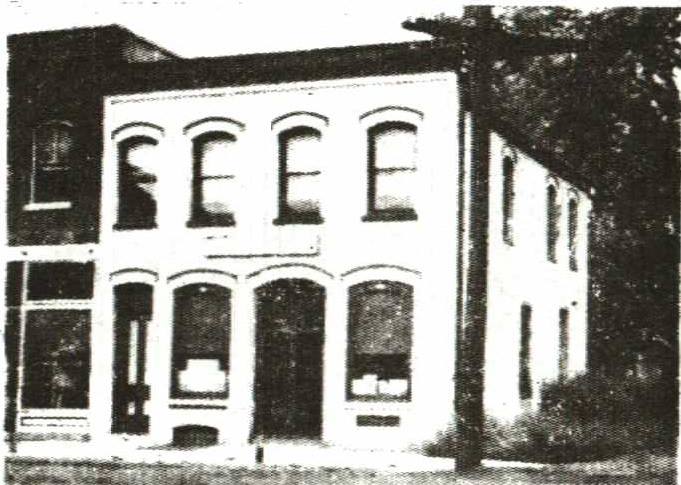
    Arthur Strang came to Bunker Hill in 1939, purchasing the Gazette-News from Harold Gerlach.


From Relections: A History of the Bunker Hill-Woodburn Area

    The Union Gazette first rolled off the presses on January 10, 1866, with A.W. Edwards as publisher.  Some 300 issues were printed, and circulation climbed to 1,000 by the end of the year.

    Edwards sold the publication in 1867 to Dr. A.R. Sawyer and F.Y. Hedley.  Sawyer died the following year.  Hedley changed the name to The Bunker Hill Gazette in 1871.

    W.S. Silence became the publisher, with Hedley remaining as editor, in 1879, at which time the paper was leased for a short time before returning to Hedley's editorship.

    The paper became the Gazette-News in 1905 under the association of Phil C. Hansen and W.B. Powell.  At this time two competing newspapers were combined, The Bunker Hill News and the Gazette.

    Other names of leadership throughout the years included Harold Gerlach, Arthur and Frieda Strang, and Lawrence Gosch.

    In 1964, the paper was purchased by Carl Stanton, who remained publisher/editor until 1987, at which time it was sold to John Galer, a Hillsboro, Illinois publisher.

    The Gazette-News is one of five news and advertising media now being published under the name of Bunker Hill Publications.  The other publications are The Advertiser, the Southwestern Journal News, and the Southwestern Shopper at Brighton, and the Madison County Chronicle at Worden.  --Submitted by the Gazette-News.

...Read this and other Bunker Hill, IL historical stories at https://bunkerhillhistory.org/

--Cite this story: The Bunker Hill IL Historical Society. "A Look Back in Bunker Hill History." Bunker Hill Gazette-News, May 26, 2022.

Redford, Carol, and Betty Triplett. "Bunker Hill History." In Reflections: A History of the Bunker Hill-Woodburn Area, p. 131. Bunker Hill: Bunker Hill Publications, 1993. Provided by the Bunker Hill Historical Society.

Wednesday, May 18, 2022

W.B. Powell Tells of Coming to Bunker Hill, Buying Paper

Pictured: Bunker Hill Gazette-News on NW corner of E. Warren and N. Pine St.
Was the former Chas. Folkerts Grocery Store  

    In the September 13, 1940 issue of the Gazette news, the 75th anniversary issue, a letter from W.B. Powell tells about the beginning of the Gazette news.  Mr. Powell, former editor of the paper, then the Bunker Hill News, is the man responsible for merging that paper with the rival Gazette.

    "One bright Sunday, sometime in 1903 or 1904," Mr. Powell began, "I went to Bunker Hill on an excursion that ran out of St. Louis.  I bought some of Louie Bartels' peanut candy.  If it hadn't been for that candy, Bunker Hill would never have had the distinction of my presence."

    "I resigned from the managership of Nugents' mail order department, a St. Louis concern doing a two million dollar a year business, and with a few manipulations with a newspaper broker, with offices in Litchfield, I found myself owner of the Bunker Hill News, located in a two-story brick building back of Sessel's Store, and over Barth's Harness Shop."

    From the building, Mr. Powell could smell Louis Bartels' candy cooking, but there was little else to recommend the plant he had purchased sight unseen.

    "The presses and make up stones were in the rear of the loft and the type cases in front and between the two there was space for a basketball court."

    The paper also had 125 subscribers and a broken job press.  Full page ads were sold for $5 an issue.  Mr. Powell bought new equipment, rented another building, hired a staff, and two weeks later published an issue of the Bunker Hill News.

    Within a few weeks, Mr. Powell bought out his competitor, the Gazette for $1,000.  This was the beginning of the Bunker Hill Gazette-News.

    From 100 subscribers, the number rose to 1,600.  Mr. Powell bought the Dorchester Hustler and merged it with the Gazette-News.

    It wasn't all quite that smooth going.  Once, as a result of a religious war in Bunker Hill, women cancelled their subscriptions and made the husbands cancel their advertising.  However, Powell's faithful friends, the German dairymaen of the area, ordered two subscriptions for every one that was cancelled and forced out of business, a man who cancelled his advertisement, the whole thing blew over and the Gazette-news came out on top.

...Read more about this and other Bunker Hill, IL historical stories at https://bunkerhillhistory.org/

--Cite this story: The Bunker Hill IL Historical Society. "A Look Back in Bunker Hill History." Bunker Hill Gazette-News, May 19, 2022.  

Thursday, May 12, 2022

Gazette has Roots in Staunton and Gillespie

Pictured: Bunker Hill Gazette-News on SW corner of N. Washington and W. Fayette St.

    The Staunton Banner first appeared March 8, 1858, owned and edited by Parsons Percy, who bought the office from Monroe County.  He continued publication until 1860 when it was purchased and removed to Gillespie by A.W. Edwards, and in November of 1860 the first issued appeared in Gillespie as the Union and Gazette.  This paper continued under Edwards until 1863 when Edwards enlisted in the Union Army.  The publication continued for sometime afterwards by Alonzo James, but when he enlisted, the publication was suspended.

    The first Newspaper printed in Bunker Hill was the Bunker Hill Journal, five column paper with E.J. Bronson as editor and publisher.  The first issue was December 8, 1859 and the last in May 1860.

    When Edwards returned from the war in 1865, he moved the printing office from Gillespie to Bunker Hill, and resumed the publication as the Union-Gazette, with the first issue being published January 19, 1866.

Edwards continued publication until January 31, 1867 when he sold to Dr. A.R. Sawyer and F.Y. Hedley.  Dr. Sawyer died in May 1867.  In 1871, the name of the paper was changed with the word Union dropping out.

    Hedley continued as editor and proprietor until January 1, 1878, when W.S. Silence became editor.  This arrangement continued until January 24, 1879 when it was leased to Mr. Said and Mr. Poorran of Charleston, who published until July 1879.  At that time, Hedley, then the postmaster, resumed the editorship.

...Read this and other Bunker Hill, IL historical stories at https://bunkerhillhistory.org/

--Cite this story: The Bunker Hill IL Historical Society. "A Look Back in Bunker Hill History." Bunker Hill Gazette-News, May 12, 2022.

Thursday, May 5, 2022

The "Not So Warm" Welcome of President Andrew Johnson

Pictured: Big Four Depot
 

A reprint of our blog from Oct., 9, 2014... https://bunkerhillhistory.blogspot.com/2014/10/president-andrew-johnson-hooted-during.html

From the Bunker Hill Union Gazette September 14, 1866

President Andrew Johnson Hooted During Train Stop in Bunker Hill

    Quite a large collection of people were at the depot on the arrival of the special train at 9:40 on Monday morning.  Bunker Hill, true to her instincts and past record, offered no insult to President Johnson and only showing their abhorrence of him by their prolonged cheers for General Grant and Admiral Farragut (with Lincoln's assassination, Vice President Andrew Johnson became President).

    The President of the United States, Andrew Johnson, was introduced by John Hogan; three cheers were given which he acknowledge [Sic] by taking off his hat and was about to leave with us the Constitution and the Stars and Stripes, when a gentleman proposed three cheers for General Grant, three cheers for Admiral Farragut, and three cheers for the Congress.  President Johnson again attempted to speak, but the cries for Grant compelled him to forgo.

Mr. Hogan proposed three cheers for the Thirty-Six States, which were given and then someone fired a pistol in the crowd, which disturbed the nerves of the party.  The train moved off and, as far as the eye could reach, the humble individual with hat in hand was bowing to the right and left, poor President Johnson.  We sympathize with Grant and Farragut in their forced company.

Pictured: The Big Four Depot (circa 1939)


...Read more about this and other Bunker Hill, IL historical stories at https://bunkerhillhistory.org/

--Cite this story: The Bunker Hill IL Historical Society. "A Look Back in Bunker Hill History." Bunker Hill Gazette-News, May 5, 2022.  

Redford, Carol, and Betty Triplett. "Bunker Hill History." In Reflections: A History of the Bunker Hill-Woodburn Area, p. 35. Bunker Hill: Bunker Hill Publications, 1993. Provided by the Bunker Hill Historical Society.

Thursday, April 28, 2022

National Defense Class in Electricity Wires Oldest House in Community


Pictured is the Joe Jarden Home

From the Bunker Hill Gazette News: February 20, 1941

     The first unit of the National Defense Training Program offered in Farm Mechanics Shop at the local high school completed an eight week course this week with the wiring of a barn and complete layout of out buildings for Frank Gerdes, and the wiring and installation of fixtures in the Al Goodwin farm house.

    According to Edward J. Barnes, instructor, the class gained some valuable experience through difficult wiring in the Al Goodwin Home;  the back part of which was a Drover Hotel on the trail between St. Louis and Springfield.  No one knows what year the hotel was built, however, Goodwin can trace it back to 1834, and it was not a new building at that time.  The part of the dwelling which was the old hotel is of log construction, with the walls packed with mud, bound together by chopped prairie grass and hickory sticks.

    As related to the class by Mr. Goodwin, there are many pioneer stories connected with the old hotel.  Mr. Goodwin has in his possession a tax receipt amounting to forty cents which was the annual property tax on the old hotel and accompanying 160 acre farm.  Taxes at that time were paid in Edwardsville.

    Members of the class wiring the historic building were Oscar Boettger, Melvin Buhs, Harold Brueggeman, Stanley Dana, Victor Dubbelde, Albert Fahrenkrog, Harvey Howerton, Ralph Huette, Alfred Jacobi, Daniel Mancini, Kenneth Mansholt, Arnold Oldenettle, Elmer Oldenettle, Chester Rull, and Leland Scroggins.

    This property was owned by Lillian Goodwin Jarden and is the home of her son, Joe.

...Read more about this and other Bunker Hill, IL historical stories at https://bunkerhillhistory.org/

--Cite this story: The Bunker Hill IL Historical Society. "A Look Back in Bunker Hill History." Bunker Hill Gazette-News, April 28, 2022.  

Redford, Carol, and Betty Triplett. "Bunker Hill History." In Reflections: A History of the Bunker Hill-Woodburn Area, 50. Bunker Hill: Bunker Hill Publications, 1993. Provided by the Bunker Hill Historical Society.

Stanton, Carl L. . "Bunker Hill News 1941." In Bunker Hill Revisited, Volume Seven, 1941-1948, p. 2. Bunker Hill: Bunker Hill Publications, 2007. Provided by the Bunker Hill Historical Society.


Thursday, April 21, 2022

Bunker Hill Memorial Dedication Ceremony to Truesdale, MO Founder


Pictured is the headstone of William Truesdale in the Bunker Hill Cemetery

From the Bunker Hill Gazette:

Truesdale, MO Founder Buried in Bunker Hill     

     On Saturday, April 9, 2022 in the Bunker Hill Cemetery, a memorial headstone was dedicated to honor William Truesdale. 

    Mr. Truesdale was born in Chautauqua County New York on January 9, 1815.  At the age of 12, he was working as an indentured merchant in Erie, PA.  In 1849, he contracted with the Panama Railroad Company to build a railroad across the Isthmus of Panama.

     In 1851, Mr. Truesdale, now married and with a growing family, headed west.  He contracted to build a railroad from Sandoval, IL to St. Louis, MO.  During his years working for the railroad in Missouri, he settled his family in Warren County, MO.  He purchased land (932 acres) and laid out a village.  He made a deal with the North Missouri Railroad to give them land to build a depot and switch yard if they would agree to name the village after him.  In 1857, the first train arrived in Truesdale, MO.

     Although he remained a civilian throughout the Civil War, Mr. Truesdale was referred to as "Colonel" Truesdale.  After the fall of Fort Sumpter, he was appointed as a military superintendent of the North Missouri Railroad.  He was put in charge of the Police and Secret Service under General Rosecrans who was in command of the Army of the Mississippi.

     Mr. Truesdale's 932 acre estate, comprising of most of present Warrenton and Truesdale, MO., was purchased May 19, 1863 by the Methodist Episcopal church as a school and home for orphans of fallen Civil War soldiers.  It was called the Western Orphan Asylum and Educational Institute.  The large house that the Truesdale's lived in became the orphanage.  In 1869, the name changed to Central Wesleyan College and Orphan Asylum.

     In 1864, Mr. Truesdale moved his family to Bunker Hill.  Mr. Truesdale died November 28, 1867.  His wife and children remained here until 1868 when they moved to Pennsylvania to live with her parents.  Buried here in the Bunker Hill Cemetery are Mr. and Mrs. Truesdale, two of their daughters, and three of their grandchildren.

     The city of Truesdale, MO conducted the dedication ceremony.  Guests included the City Hall staff:  Elsa Smith-Fernandez, Missy Bachamp, Elsie Morris, Mark Bennett, and Hal Pherigo. Police Chief Casey Doyle, Truesdale Mayor Chris Watson and Board of Alderman: Joe Brooks, Jerry Cannon, Robert Green, and Mike Thomas.  Mr. Truesdale's ancestor, grandson, Steve Williams from Tennessee and retired Truesdale Administrator and Truesdale Historian Marylou Rainwater.  other guests were also present.

...Read more about this and other Bunker Hill, IL historical stories at https://bunkerhillhistory.org/

--Cite this story: The Bunker Hill IL Historical Society.  "A Look Back in Bunker Hill History." Bunker Hill Gazette-News, April 21, 2022

Thursday, April 7, 2022

History of Round Prairie Christian Church


    This is a followup blog to our previous posting at: https://bunkerhillhistory.blogspot.com/2022/02/history-of-round-prairie-church.html

    The Round Prairie Christian Church organized July 1, 1845 by appointing John P. Bayless and Samuel Wood to the office of Eldership.  Hiram Daughterty [Sic], and John Nesbit were appointed as Deacons at the same time.  About 1849, John W. Keller was added to the list of Elders and Johnson McGilvary and W.S. Spruill were ordained Elders.  Levi Miller and William Nesbit were ordained as Deacons at the same time.

    Johnson McGilvary went off to the Army and died.  In 1874, Peter C. Randle and Albert Fairchild were added to the Eldership and Benjamin Mize and Wm. Soapes to the deaconship.

    Elder Fairchild moved his membership and died  March 12, 1881.  Scott Mize was added to the list of Deacons by the church and Sanford Mize, at the same time, was appointed the same time as an assistant clerk for the church at Round Prairie.  The church continued to add persons to the roll until the membership reached 376.  The church was discontinued about 1918.  --Submitted by Helen Mize.

From Bunker Hill Revisited, Vol. 6, 1920-1940 by Carl Stanton

    March 25, 1932: the site of Round Prairie Christian Church located about 5 or 6 miles Southeast of the City was recently sold and the proceeds distributed to the National City Church at Washington, D.C., the neighboring Christian churches, and to missionaries.  

    While a church has passed, its memory and influence still live.  This congregations was organized on July 31, 1845. Its first officers were John P. Bayless, Samuel Wood, elders, Hiram Daugherty and Jon Nesbit, deacons.  Other office bearers remembered are John Keller, 1849; John McGilvery, W.P. Spruill, 1854; Peter Randle, Albert Fairchild, Benjamin Mize, William Soapes, 1874;  Scott Mize, deacon, 1881; Sanford Mize, clerk.  Trustees who served from 1912 to the date propery was disposed of are: R.N. Nesbit, J.R. Coatney and James Richards.  Early members still living are Mrs. C.A. Craw, Wichita, Kans. 95 years, and Mrs. Margaret Mize Teeters, Kansas City, Mo., age 86.  W.H. Groner, one of the ministers long since dead, who served for 37 years and baptized upward of 400 of its members, is lovingly remembered.

...Read more about this and other Bunker Hill, IL historical stories at https://bunkerhillhistory.org/

--Cite this story: The Bunker Hill IL Historical Society. "A Look Back in Bunker Hill History." Bunker Hill Gazette-News, April 7, 2022, February 10, 2022.  

Stanton, Carl L. . "Bunker Hill News 1932." In Bunker Hill Revisited, Volume Six, 1920-1940, p. 120. Bunker Hill: Bunker Hill Publications, 2006. Provided by the Bunker Hill Historical Society.

Redford, Carol, and Betty Triplett. "Bunker Hill History." In Reflections: A History of the Bunker Hill-Woodburn Area, p. 123. Bunker Hill: Bunker Hill Publications, 1993. Provided by the Bunker Hill Historical Society.

Thursday, March 31, 2022

History of the Bunker Hill Gazette

Pictured: Bunker Hill Gazette-News on NW corner of E. Warren and N. Pine St.
Was the former Chas. Folkerts Grocery Store

    The press and type of the STAUNTON BANNER were purchased by A.W. Edwards, and in November of 1860 the first number of the Gillespie UNION AND GAZETTE  made its appearance.  The paper continued under Mr. Edwards control until 1863, when he enlisted in the Union Army where he remained until the close of the war.  The publication was, however, continued for some time afterwards by Alonzo James, but he too enlisted and the publication was then suspended.  The UNION AND GAZETTE was extremely Democratic in tone.

    The BUNKER HILL JOURNAL was the name of the first paper published in Bunker Hill.  E.J. Bronson was the editor and proprietor.  It was a five-column folio and was neutral in politics.  The first number was issued December 8, 1859 and the last in May 1860.

    In 1865, after the return of Mr. Edwards from the war, her removed the printing office from Gillespie to Bunker Hill and resumed the publication of the UNION AND GAZETTE.

    The first number was issued January 19, 1866.  He continued the publication until January 31, 1867 when he sold out to Dr. S.R. Sawyer and F.Y. Hedley.  The paper was then Republican in politics.  When Messers Sawyer and Hedley assumed control, they changed the tone and made it independent and it so remained until Dr. Sawyer's death, which event occurred on May 24, 1868.  After that date, it again became Republican in politics and has remained the organ of the Republican party of Bunker Hill to the present time.  In 1871, the name of the paper changed.  The work [Sic] "UNION" was dropped out and from that date to the present it is known as the BUNKER HILL GAZETTE.

    Mr. Hedley continued as editor and proprietor until January 1, 1878 when Mr. W.S. Silence became the publisher, Mr. Hedley still acting as editor.  This arrangement continued until January 24, 1879 when both Hedley and Silence retired and the office was leased to Messers Said and Poorman of Charleston, IL, who published the paper until July 1879.  The circulation of the GAZETTE is about 750.  It is a neat, sprightly paper and enjoyed the confidence of its constituency.  Mr. Headly, who may be regarded as the father of journalism in Bunker Hill, has retired from the active participation of the business but not without first demonstrating his entire capability to run a newspaper successfully.  He is a practical printer, and the GAZETTE, under his management, was a model of typographical neatness.  He is a good writer.  He is now postmaster of this beautiful little city, and as a man and officer, is respected by all who knew him  Mr. Headley resumed editorial charge of the GAZETTE  about the 10th of July, 1879.

    The paper became the GAZETTE-NEWS in 1905 under the association of Philip C. Hansen and W.B. Powell.  At this time, two competing newspapers were combined, the BUNKER HILL NEWS  and the GAZETTE.  Other names of leadership through the years included Harold Gerlach, Arthur and Frieda Strang, and Lawrence Gosch.

    In 1964, the paper was published by Carl Stanton, who remained publisher/editor until 1987, at which time it was sold to John Galer, a Hillsboro, Illinois publisher.

Pictured: Bunker Hill Gazette-News on SW corner of N. Washington and W. Fayette St.

    The GAZETTE-NEWS is published under the name of BUNKER HILL PUBLICATIONS along with the MT. OLIVE HERALD,  the MADISON COUNTY CHRONICLE,  and the SOUTHWESTERN JOURNAL.  Cheri Petroline is the current manager.

...Read this and other Bunker Hill, IL historical stories at https://bunkerhillhistory.org/

--Cite this story: The Bunker Hill IL Historical Society. "A Look Back in Bunker Hill History." Bunker Hill Gazette-News, March 31, 2022.

Redford, Carol, and Betty Triplett. "Bunker Hill History." In Reflections: A History of the Bunker Hill-Woodburn Area, p. 131. Bunker Hill: Bunker Hill Publications, 1993. Provided by the Bunker Hill Historical Society.

Thursday, March 17, 2022

Bunker Hill City Library


Pictured: Present-day Bunker Hill Public Library


From the Bunker Hill Gazette-News October 1950

    The J.H.L. Fahrenkrog building on Warren Street has been purchased by the local library board at a cost of $1,500 and will house the Bunker Hill Library.  (Today, the City of Bunker Hill owns the building which housed the Bunker Hill Historical Society and Museum.

    The Bunker Hill City Library will open for public use Saturday evening, October 7.  The opening will be held although there are some minor details both inside and out of the building yet to be finished.

Pictured: Old Bunker Hill Public Library

    The new library is located on East Warren Street and occupies the site of the library and contents that were destroyed in the March 1948 tornado.  Although the building had been completed for some time, opening has been delayed because of the limited budget on which the board has to work.

    Much of the equipment has been donated.  Two desks were given by Dr. and Mrs. George Hess and one each by Mr. and Mrs. W.E. Haxel and Mr. and Mrs. R.E. Rigg.  Some steel cabinet and six chairs have been purchased by the board.  It is pointed out that more chairs are needed and if anyone has some spares they would be gladly accepted for use at the library.

    Some 300 books have also been donated to start off the new library.  Mr. and Mrs. F.A. Wende of Winnetka, IL have given 195 books and others have been given by Mrs. B. Deffenbaugh of St. Louis, MO., and Mrs. Bella Zimmerman of Beloit, WI., who donated a book in memory of her son.

    Mrs. Theo Stone of St. Louis has donated a number of books which she collected there from members of the book club.

    As books come into the library, they are catalogued [sic] by a library committee of which Mrs. O.C. Weidner is chairman.  This committee has received the help of several interested citizens in their work.

    For the opening, six cases of books from the State Library will be on hand.  These are made available on a loan basis.  By receiving books from the state, much good reading is provided for both children and adults.  Miss Loretta Bartels will continues as librarian as she has done for many years in the past.

    The new library building is a modern fireproof structure, with buff brick front.  The interior has been finished in a light green plaster and it is heated with an oil furnace.  Ralph Moxey installed the heating plant free of charge.

    Members of the library board, of which R.E. Rigg is chairman, are Lee Sutton, Walter Heal, Goebel Ladd, max Bertagnolli, Clara Mason, Cora Fensterman, Mr. O.C. Weidner, and Mrs. L.O. Schreier, who is secretary.  Board Committees will be working at the library Thursday and Friday getting ready for opening on Saturday.  At the opening, a free souvenir book markers will be passed out to all who attend.

...Read more about this and other Bunker Hill, IL historical stories at https://bunkerhillhistory.org/

--Cite this story: The Bunker Hill IL Historical Society. "A Look Back in Bunker Hill History." Bunker Hill Gazette-News, March 17, 2022.

Redford, Carol, and Betty Triplett. "Bunker Hill History." In Reflections: A History of the Bunker Hill-Woodburn Area, p. 32. Bunker Hill: Bunker Hill Publications, 1993. Provided by the Bunker Hill Historical Society.

Thursday, March 10, 2022

Ed Bruckert's School Buses

Pictured: Bruckerts on NW Corner of N. Washington and W. Fayette St. in 1950


From the Gazette-News March 20, 1952

    Each day, some 200 children living outside the City of Bunker Hill are brought to school in four buses.  The mileage they cover on their on their trips averages 230 miles daily.  In a few cases, students drive their own cars to school.

    Ed Bruckert's Garage furnished transportation for the school district, being under contract and receiving payment on the mileage basis.  Bruckert assumes full responsibility for the buses, which he owns, doing his own maintenance and providing drivers for each.  In addition to being a regular driver himself, Bruckert employs the following men, Chester Kehr, Charlie Forrler, and Chester Scroggins.  Alfred Snedeker is an alternate driver.

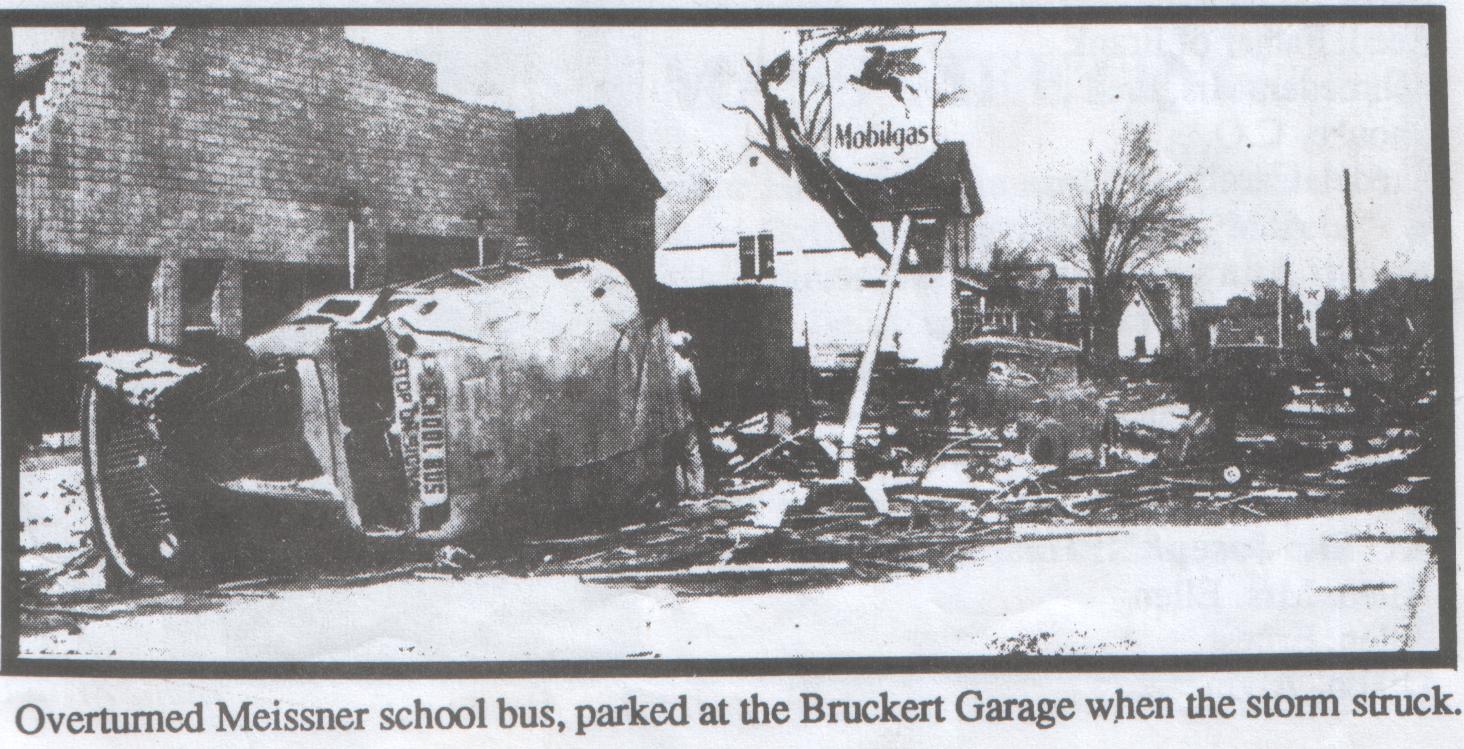
Pictured: Overturned Meissner schoolbus parked at the Bruckert Garage after the 1948 Tornado
    
    Prior to 1948, the school maintained their own transportation, owning their bus and employed drivers for the daily trips.  The system proved to be hard to manage properly and was costly in upkeep because of such.  The arrangement with Bruckert was instituted in the fall of 1948 and has been efficient and has provided better service.

Pictured: Ed Bruckert's Mobilegas / Mobiloil  Dealership Plaque


    In order to facilitate orderly conduct and loading of buses, at the end of the day, classes are dismissed after short intervals to avoid pushing and a big rush which would be likely if they were all turned loose at once.

...Read more about this and other Bunker Hill, IL historical stories at https://bunkerhillhistory.org/

--Cite this story: The Bunker Hill IL Historical Society. "A Look Back in Bunker Hill History." Bunker Hill Gazette-News, March 10, 2022. 

Redford, Carol, and Betty Triplett. "Bunker Hill History." In Reflections: A History of the Bunker Hill-Woodburn Area, p. 105. Bunker Hill: Bunker Hill Publications, 1993. Provided by the Bunker Hill Historical Society.

Thursday, March 3, 2022

Mercers' Confectionery

 From the Gazette-News - August 1951

    Roger S. Mercer is holding a formal opening of his newly built confectionery on Saturday.  The new business, located between the C.M. Miller Card Co., and "Tickles" Barber Shop, is a fine addition to the business section of town.

    The confectionery is 18 x 50 feet in size and is of concrete block construction.  It has a perma-stone front, done up in brown and white, and is pleasing to the eye.  Another building, east of the confectionery, purchased by Mercer from C.M. Miller, has also been given a perma-stone front.  Equally attractive is the interior of the new building, which has been finished entirely in natural color knotty pine.  All new fixtures have been installed.  These include a large fountain, counter and stools, booths with red and green plastic coverings and a showcase and coolers necessary for the operation of such a business.

    Full kitchen facilities are provided behind a partition toward the rear of the building.  In addition offering smokes, soda, candy and a fountain service, a complete line of sandwiches will also be offered patrons.

    In a statement on his opening Mercer said that it isn't going to be as formal as you might expect in that he has already been pouring coffee and dishing up ice cream for about a week.  Saturday will be the first day the full facilities of the store will be put into operation and he says it will be  "just come as you are".

    Mercer formally operated a similar business across the street from his present location on East Warren Street and without a doubt many of his friends are glad to see him back at his old work.  This newspaper, as we are sure many other people have already cone [Sic],  congratulate him for making such a fine addition to the business district.

...Read more about this and other Bunker Hill, IL historical stories at https://bunkerhillhistory.org/

--Cite this story: The Bunker Hill IL Historical Society. "A Look Back in Bunker Hill History." Bunker Hill Gazette-News, March 3, 2022.  

Thursday, February 17, 2022

The Fires of Bunker Hill

Pictured: The Bunker Hill Fire Department, date unknown.  Firemen and horses pose before the old fire house which was replaced in the 1940's

Reprint of our earlier Bunker Hill News article blog postings  at https://bunkerhillhistory.blogspot.com/2015/05/the-fires-of-bunker-hill.html and also at  https://bunkerhillhistory.blogspot.com/2020/04/the-fires-of-bunker-hill.html

From Bunker Hill Revisited Volumes - One and Three    


Pictured: Washington St., as viewed from the Opera House corner.  Sanford's south wall on right.

    The fire January 23, 1880, originated in Sanford's Grocery Store on the same ground.  The damage on the fire proper footed up $12,000.  The insurance was fair.[1]

    December 1, 1882, the ground from Bumann's three story building to Sessel's corner and on Warren Street west to the alley, was burned.  The loss totaled $37,000, nearly equally divided between buildings and stock.[1],[2]

These fires occurred on the west side of Washington Street.

Pictured: Warren St. as seen from Klinefelter's store.  Sessel's west wall on right.


    From the Gazette News, September 20, 1893:  On Friday evening, for the third time, fire held a fierce carnival on the west side of Washington Street.  The alarm was given about 6:20 p.m. and within two hours $75,000 worth of the business property in the city had been wiped out.

    The fire originated in the immense barn in the rear of the Johnston block.  It was probably due to the pipe of a tramp or bum, or a cigar of card-playing youngsters.  The facts will never be known.  Almost simultaneously, all buildings south of the Johnston block were ablaze so fiercely that little could be done in the way of saving contents.

    The local fire company did noble work with the fire engine, chemical, and new extinguishers and were nobly seconded by many of our people.  To such effort is due the arrest of the fire at the Johnston block and the saving of the business property on the east side of Washington Street.

    As near as can be ascertained the fire losses were $75,000.  This includes damage to buildings and stocks not destroyed.[3],[4]

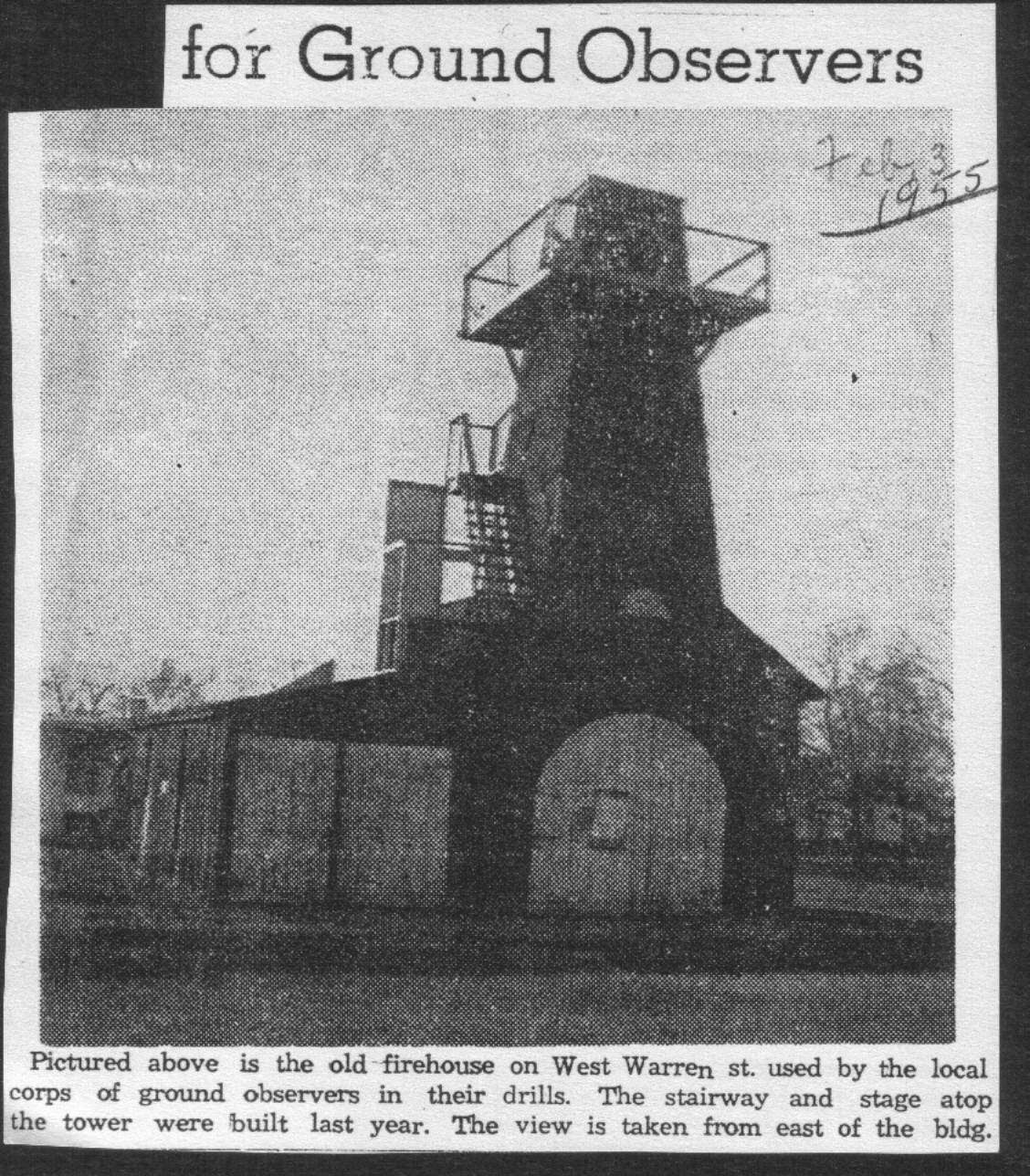
Pictured: The old firehouse on West Warren St. used by the local Corps of ground observers in their drills.  The stairway and stage atop the tower were built last year.  The view is taken from east of the building. (photo circa Feb. 3, 1955)


...Read more about this and other Bunker Hill, IL historical stories at https://bunkerhillhistory.org/

--Cite this story: The Bunker Hill IL Historical Society. "A Look Back in Bunker Hill History." Bunker Hill Gazette-News, January 10, 2013, April 30, 2020, February 17, 2022. 

[1]Stanton, Carl L. . "Bunker Hill News 1893." In Bunker Hill Revisited, Volume Three, 1892-1900, p. 62. Bunker Hill: Bunker Hill Publications, 2000. Provided by the Bunker Hill Historical Society.

[2]Stanton, Carl L. . "Bunker Hill News 1882." In Bunker Hill Revisited, Volume Two, 1882-1891, pp. 44-46. Bunker Hill: Bunker Hill Publications, 1999. Provided by the Bunker Hill Historical Society.

[3]Stanton, Carl L. . "Bunker Hill News 1893." In Bunker Hill Revisited, Volume Three, 1892-1900, p. 60-64. Bunker Hill: Bunker Hill Publications, 2003. Provided by the Bunker Hill Historical Society.

[4]Stanton, Carl L. . "Bunker Hill News 1880." In Bunker Hill Revisited, Volume One, 1866-1881, pp. 209-210. Bunker Hill: Bunker Hill Publications, 1997. Provided by the Bunker Hill Historical Society.


Thursday, February 10, 2022

History of the Round Prairie Church


    The first church to be erected was by the Christian denomination at Round Prairie, Section 32 in Dorchester Township, in the year 1845.  This church would have been about two miles east of the Willis Wolf farm on the Catholic Springs Road.  The first ministers were Robert Foster and Jonathan G. Wood.

The following is from the records of the church:

    Round Prairie Church was organized July the first in the year of our Lord eighteen-hundred and forty  five by appointing the following named persons to the office of the Eldership to wit:  John P. Bayless, Samuel Wood, and Hiram Daugherty, and John Nesbit as Deacon, at the same time.  About 1849, John W. Keller was added to the list of Elders and resigned in 1854 and Johnson McGilvary and W.S. Spruill were ordained as Elders and Levi Miller and William Nesbit were ordained Deacons at the same time.  Johnson McGilvary went off to the Army in 1862 and died.  In 1874, there was added to the Eldership, Peter C. Randle, Albert L. Fairchild, Benjamin Mize, and William Soapes to the Deaconship.  Elder Fairchild moved his membership and died March 12, 1881.  Scott Mize was added to the list of Deacons by the church and Sanford Mize at the same time was appointed as an assistant clerk for the church of Round Prairie.

    January 1, 1865, a subscription for the support of a minister at Round Prairie Church, eighty nine dollars contributed by 16 people.

--Cite this story: The Bunker Hill IL Historical Society. "A Look Back in Bunker Hill History." Bunker Hill Gazette-News, February 10, 2022, April 7, 2022.  

Stanton, Carl L. . "Bunker Hill News 1932." In Bunker Hill Revisited, Volume Six, 1920-1940, p. 120. Bunker Hill: Bunker Hill Publications, 2006. Provided by the Bunker Hill Historical Society.

Redford, Carol, and Betty Triplett. "Bunker Hill History." In Reflections: A History of the Bunker Hill-Woodburn Area, p. 123. Bunker Hill: Bunker Hill Publications, 1993. Provided by the Bunker Hill Historical Society.

Thursday, February 3, 2022

Ordinances of the City of Bunker Hill - 1873


Ordinances of the City of Bunker Hill 

Organized April 15, 1873, under the general law of the State of Illinois

City Officers 1873

Mayor: James F. Cummings

Aldermen for two years: S.A. Fletcher; E.S. Williams; and David Morris

Aldermen for one year: H.H. Brown; C.A. Bartels; and John Gosch

City Clerk: S.N. Sanford

Treasurer: John G. Auer

City Attorney: H.R. Budd

An Ordinance relating to misdemeanors:

Sec. 17: Whoever shall, without the consent of the owner or occupant of the premises, fasten any horse or other animal to any tree or to any boxing place around any tree, shall forfeit and pay the sum of not less that one dollar.

Sec. 19: Whoever shall purposely, rapidly, or immoderately ride or drive any horse or mule, or any cattle, or other like animals, or any team in any street or alley of the City of Bunker Hill shall forfeit and pay for each sum of not less that ten dollars. 

Sec. 37: The running of large cows within the city limits of the City of Bunker Hill, between the 15th day of November and the 1st day of April each year, shall forfeit and pay the sum of one dollar for each cow, and in addition, shall pay the sum of one dollar for every twelve hours said cow shall continue to run at large.

Sec. 42: Any person or persons who shall within the city limits carry any concealed on their persons any knife, Bowie knife, pistol, revolver, slingshot, or any dangerous or deadly weapon for the purpose of unlawfully using the same, shall forfeit and pay the sum of not less than twenty-five dollars.

Sec. 44: That any person or persons who shall ride, lead, or drive any horse, mule, or ox upon or over any plank or brick sidewalk within the city limits shall on conviction thereof, be fined not less than three or more than ten dollars.

Pictured: One of the later Ordinances of Bunker Hill


...Read more about this and other Bunker Hill, IL historical stories at https://bunkerhillhistory.org/

--Cite this story: The Bunker Hill IL Historical Society. "A Look Back in Bunker Hill History." Bunker Hill Gazette-News, February 3, 2022.